Fort Myers Tree Removal Pros handles tree-removal in Alva, and twenty-plus years on this coast have taught us that the first question here is not which saw to bring but which paper track the property sits on. Alva is unincorporated: there is no city hall to call and no municipal tree ordinance to read. Lee County is the land use authority at every address in the community.
What sets Alva apart from the rest of unincorporated Lee County is that the county wrote a chapter of its comprehensive plan for this community alone. That chapter shapes how a removal is discussed long before it changes what gets cut, and it is why a quote written here does not read like one written a few miles west on State Road 80.
Hauling and disposal sit on their own line of every estimate, because the tipping gate changes price at every county line we cross. Any tree we recommend taking down gets a written, dated condition report first, so the reasoning exists before the saw does. Topping, hat racking and hurricane cuts are refused here, on hardwoods and on palms.
The county plan that names this community
Most of unincorporated Lee County runs on one general set of plan policies. Alva has its own, and that is the difference between a contractor guessing at the rules and one who can tell you what the county has committed to protect here.
Ordinance No. 11-21 and Goal 34
Lee County Ordinance No. 11-21, called in its own text the Alva Community Plan Ordinance (CPA2010-00017), was adopted by the Lee County Board of County Commissioners on 28 September 2011, amending the Lee Plan. It replaced the previous Goal 26 with Goal 34: ALVA, whose stated purpose is to support and enhance Alva’s unique rural, historic, agricultural and natural environment and resources, including the rural village and surrounding area.
Objective 34.1, on rural character, lists protecting and enhancing native species, ecosystems, habitats, natural resources and water systems among its items. That is not a rule handed across a permit counter, but it is the standing statement of what the county says it protects when a large tree comes down.
Policy 34.5.2, which names clear cutting
Policy 34.5.2 directs Alva to work with Lee County to identify and evaluate land conservation funding opportunities and acquisition priorities, protecting vital natural resources, ecosystems and habitats from the impacts of clear cutting for residential or agricultural purposes. The phrase in the policy is clear cutting, and both purposes are named in the same breath.
We read that as the plain boundary it is. Taking one declining laurel oak off a roof is not what the policy aims at; opening several acres to bare ground is. Where a scope drifts from the first toward the second, we say so in the condition report.
A plan goal is not a permit
Goal 34 lives in the comprehensive plan, and its policies are written as things Alva will work with Lee County to establish in the land development code. That matters for setting expectations: the goal tells you the county’s direction, while the vegetation removal permit and the notice of clearing are the documents that actually get reviewed.
So we answer them as two separate questions. What has Lee County said it protects in Alva, and what does the Department of Community Development need on the desk before this particular tree or this particular acreage can come out?
Looking for tree-removal closer to Bonita Springs? See Tree-Removal in Bonita Springs.
Vegetation permits and the notice of clearing
Two different submittals cover most removal work on Alva land, and which one applies turns on why the ground is being cleared rather than on how many trees are involved. The Lee County Department of Community Development reviews both for unincorporated land.
Five acres, and the site plan that comes with it
The county’s Vegetation Permit Submittal Requirements form, revised 5/14/2021, states that for a single family lot which is five acres or more in unincorporated Lee County, a lot on a barrier island, or a lot on Pine Island that is two acres or more, the applicant must provide a detailed site plan: the shape and dimensions of the lot or a boundary survey, and the location of existing or proposed structures and any other improvements.
Alva is where that acreage threshold is routinely reached rather than theoretical. The form’s own example of an improvement to be located is the drain field, which tells you plainly what kind of parcel it was written for, and it is worth knowing before anyone assumes a removal here is same-week work.
The notarized bona fide agricultural statement
Clearing for agriculture runs on the notice of clearing instead. The county asks for a written notarized statement from the property owner that the purpose of the clearing request is for bona fide agricultural reasons, specifying the proposed agricultural use, plus current aerial section maps with the property boundaries clearly outlined and a sealed sketch of the legal description.
It also asks for documents demonstrating intent, and names its own examples: a South Florida Water Management District water use permit, cattle lease agreements, forestry management plans, expansion of a current bona fide agricultural operation, receipts for stock materials. Bona fide is doing real work in that sentence.
Three years, then eight
The form carries a warning worth reading before a grove comes out. If an application to rezone a parcel is filed within three years of the date of the most recent notice of clearing, and the rezoning is granted, the open space requirements of Chapter 10 of the Lee County Land Development Code must be satisfied.
That means trees from LDC Appendix E placed, planted and maintained consistent with Section 14-384(a)(1)-(4) where existing natural forest cannot meet the minimum, and reforestation under Section 14-377 imposed as a condition on any final development order issued within eight years after the rezoning. Clear as agriculture, rezone inside three years, and the replanting follows the land for another eight.
Narrow streets, river frontage and the trees on them
The ordinance describes Alva as a place of huge oaks and cypress, surrounding citrus groves and a rural village, and says of the village itself that streets remain narrow with a dense tree canopy. Read as a work order rather than as scenery, that is an access and rigging description.
A closed canopy over a narrow right-of-way
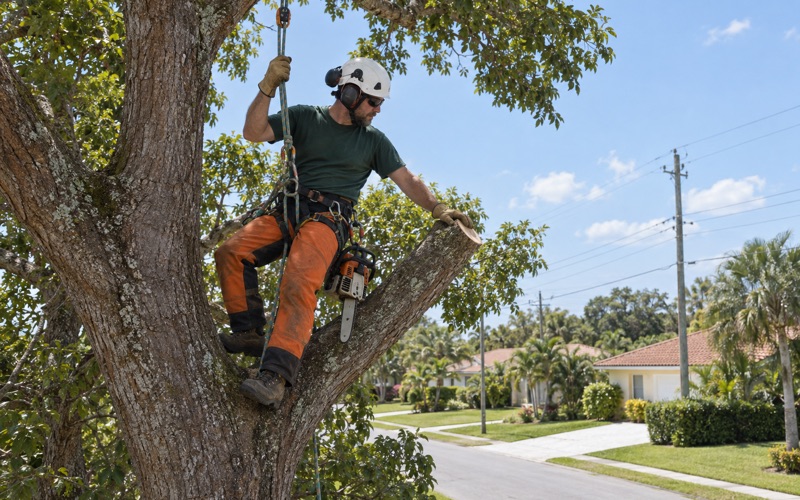
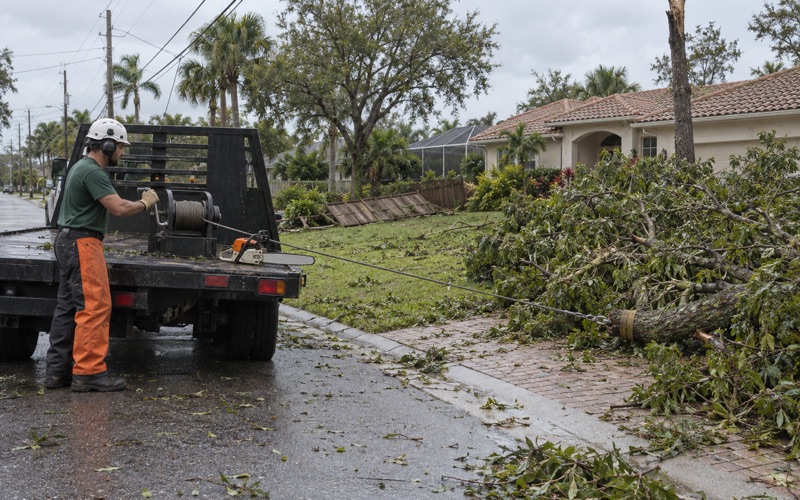
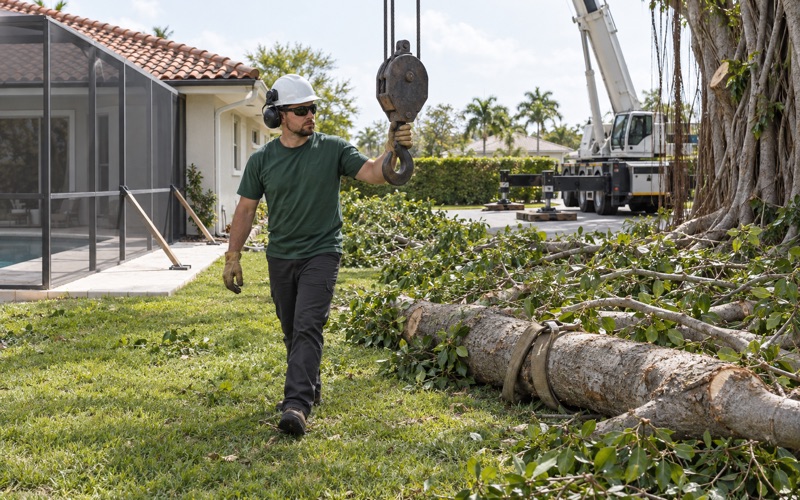
There is often no room to set a crane in the street, no room to swing a boom without entering a neighbor’s crown, and a drop zone under somebody else’s limbs. We match machines to the gate rather than to the tree: a thirty-five inch grinder down a side yard, a spider lift where an outrigger pad will not stand, a crane pick where the alternative is dropping through the canopy.
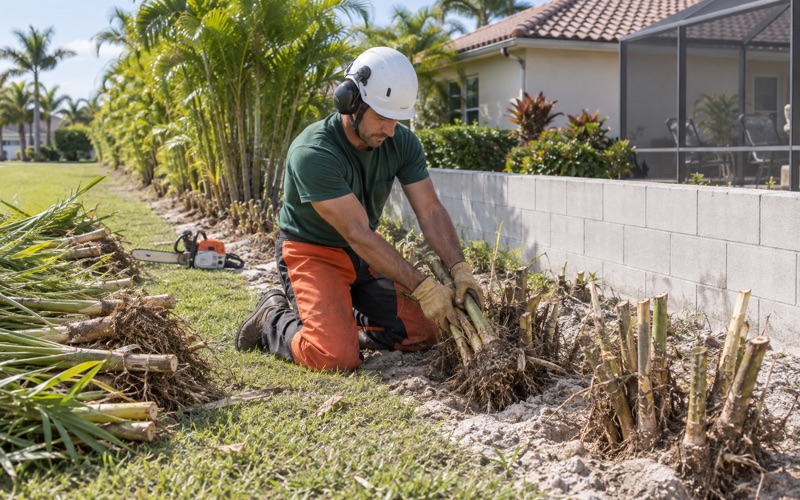
Policy 34.2.6 directs a landscape theme for the rights-of-way of North River Road and other county-maintained roads, preservation of native plant communities, and encouragement of exotic removal; Policy 34.4.3 adds designating North River Road and other qualifying roads as county scenic roads. Clearing Brazilian pepper, melaleuca, Australian pine or carrotwood runs with that direction; taking a canopy oak at the road runs against it.
Mature trees carry mature defects
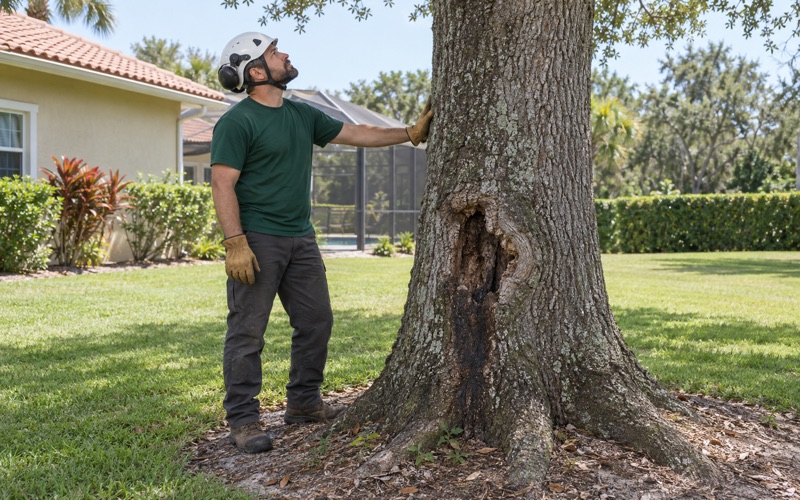
This is not a planting cohort arriving at size together. The rural village takes in ground originally platted in the late 1800s, and the river canopy is hammock oak and cypress carrying a century of accumulated cavities, included bark and co-dominant stems. Our assessments follow the ISA Best Management Practices Tree Risk Assessment, Second Edition 2017, and our specifications follow ANSI A300.
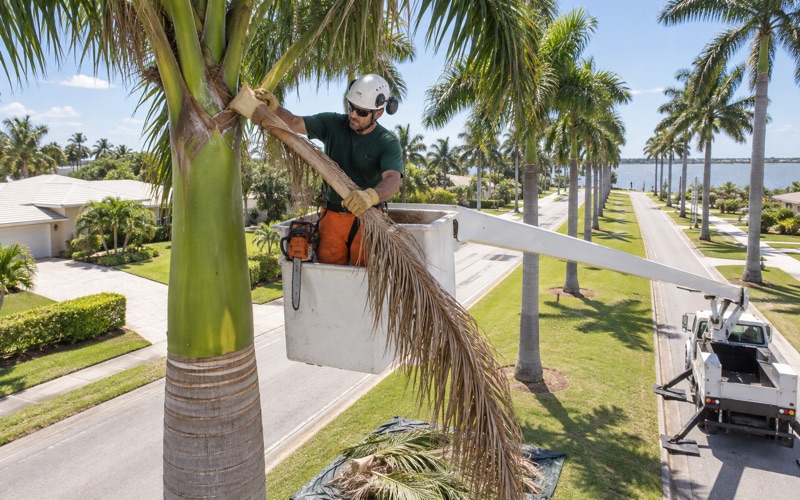
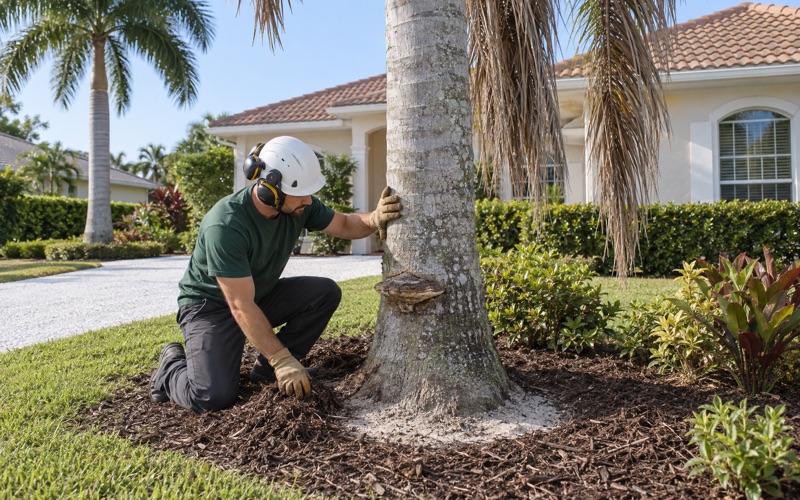
Palms are quoted as palms, on their own, because a palm has no branch collar and no cambium, one growing point and a trunk that will never thicken again. Ganoderma butt rot and lethal bronzing end a palm rather than injure it, and spear leaf collapse is a different conversation than a broken hardwood lead.
Oxbows, cypress heads and the setback line
Policy 34.5.1 directs increased development setbacks from natural areas and surface waters, natural buffers from parcel lines to development areas, and surface water management standards that incorporate natural flowway corridors, cypress heads and natural lakes. A cypress head is a named feature in that policy, not a wet spot in the yard, and it decides where equipment can stage.
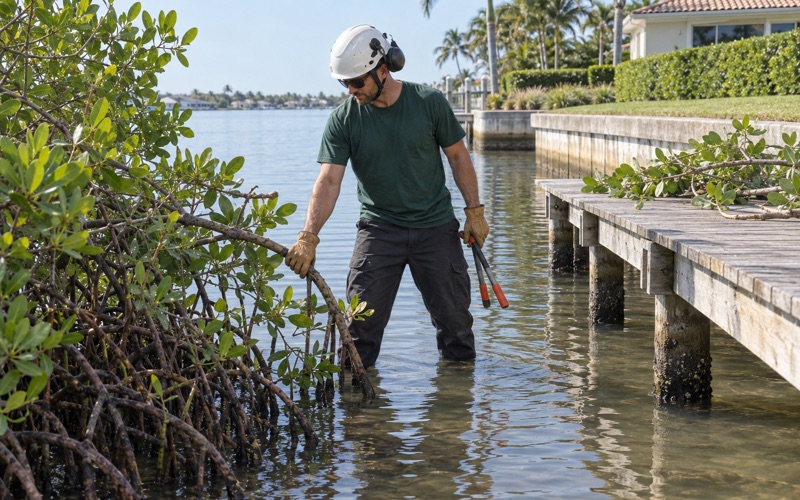
The oxbows are bends left after dredging that began with the 1930s Cross State Ship Channel, and they are the receiving water for anything cut on a riverfront lot, which is why brush and chips never get pushed toward the bank. This is freshwater well above the estuary, so the Mangrove Trimming and Preservation Act has nothing to say about an oak standing here.
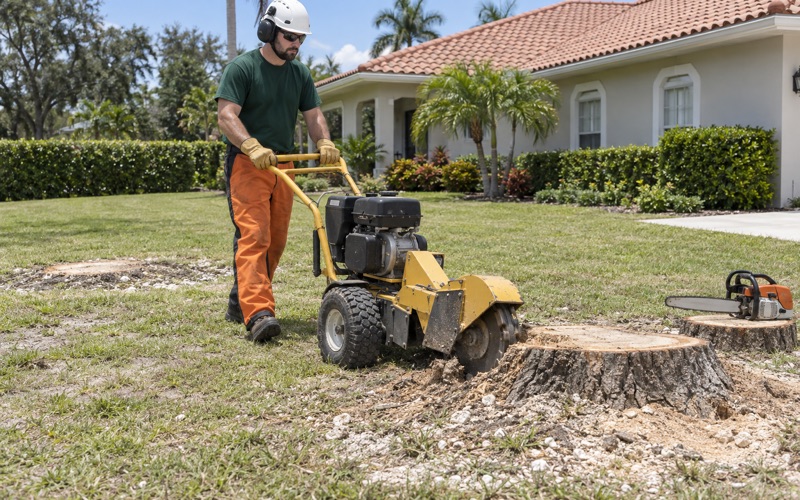
The limiting layer under these flatwoods is a hardpan and a shallow seasonal high water table rather than bedrock. In the saturated months a stump grinder is working wet sand over a restrictive layer instead of chasing a deep taproot, and those are the same months when the root plate of a mature oak has the least holding.
Rural acreage is not a subdivision lot
Nearly everything about a removal changes when the parcel is measured in acres and the land use around it is agricultural. Two of those changes are legal, and one of them is simply the price of getting the wood off the property.
Where section 163.045 stops
Florida Statutes section 163.045 bars a local government from requiring a notice, application, approval, permit, fee or mitigation for pruning, trimming or removing a tree on residential property when the owner holds signed documentation from an ISA-certified arborist or a Florida licensed landscape architect that the tree poses an unacceptable risk. It is a real and useful preemption.
Its limit matters more in Alva than its grant. Section 163.045(1)(b) defines residential property as a single-family, detached building on a lot actively used for single-family residential purposes, which does not reach agricultural property. On a pasture, a grove or a leased cattle parcel, the statute is not the answer and the county’s paperwork still is.
The word we will not print
Florida issues no tree or arborist contractor license at all, and section 163.211 preempts local occupational licensing, so Lee County cannot issue one either; pre-2021 grandfathered local licenses expired on 1 July 2025. We tell customers that outright instead of printing the word everyone expects to see on a tree company’s page.
What we carry instead is ISA certification, verifiable general liability and workers’ compensation, and crews working to ANSI Z133. ISA certification is also the statutory gatekeeper, since the section 163.045 documentation can be signed only by an ISA-certified arborist or a Florida licensed landscape architect.
Hauling, disposal and the gate
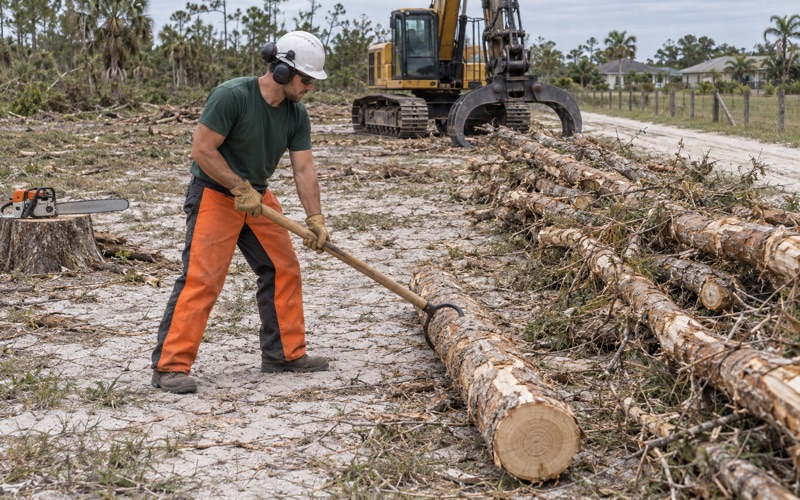
Contractor-generated debris is not curbside work, and on an acreage job the volume settles that question by itself. Horticultural waste goes over the scale: Lee County’s FY26 commercial horticulture rate is $43.92 per ton with a $15.00 minimum charge at the Buckingham horticulture operation on Buckingham Road, the same $43.92 per ton applies to horticulture at the Lee-Hendry Landfill, and finished mulch sells back at $10.00 per cubic yard.
That is why disposal sits on its own line rather than folded into an hourly rate. We would rather show you the gate rate and let you decide whether the chips stay on the property, and we will say plainly when a tree should stay and what pruning or a cable would cost instead of a removal.
- 20+ Years on This Coast
- Written Condition Reports
- Four Counties Covered