
Fort Myers Tree Removal Pros has spent twenty-plus years doing arborist work in Fort Myers, FL, serving surrounding cities including North Fort Myers, Cypress Lake, Cape Coral, Florida Gulf Coast University and Lehigh Acres. That means tree risk assessment, written condition reports, defect inspection on mature hardwoods and palms, and a straight account of what a tree is actually likely to do rather than a verdict with nothing behind it.
The reason this page exists is that almost nobody in this county sells the assessment as its own deliverable. Operators north of here and in Charlotte County advertise a written tree assessment as a named product; the largest multi-county operator in this region publicly refers those reports out. A removal quote is not an assessment, and a homeowner who needs a document to hand to a permit office, an insurer or an association board is usually offered a price for cutting instead.
We assess before we quote, and the assessment stands on its own whether or not the tree comes down. Every tree we recommend removing gets a dated written report describing what we found and why the recommendation follows from it, so the reasoning exists on paper before the equipment arrives. Every tree we recommend keeping gets the same document, with a price beside the pruning or the cable that would replace the removal.
Tree Risk Assessment to a Published Standard
Which Level of Assessment Your Tree Needs
A limited visual assessment is a fast pass over many trees looking for obvious defects, a basic assessment is a walk-around inspection of one tree from the ground including the root collar, and an advanced assessment adds an aerial inspection or instrumented decay testing. Most residential calls here need the second. We say which one we did, because a drive-by and a root collar inspection are not the same document.
Reading the Root Plate, the Root Collar and the Flare
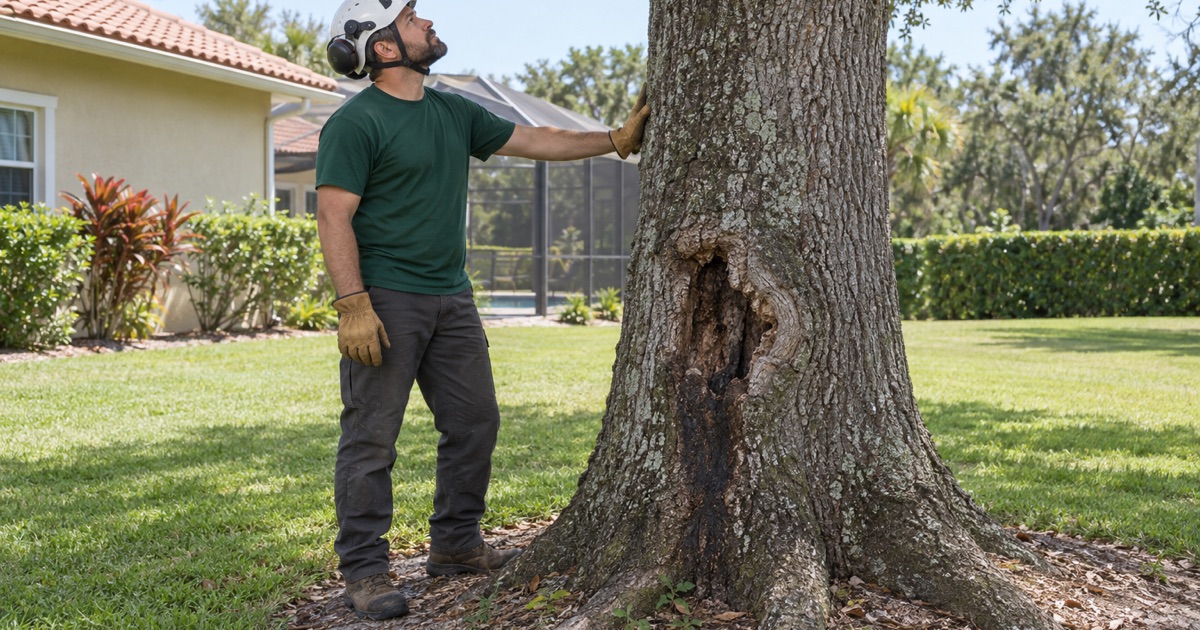
The most consequential defects on this coast sit at or below grade, which is exactly where nothing is visible without doing the work. We look for soil heave on the tension side, a trunk that enters the ground like a telephone pole with no visible flare, girdling roots, and decay at the buttress. A mounded or cracked root plate after a storm is a finding; a lean the owner has watched for a decade usually is not.
Included Bark, Co-Dominant Stems and Long Leads
Where two stems of similar size meet, bark can become trapped in the union instead of wood forming across it, and that union is weak in a way the tree’s size and vigor do nothing to fix. Included bark at a co-dominant fork over a roof is one of the few findings here that justifies intervention on a tree with a full, healthy canopy, and long horizontal leads on mature hardwoods are the other.
Targets, Not Just Defects
Risk is a product of likelihood of failure, likelihood of impact and consequence, and the third term is the one homeowners are rarely shown. The same dead limb over a pasture and over a screen enclosure produce different recommendations, and the same tree can be low risk in July and higher risk once a pool deck is built under it. We record the targets as their own line so the finding can be re-read when the property changes.
The Section 163.045 Arborist Letter
What the Statute Actually Requires
Florida Statutes section 163.045 bars a local government from requiring notice, application, approval, permit, fee or mitigation to prune, trim or remove a tree on residential property, where the owner possesses signed documentation from an ISA-certified arborist or a Florida licensed landscape architect. It is the widest opening in Florida tree law, and it is a documentation requirement rather than a blanket exemption from doing anything.
Unacceptable Risk, Not Presents a Danger
The standard the statute names is that the tree poses an unacceptable risk, assessed against the ISA Best Management Practices Tree Risk Assessment Second Edition 2017. At least three artifacts circulating in this market, one of them a village land development code, still publish the superseded phrase presents a danger. That older phrase is materially easier than the law in force, and a homeowner acting on it removes a tree without the documentation the statute actually requires.
Where the Preemption Stops
The statute reaches a single-family detached building on a lot actively used for single-family residential purposes, and the second half of that sentence is the part nobody quotes back. A vacant lot, an attached dwelling, a duplex, a commercial parcel, an association common element and a house on a lot whose use does not conform all fall outside it. Mangroves are written out of the preemption on purpose.
Written Condition Reports and What Goes In Them
A Dated Record Before the Saw
The report is produced and dated before any work is scheduled, not written up afterward to justify a decision already taken. It names the tree, its species, its diameter at breast height, the defects observed, the targets beneath it, the recommendation and the reasoning. Dated photographs of the root collar and of every defect called out go in alongside the text.
When the Report Says Keep the Tree
A report that recommends retention is worth exactly as much as one that recommends removal, and we write it the same way. It states what we would monitor, how often, and what change in the tree would alter the recommendation. For an association or a property manager that document is often the whole point, because a board needs a record of why a tree on common ground was left standing.
Mitigation Priced Beside Removal
Where something short of removal genuinely reduces the risk, it appears in the report with a number next to it: directional pruning to shorten an over-extended lead, a support cable across a weak union, a root collar excavation with an air spade to see what is under the flare, or soil decompaction where the root zone has been driven on. You can then compare the two prices rather than take our word for one.
Assessing Palms and Species That Behave Differently
A Palm Assessment Is a Different Job
A palm is a monocot with a single apical meristem, no cambium, no branch collar and no capacity to compartmentalize decay, so almost none of the hardwood defect vocabulary applies. We assess the spear and the newest fronds, the trunk for penciling, the lower four or five feet for a shelf-shaped conk, and the crownshaft or boot skirt depending on the species in front of us.
Disease Findings That End the Assessment
Some findings close the question rather than opening a treatment discussion. Ganoderma butt rot has no fungicide, no soil amendment and no cure, and mandates removal and grinding once the conk forms. Lethal bronzing runs one direction, with spear leaf collapse and premature fruit drop among the things to look for. Palmetto weevil is untreatable by the time the damage shows on the crown.
Species Behavior After Wind and After Salt
A species list built from one hurricane misleads you about the next one, because wind resistance and surge resistance are separate properties on a delay of years. Gumbo limbo came through the 2004 storm with one of the best survival records on this coast and is now among the most affected trees on Sanibel, toppling in ordinary summer storms because prolonged salt water rotted the root plates underneath.
Our Step-by-Step Tree Risk Assessment Process
Step 1: Site Walk and Target Inventory
We walk the property before we look closely at any single tree, noting what sits under each canopy: the house, the driveway, a screen enclosure, a septic field, a power drop, a fence line shared with a neighbor. That inventory decides which trees get a closer inspection and in what order, and it is written down rather than held in somebody’s head.
Step 2: Ground Inspection, Root Collar First
Each tree flagged in the walk gets a full circuit from the ground, starting at the root collar and working up through the buttress, the trunk, the scaffold unions and the canopy. Where the flare is buried or the finding is ambiguous, we say so and quote the air spade excavation that would answer it rather than guessing at what the soil is hiding.
Step 3: The Written, Dated Report
Findings, photographs, the recommendation and the reasoning go into one dated document, with likelihood and consequence recorded separately. If retention with monitoring is the right call, the report says that and sets the interval. If a document signed by a certified arborist or a landscape architect is what your situation actually needs, the report says that too.
Step 4: Permit Path and Scheduling
Last, we name the jurisdiction the parcel sits in and what it will accept, because Lee, Charlotte, Collier and Hendry answer that question four different ways and one of them publishes no vegetation removal application at all. Only then do we schedule work, with hauling and disposal quoted on their own line because the horticultural waste gate rate changes at every county line we cross.
- 20+ Years on This Coast
- Written Condition Reports
- Four Counties Covered