Fort Myers Tree Removal Pros has handled tree removal in Bonita Springs for more than twenty years, and the useful thing about this city is that it has already written down when a tree may come out. Its permit application runs to a single page, and near the signature block it states that the city protects its native and code-required trees until there is a valid reason to remove them. Then it lists the reasons.
That one sentence decides more jobs here than any estimate could. Before we price a crane pick over a screen cage or a thirty-five inch grinder down a side yard, we establish which document governs your tree: a city permit, a landscape plan in a county file, or a state agency the city says outranks it. Anything we recommend removing gets a written, dated condition report first.
We are equally plain about what we are not. Florida issues no tree or arborist contractor license at all, so nobody working on your property here holds one, and we would rather say so than print a word implying otherwise. What we bring instead is two decades of reading permit counters across four counties.
Two valid reasons, printed on the city’s own form
The City of Bonita Springs Community Development Department issues tree removal permits through its Environmental Sciences staff at 9220 Bonita Beach Road. The application is one page, its own footer dates the file to December 2017, and it is still what a resident downloads today.
The list is shorter than almost anyone expects
Under the heading Valid reasons to remove trees, the form gives exactly two bullets: trees too close to utility lines and damaging those lines, and trees lifting up asphalt or concrete too severe to be repaired. That is the entire list, in the city’s own words.
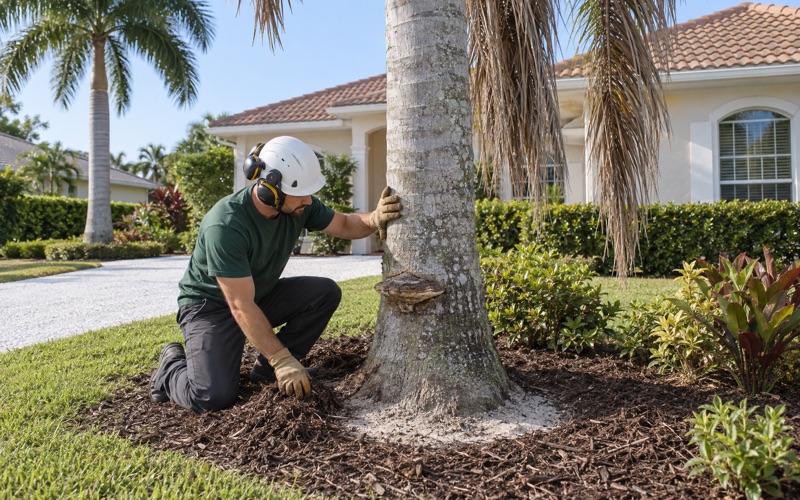
A leaning tree is not on it. Neither is a storm-battered canopy, a palm with Ganoderma butt rot, or a laurel oak with included bark standing over a bedroom. We say so on the first visit, because assuming that hazard alone opens the gate is how a job stalls at a counter.
What the application actually buys
On fees the form reads, exactly as printed, $55 for the first tree and $55 for all trees after the first. We quote that wording rather than performing arithmetic the city has not. Submitting it grants a right of on-site inspection, and a final inspection closes the permit out.
Between those visits an Environmental Specialist evaluates the damage and decides against the city’s criteria whether the tree may go. The city also publishes a trigger you can measure from the driveway: if a tree’s height is within 1.5 times its distance from a structure, contact Environmental Sciences before removal.
The lot type the state carved out, and the ones it did not
Since July 2022, Florida Statutes section 163.045 has barred a local government from requiring a permit, fee or mitigation to prune or remove a tree on residential property where the owner holds signed documentation from an ISA-certified arborist or a Florida licensed landscape architect that the tree poses an unacceptable risk. The statute defines residential property narrowly: a single-family detached building on a lot actively used for single-family residential purposes.
That definition does most of the work here. Detached houses account for 17,952 of this city’s 39,895 housing units; attached homes, everything in a two-or-more-unit building, and 4,651 mobile homes sit outside the carve-out, and on those the city process is the live one. Nothing the city publishes about trees mentions the statute anywhere.
Looking for tree-removal closer to Fort Denaud? See Tree-Removal Services in Fort Denaud.
Whether your tree is a required tree turns on two dates
The protection is not blanket, and it is not guesswork either. It reaches naturally occurring native trees, palms and vegetative communities plus required landscape trees, and the city’s standing hurricane document sets out how to tell which you have.
1983, and the development order behind your subdivision
The test is a question: does the development or site have a Local Development Order, meaning construction plans, issued on or after 1983? If the answer is yes, most single-family lots require two native hardwood trees per lot, while commercial and multifamily sites go to their approved landscape plans for the counts.
A second question belongs to this city’s own age. Bonita Springs incorporated effective 31 December 1999 but did not take over development review until 2008, so for an older site the governing landscape plan is a Lee County document in a county file. With 68.3 percent of the housing stock built between 1980 and 2009, that is the normal case, and it is a records search rather than a phone call.
Dead without a permit, damaged with one
The hurricane guidance is unusually quotable. If a tree required by the landscape code was destroyed or is dead, removal without a permit is authorized, and the owner should document the instance for verification. If a required tree has been damaged but is not dead, a tree removal permit is required.
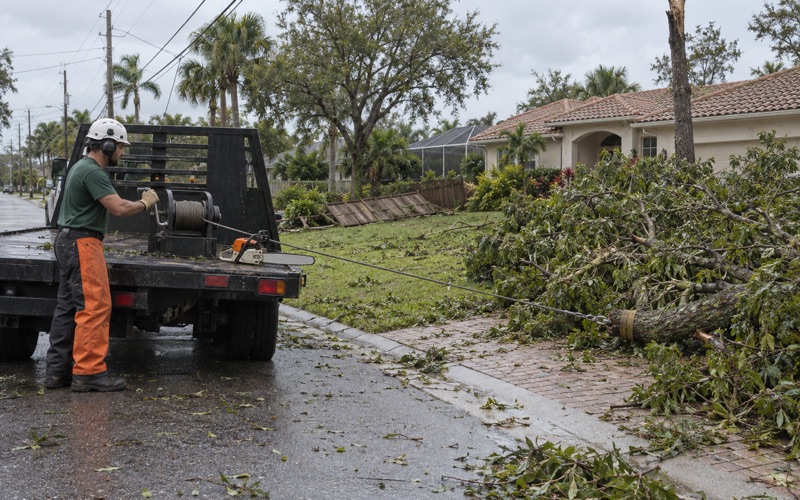
That is the reverse of what most people assume once the wind drops, which is why our post-storm visits open with photographs and a dated write-up rather than a chainsaw. The backstop is not a flat penalty either: a violation may be enforced through a restoration planting plan requiring more vegetation than previously stood there.
The replacement is part of the price
Replacement of a required tree is mandatory and the specification is published in numbers. At installation a code-required tree must stand at least ten feet tall, carry a two-inch trunk caliper 12 inches above the ground and show a four-foot crown spread, while a palm needs a minimum of eight clear trunk feet.
Stock must be Florida No. 1 or better under the state Grades and Standards for Nursery Plants, mulch is specified down to the ring around the trunk, and every stake and tie comes off within 12 months. Hauling and disposal ride their own line of our estimate for the same reason we raise all this: the figure you are shown should be the figure you pay.
The city’s own list, the decal on the truck, and a standard older than both
Two further things a resident can check before hiring anybody: the species list the city publishes for replacements, and the annual registration it requires of the people who maintain landscapes inside these limits. Both are public, and neither takes long to read.
A species list with a canopy conversion
Native Trees and Palms For Use In Bonita Springs, Florida was written by a named arborist, Laura Gibson, and last updated in October 2022. It sorts species into shade canopy trees at a mature spread of 30 feet or more, general and buffer trees at 20 to 30 feet, smaller semi-tropical evergreens at 15 to 20 feet, and a conversions column.
That last column is the one nobody quotes at you. Its footnote gives the number of trees needed to meet the 20-foot canopy minimum for one required tree, and several smaller species sit at three to one, meaning three planted to satisfy a single obligation. The list also leaves hollies and most magnolias off deliberately, because they grow poorly in subtropical conditions.
Registration, training, and what it is not
Professional and institutional landscapers working here complete Green Industries Best Management Practices training for the protection of Florida water resources, obtain a certificate of completion, register annually with Neighborhood Services and display current decals under City Code Chapter 44, Article II. That is a fertilizer and landscape-management registration tied to water quality, not a tree contractor credential, and Florida Statutes section 163.211 preempts local occupational licensing in any event.
A standards name the city still prints
The pruning language requires that required vegetation be pruned only to promote healthy, uniform, natural growth, in accordance with the Pruning Standards of the National Arborist Association, and that trees not be severely pruned to hold them at a reduced height or spread. Lee County’s current maintenance guide points instead to ANSI A300 and to the Florida chapter of the ISA on why topping hurts trees.
Two vocabularies, one rule, and the substance survives the change of name. Topping, hat racking and hurricane cuts are refused here on hardwoods and on palms however the job is asked for, and our crews work to ANSI A300 and ANSI Z133, which carry the instruction the city’s older citation was already giving.
Storm water, shoreline, and the agencies the city does not outrank
Some of the work in this city is not the city’s to permit at all. Knowing where that line falls is the difference between a clean job and a state enforcement matter, and it is worth settling before a quote rather than after.
Eight to twelve feet above ground level
The National Hurricane Center report on Hurricane Ian names this place directly, recording maximum inundation levels of 8 to 12 feet above ground level at Bonita Beach and Bonita Springs. The same paragraph draws a line inside the municipality: the most severe impacts were contained to the immediate coastline, while inland high water marks ranged from 5 to 7 feet.
We sell hurricane work before the season rather than promising it during one, because nobody cuts trees in a hundred-knot wind. Storm surge salt inundation and delayed post-storm mortality are why a palm that looked sound in October becomes a spear leaf collapse call in March, and why palms are quoted here as palms: one growing point, no cambium, and a trunk that will never thicken again.
Mangroves belong to a state office, and the city says so
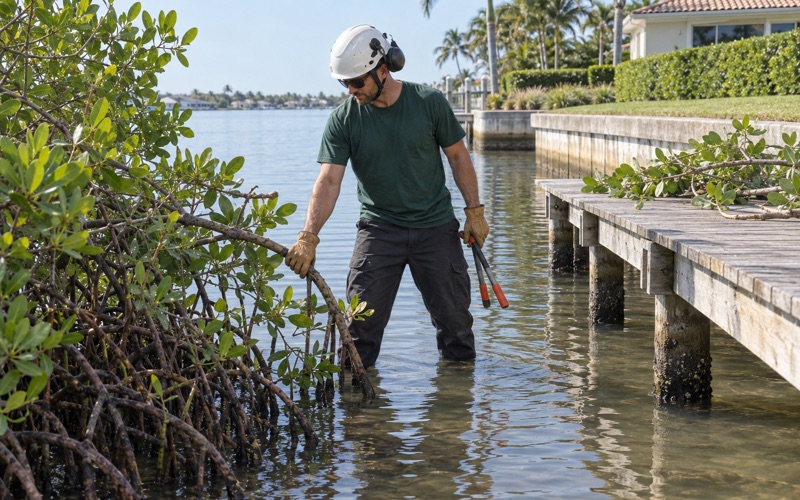
Where mangroves stand on tidal shoreline here, the city disclaims the authority in its own words, stating that the Florida Department of Environmental Protection holds the primary regulatory and permitting authority for the trimming, augmentation and removal of mangroves statewide, including within this city. The work runs under the Mangrove Trimming and Preservation Act at sections 403.9321 through 403.9333, and the referral is to the FDEP South District office.
So we check any waterfront, riverfront or barrier-island parcel for mangroves before pricing it, and we will tell you when a professional mangrove trimmer and a state permit are the answer instead of us. The same instinct applies inland: we will say when a tree should stay, and what directional pruning or a cable would cost instead of a removal.
What leaves the property, and what it costs to move
Curbside here is a small allowance, set by Lee County rather than the city: yard waste containerized or bundled at 50 pounds or less and no longer than 6 feet, with up to 50 pounds of unbundled palm fronds permitted and the excess tied. One mature laurel oak clears a week of that several times over, so removal debris goes to the county gate at the horticultural waste rate of $43.92 per ton with a $15 minimum, and that number appears on your estimate rather than inside it.
- 20+ Years on This Coast
- Written Condition Reports
- Four Counties Covered