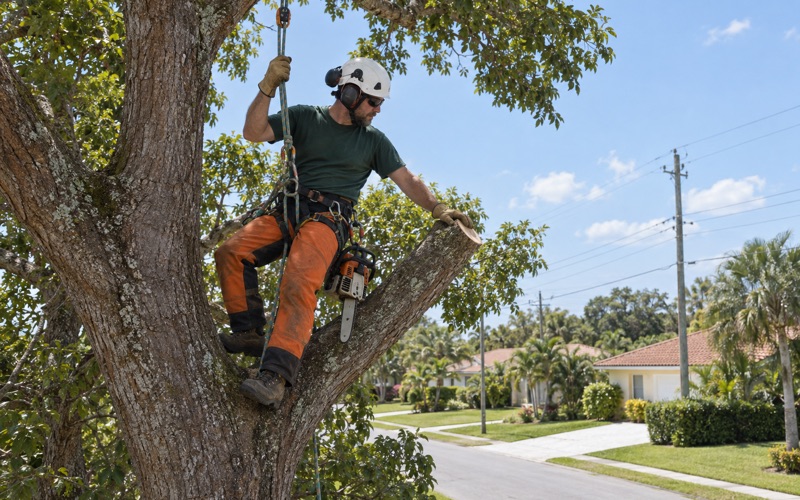
Fort Myers Tree Removal Pros has handled tree removal in Cape Coral for more than twenty years, and the first thing we tell a homeowner here is that the calendar decides more jobs than the saw does. Across most of Southwest Florida a removal is a question of access and rigging. At a city address in Cape Coral, it is just as often a question of what month it is.
That is because this is an incorporated city with its own charter, its own Land Use and Development Regulations and its own Code of Ordinances. A tree, vegetation or burrow question at a city address is answered inside city hall. We work across four counties and four separate permitting regimes, and we give you a straight account of which one your address actually sits under before we quote anything.
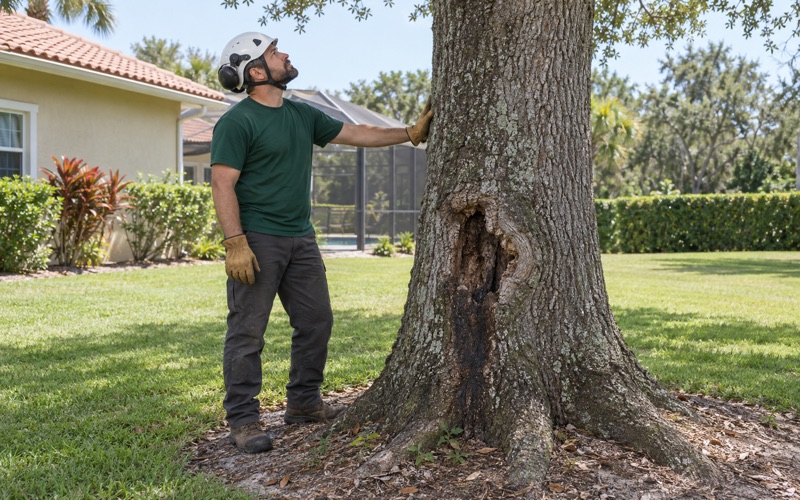
Before we recommend taking a tree down, you get a written, dated condition report, so the reasoning exists on paper ahead of the equipment. On a lot here that report also has to account for who else may be living on the ground, because the species rules attached to a permit in this city are the most demanding we work under anywhere on our map.
Tree work here stops on a date, not on a measurement
The affidavit is sworn, notarized, and looks back thirty days
Ground disturbance in this city comes with a Burrowing Owl and Gopher Tortoise Affidavit, notarized and filed with the permit. The applicant certifies that “within the last 30 days, I have inspected the property described above AND all vacant properties near the jobsite where I or my subcontractors may drive vehicles or place construction material.” The look-back is thirty days, not a glance on the morning of the job.
Burrows have to be reported whether they sit on the property, on an adjacent property, or in the abutting city rights-of-way, and the form is explicit that this includes burrows not currently being used by owls. Our walk-through therefore covers the empty lot next door and the swale we would park a chip truck on, not only the tree you called about.
Thirty-three feet from 15 February to 10 July, ten feet outside it
The buffer distances are written down, and they are not negotiable on site. A burrowing owl burrow carries a protection zone of 33 feet in radius during the nesting season, 15 February to 10 July, and a minimum of 10 feet outside that season. A gopher tortoise burrow carries 25 feet year-round under Ordinance 20-19.
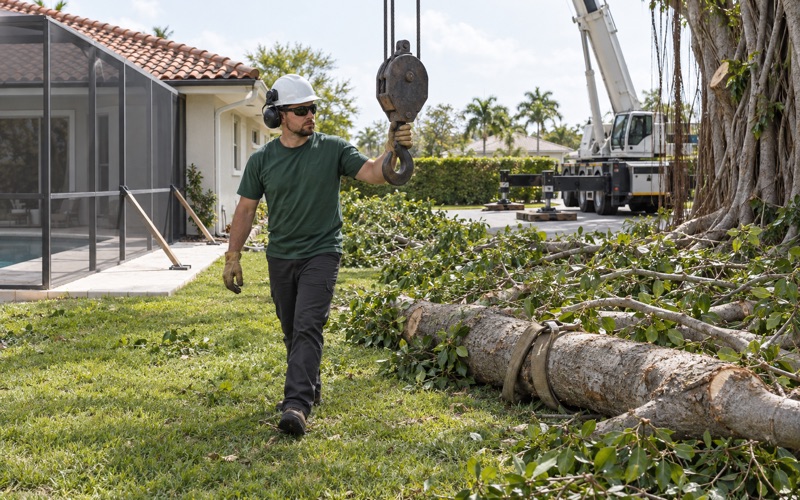
Inside those circles the affidavit allows no activity, no materials, no fill, no equipment and no parking. A 33-foot radius landing in the middle of a drop zone changes the whole plan: it can turn a straightforward felling into a rigged takedown, or move us off the driveway and onto a crane pick from the street. That is a quoting decision, which is why we look before we price.
Barriers staked before the first cut, and maintained while the job runs
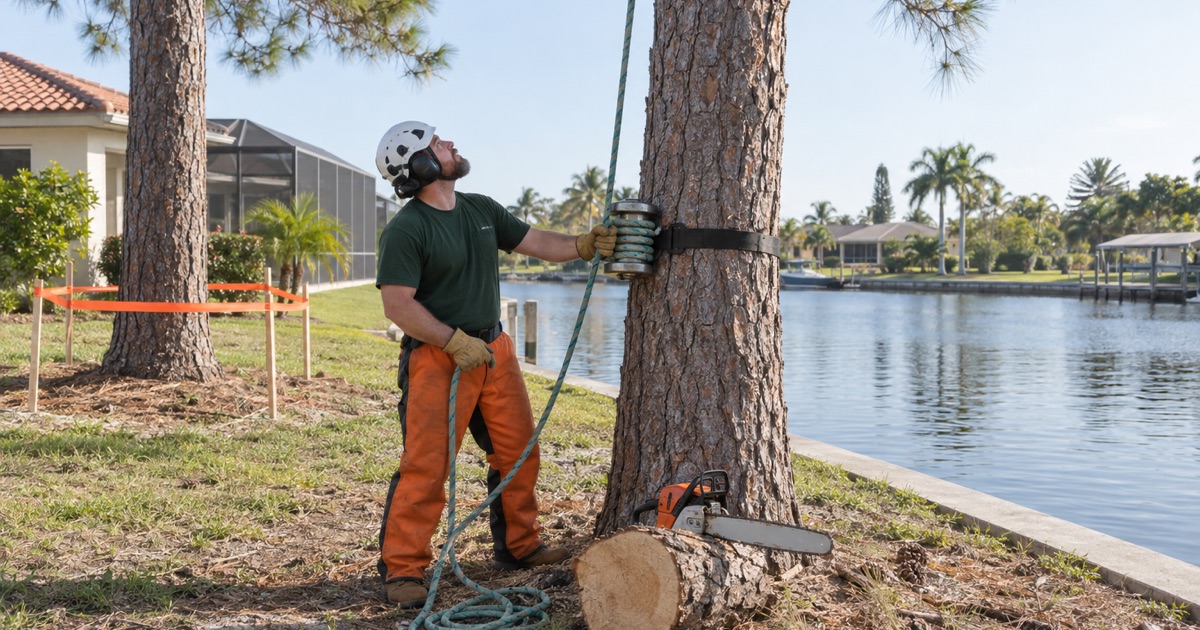
Every reported burrow is staked and roped off at those dimensions, using rope, silt fence, orange construction fencing or another previously approved material. The affidavit requires the barrier to be installed before work commences and to remain in place and in good condition for the duration of the project, not merely on the day an inspector comes by.
The enforcement is a stop work order, and the form says so in the same paragraph a contractor signs under Section 92.525 of the Florida Statutes. The city also refers observed wildlife violations to state law enforcement, with the permit holder answering for them. We build the staking time into the estimate rather than discovering it on the morning of the job.
Looking for tree-removal closer to Florida Gulf Coast University? See Tree-Removal in Florida Gulf Coast University.
An eagle nest and an 1,100-foot circle
What Chapter 23 prohibits inside the zone
Bald eagles stop tree work here through a city ordinance, not only through federal law. Chapter 23, Article I of the Code of Ordinances, adopted by Ordinance 165-06 on 27 November 2006, defines an Eagle Nest Management Zone as a circular area with the active nest at the center and a radius of 1,100 feet, or an irregularly shaped area of approximately equivalent acreage.
Section 23-5 prohibits construction and development activity inside that circle during nesting season, and it names tree trimming and tree cutting specifically, alongside excavation, land clearing and lot mowing on vacant lots. An 1,100-foot radius reaches a long way down a residential street, and your tree does not have to be the nest tree to sit inside it.
Presumed active until the city determines otherwise
The same chapter presumes every bald eagle nest in the city active until the city determines it abandoned. The ordinance sets the nesting period at 1 October to 15 May for most bald eagles, and bars any person from coming within 150 feet of the base of an occupied nest tree during that season, or beyond the nearest street edge, whichever distance is greater.
That is a seven-and-a-half-month window sitting squarely over the dry season, which is when most tree work on this coast gets scheduled. If your address falls inside a management zone, the honest answer is a date rather than a workaround, and we would rather hand you that date at the quote than three weeks into waiting for a crew.
The gate is the species rule, not a tree permit
Florida Statutes section 163.045 lets the owner of a single-family detached home prune or remove a tree with no local notice, application, approval, permit, fee or mitigation, where documentation from an ISA-certified arborist or a Florida licensed landscape architect finds the tree poses an unacceptable risk. No replanting may be required afterward either.
What that statute preempts is a local government’s tree permit. It does not reach a private covenant, a marine improvement permit, an owl buffer or an eagle nest zone, and in this city those are the gates that actually bind. It also does not reach attached housing, so a townhome or condominium address falls outside it entirely, which is worth settling before anyone relies on it.
Ground that was dredged into place
Fill over marine sediment, and what a grinder meets
Much of the buildable ground here is spoil. The dredging that produced the city’s 400-plus miles of canals is the same operation that raised the house pads, and the soil survey names the result after this county: the Matlacha series, established in Lee County in 1982, with its type location about 0.7 mile east of Del Prado Boulevard and 0.3 mile north of Veterans.
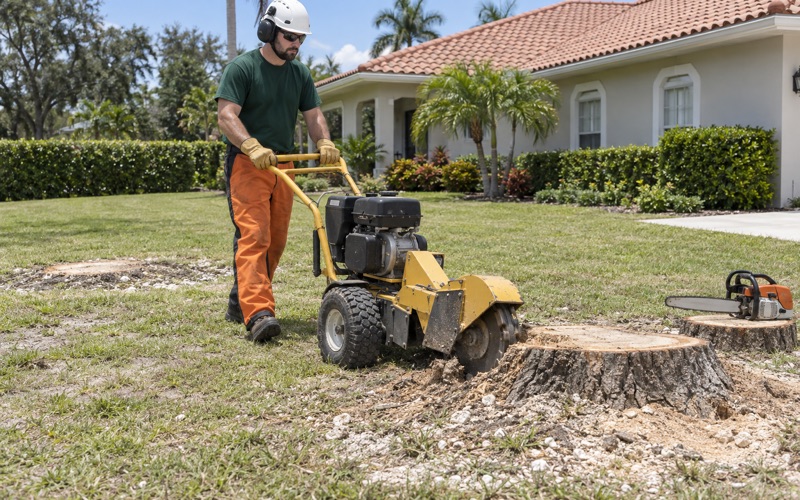
That series is 20 to 48 inches of material produced by dredge and fill operations over sandy marine sediments, somewhat poorly drained, with a seasonal high water table at 18 to 42 inches and shell fragments and limestone pieces carried through the fill. A stump grinder taking a below-grade cut here is working placed spoil and shell rather than an intact natural profile.
Shallow root plates, and a storm that reached six to nine feet
Fill depth varies with where the spoil landed, and the soil description itself notes that water table depth varies with the fill material and artificial drainage. The practical result is that root plates are shallow and the anchoring layer is inconsistent from lot to lot, so two houses on one street can hold very differently under the same wind.
Hurricane Ian is the reference point. The National Hurricane Center recorded maximum inundation of 6 to 9 feet above ground level in Cape Coral, Pine Island and other communities along the mouth of the Caloosahatchee, and noted that two of its water level sensors, in Cape Coral and Matlacha, were lost or destroyed. Storm surge salt inundation that reached a root zone that day can still surface as delayed post-storm mortality, so an assessment here reads the root collar and the soil, not just the crown.
A tree at a seawall is a permit before it is a rigging plan
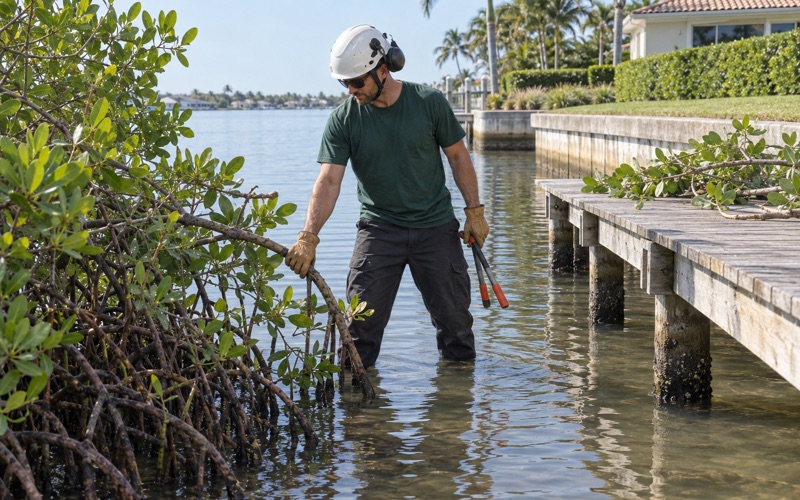
A tree growing at the water’s edge is a different job, and the difference is paperwork rather than ropes. Repairing or replacing a residential seawall is a Marine Improvement permit through Development Services: a site plan locating the wall and showing its length, site-specific engineering wet-signed and sealed by a Florida Registered Professional Engineer, a notarized burrowing owl and gopher tortoise affidavit, and, before the first inspection, DEP approval or SAJ-91 except for freshwater.
The permit fee is $180 and it expires in six months, and a floating turbidity screen has to enclose all clearing, excavating, jetting and backfilling, staying up 24 hours after work ceases or until turbidity is within 20 NTU of where it started. The question we settle before quoting a waterfront tree is therefore a narrow one: does the removal or the grind disturb the wall or its backfill?
What leaves the property, and who signs the decision
Horticultural debris the contractor takes with them
The city’s rule is one sentence and it surprises people: horticulture generated by tree surgeons, nurseries, landscapers or similar contractors must be removed by the company performing the work, per City Code 9-18. Nothing we cut goes to your curb for the franchise hauler to collect, and nothing we cut is yours to stage.
The residential size limits close the same door from the other side. Yard waste has to be cut under six feet long, bundled under fifty pounds and no more than four inches in diameter, while trees, stumps, root balls and larger logs are all listed as unacceptable. Palm fronds are the one easy case, in a single neat pile all facing the same direction, and nothing off a removal qualifies at all.
Palms are quoted as palms
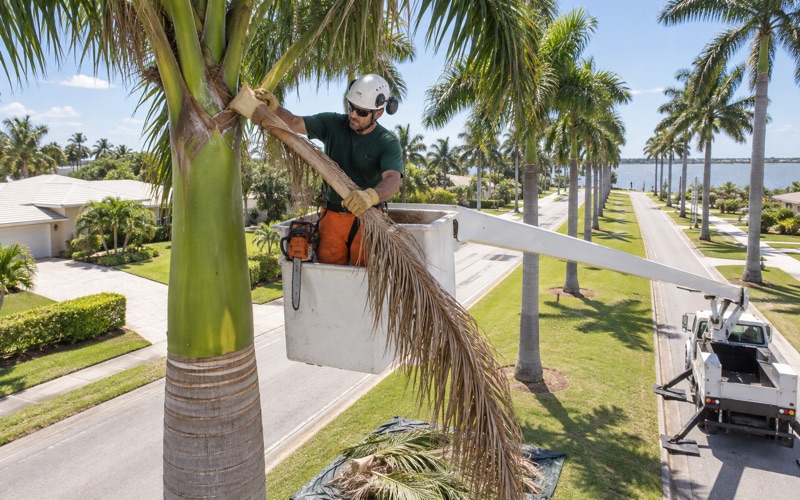
The city’s landscape code separates palms from trees, defining a palm as a self-supporting, fibrous-stemmed monocotyledon of the family Arecaceae, and measuring caliper palm at the widest part of the trunk between one and three feet from the ground. We price them along the same split, because the biology underneath the two jobs is not the same.
A palm has one growing point, no branch collar and no cambium to compartmentalize a wound, and a trunk that will never thicken again once it is cut. That is why hat racking and hurricane cuts are refused here on palms and hardwoods alike, however the job is asked for, and why a sabal palmetto is quoted in clear trunk feet rather than by crown spread.
No tree license exists in Florida, and what stands in its place
Florida issues no tree or arborist contractor license at all, and section 163.211 of the statutes stops a municipality from creating a local one, so this city cannot license tree work even if it wanted to. We say that plainly instead of printing a word that would mean nothing here. What we can put in front of you is general liability and workers’ compensation coverage you are welcome to verify.
The rest is written down rather than asserted. Pruning specifications follow ANSI A300, the crew works to ANSI Z133, hauling and disposal sit on their own line of the estimate because the horticultural waste gate rate changes at every county line we cross, and the dated condition report names the defect we found. When a tree should stay, we say so, and price the pruning or the cable instead.
- 20+ Years on This Coast
- Written Condition Reports
- Four Counties Covered