Fort Myers Tree Removal Pros has been doing tree removal in Captiva for more than twenty years, and on this island the first question is never the tree. It is the lot. What a crew is allowed to cut on a Captiva parcel is settled by a county form rather than by anything an owner can read on a sign at the end of the road.
So we start every estimate here the same way: whose rules reach this address, what has to be on paper before a saw moves, and what the work costs once the material has to leave. Four counties sit on our service map and each answers those three questions differently. We tell you which answer is yours instead of quoting an average.
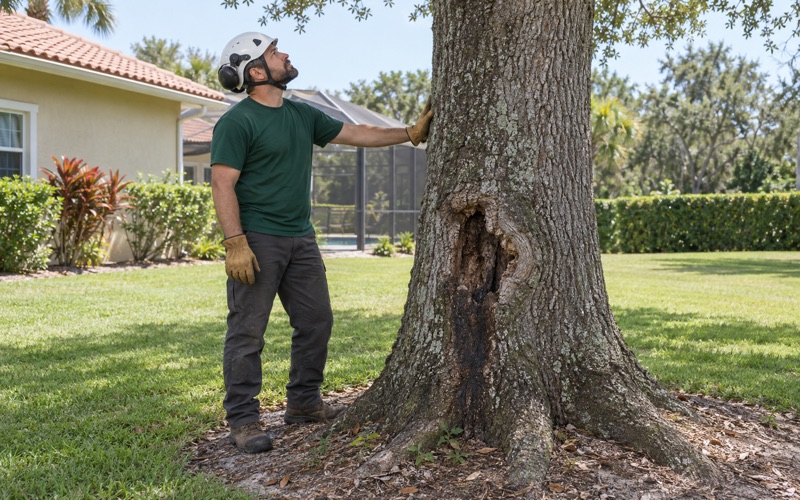
Any tree we recommend removing gets a written, dated condition report first, so the reasoning exists before the saw does. Florida issues no tree or arborist contractor license at all, and we tell owners that plainly rather than implying a credential nobody in this trade holds. Topping, hat racking and hurricane cuts are refused here, on hardwoods and on palms, however the job is asked for.
A barrier-island lot is its own permit trigger class
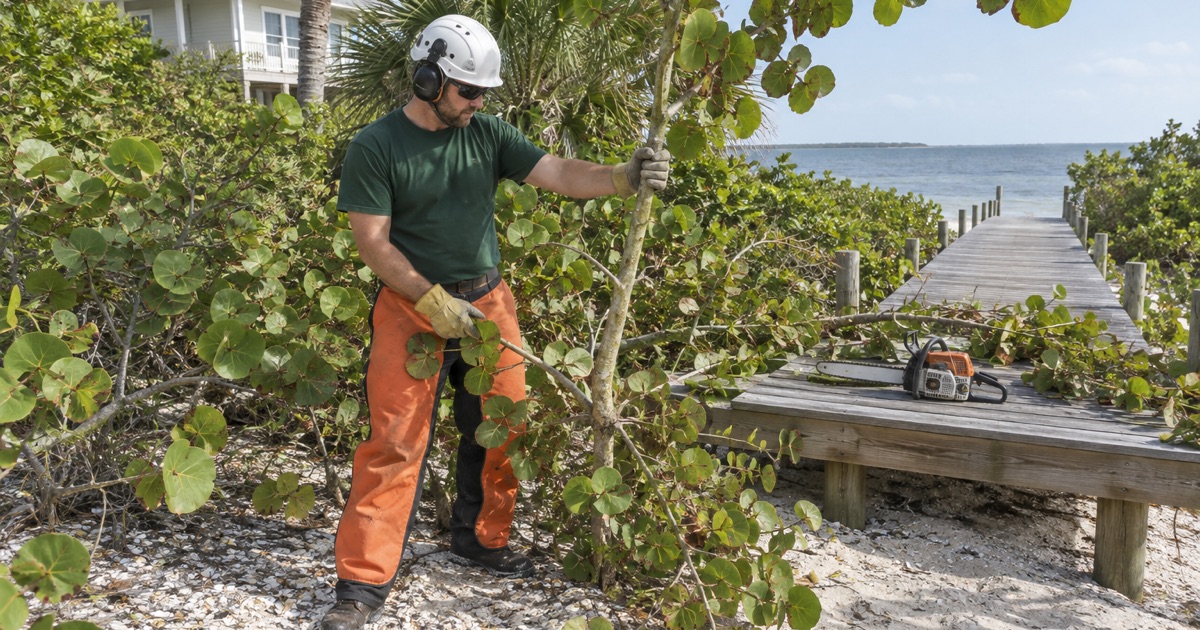
Most of unincorporated Lee County reads its clearing rules in acres. A barrier-island lot does not, and the county says so in the middle of one sentence on its own permit paperwork.
The middle clause of the county’s own form
Lee County Community Development’s Vegetation Permit Submittal Requirements sheet, dated May 14, 2021, names three triggers in a single breath: a single-family lot of five acres or more in unincorporated Lee County, a lot on a barrier island, or a lot on Pine Island that is two acres or more. Two of those carry a number. The middle one carries none.
Captiva is a barrier island, lying between Blind Pass and Redfish Pass. The acreage question that settles the matter on a mainland parcel never gets asked here, which puts a quarter-acre lot on this island in the same trigger class as a five-acre tract inland.
What the application has to show before a saw moves
The same sheet sets out what a clearing application carries: the shape and dimensions of the lot or a boundary survey, and the location of existing or proposed structures and any other improvements. It also states that where the applicant is not the property owner, a letter of authorization has to be submitted with the application.
That is survey-grade information, and assembling it is not a same-week errand. On an island where the owner is frequently two time zones away, the letter of authorization is the item that holds a job up most often, so we raise it at the estimate rather than at the counter.
Section 163.045 is real law and reaches very little here
Florida Statutes section 163.045 bars a local government from requiring notice, application, approval, permit, fee or mitigation to prune or remove a tree on residential property when the owner holds signed documentation from an ISA-certified arborist or a Florida licensed landscape architect that the tree poses an unacceptable risk. That standard is defined by reference to the ISA Best Management Practices for Tree Risk Assessment, Second Edition. Subsection (3) bars a replanting requirement and subsection (4) leaves mangroves out.
The catch is the definition. Subsection (1)(b) reads residential property as a single-family, detached building on a lot actively used for single-family residential purposes, and Captiva holds 22 owner-occupied one-unit detached homes against 1,176 total housing units. The statute is genuine and we use it where it fits; on this island it fits a very small number of addresses.
Looking for tree-removal closer to Punta Gorda? See Tree-Removal Services in Punta Gorda.
An island with no city hall, and the bodies that do exist
Captiva is an unincorporated community in Lee County, and that is not a technicality about a mailing address. There is no mayor here, no council, no municipal code and no permit counter on the island to walk into.
The code that reaches this address is the county’s
Lee County’s Land Development Code is what governs a Captiva tree, Lee County Community Development is the office that issues the vegetation removal permit, and the Lee County Board of County Commissioners is the legislative body behind both. Chapter 14, Article V is where tree protection sits, with the county’s own tree list at Appendix E.
Law enforcement here is the Lee County Sheriff, and the practical effect for a crew is that every approval, inspection and question travels to the mainland. Anyone who tells you a Captiva ordinance covers your oak is describing a government that does not exist.
Two elected taxing districts, and neither is a tree authority
Two real, elected bodies do tax property on this island. The Captiva Erosion Prevention District is an independent special beach and shore preservation district under Chapter 161, Florida Statutes, codified by Chapter 2000-399, Laws of Florida, covering all of Captiva Island from the centerline of Blind Pass to the centerline of Redfish Pass and extending 300 feet into the Gulf of Mexico and Pine Island Sound.
The Captiva Island Fire Control District was created by the Legislature in 1955 as an independent state taxing authority, and it is governed by three elected commissioners serving four-year terms. Neither district issues a tree permit. The Captiva Community Panel, tasked by the county commission with community planning, is advisory and issues nothing at all.
Mangroves here are permitted by the state
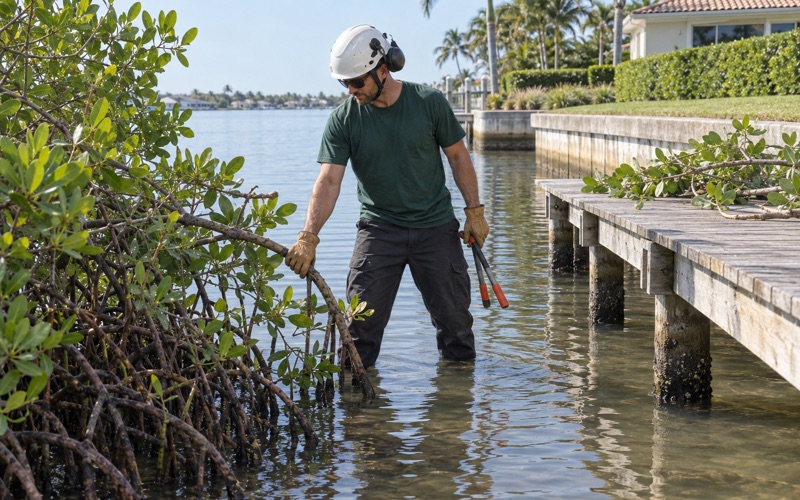
The Florida Department of Environmental Protection publishes the list of local governments that hold mangrove trimming authority handed down from the state under Florida Statutes section 403.9324. It names seven, and neither Lee County nor any Captiva body is on it. A mangrove at an address on this island is an FDEP South District matter, governed by the Mangrove Trimming and Preservation Act.
Under the act’s owner exemption, a riparian fringe on a shoreline of 150 feet or less may be trimmed no more than 10 feet pretrimmed and never cut below 6 feet, and herbicides used to defoliate a mangrove are prohibited outright. We read the statute before quoting, because a mangrove question sent to the wrong agency can cost an owner a season.
Sand, shell and a water table where a hardpan would be
The second thing that changes on Captiva is underground. Twenty-plus years on this coast have taught us that here it is the water table, not any hardpan, that stops a stump grinder most months of the year.
What a root plate sits in on a barrier island
The USDA’s official series description for the Captiva series, named for this island and with its type location in Lee County, reads poorly drained with very rapid permeability, formed in thick deposits of sand and shell fragments on broad low flat areas with slopes under 1 percent. Which series maps onto a given parcel is not something we will claim from a desk.
The same description puts the water table within 10 inches of grade for one to two months during summer rains, and within 10 to 40 inches for roughly ten months of the year. A root plate in loose sand and shell with water that close behaves nothing like one anchored in mainland clay, and it fails differently.
What the hole looks like after the stump comes out
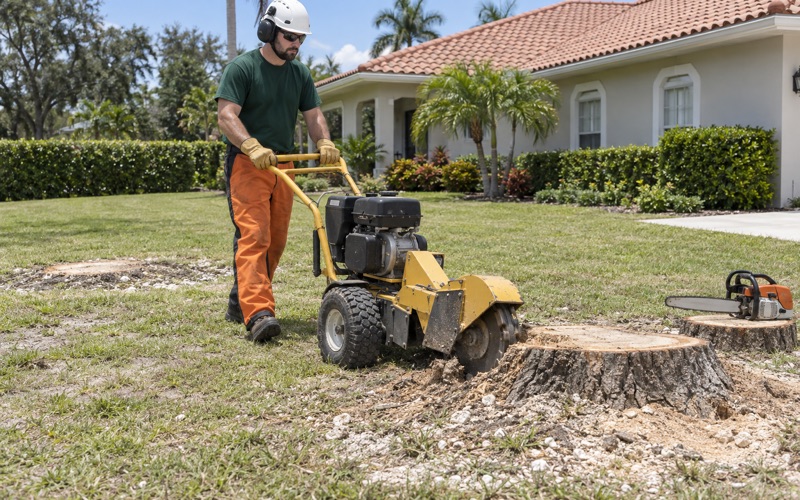
A below-grade grind in this material takes less time and produces more spoil than the same stump inland, because there is nothing hard to stop the wheel and what comes up is mostly sand. What it does not do is hold its shape. We plan the backfill and the settlement into the quote rather than leaving an owner a slump in the lawn.
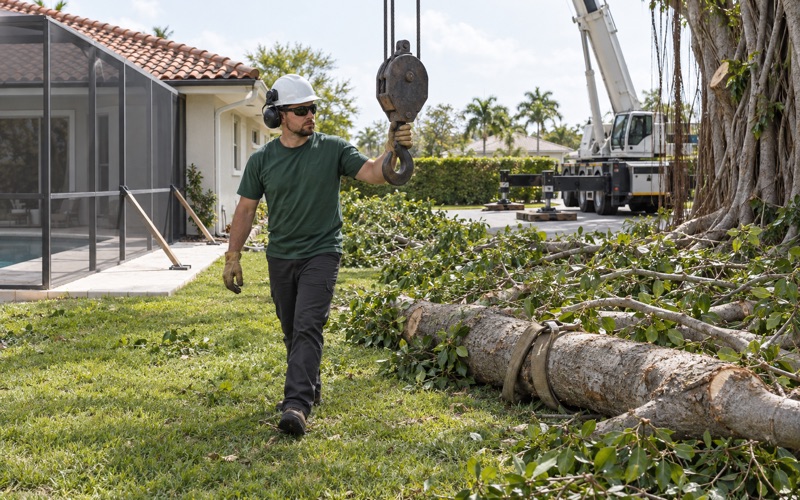
When the wheel reaches standing water the job turns from grinding into excavation, and we say so before we start instead of afterward. Machines get matched to the gate as well: a thirty-five inch grinder goes down a side yard where a larger one simply will not turn.
Palms quoted as palms
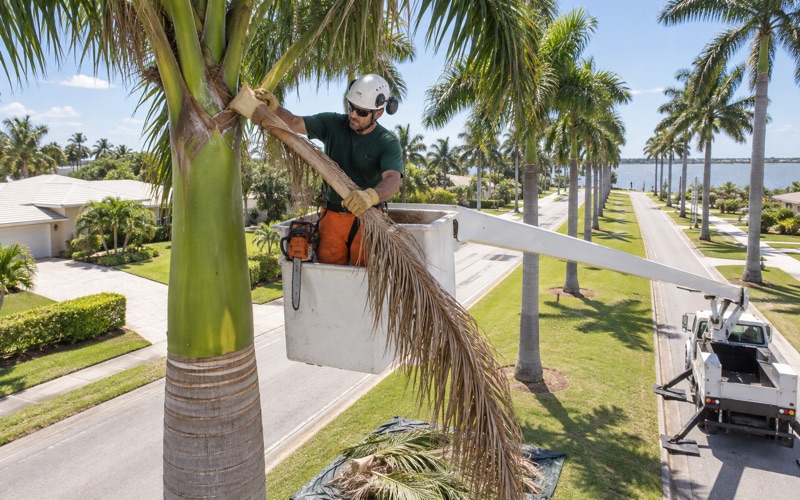
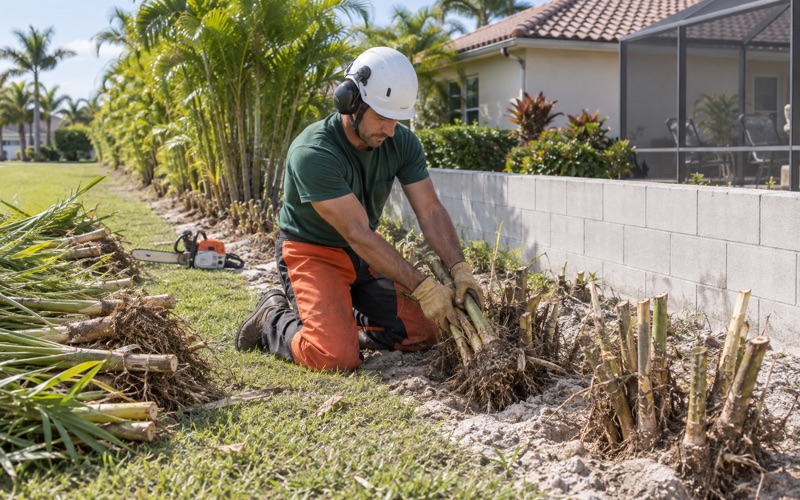
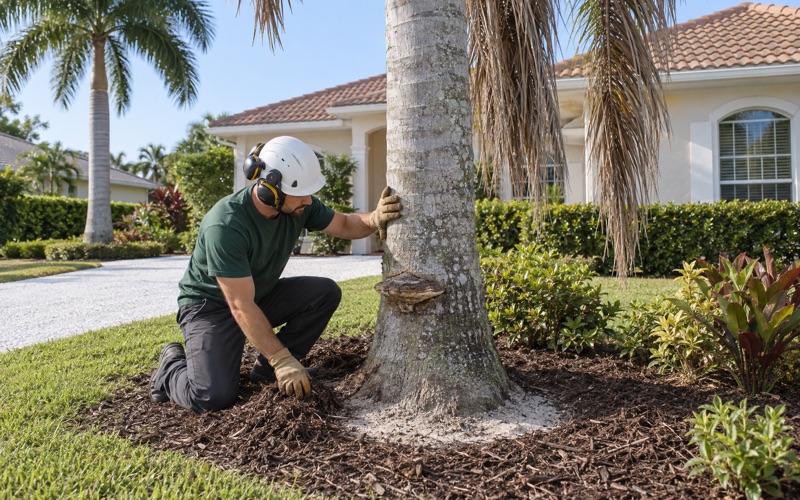
A palm is not a small tree. There is no branch collar, no cambium to compartmentalize a wound, one growing point, and a trunk that will never thicken again, so a cut a laurel oak absorbs can end a sabal palmetto. Ganoderma butt rot and lethal bronzing are removal decisions rather than pruning decisions.
That is why a frond skirt, penciling or spear leaf collapse gets assessed on its own instead of folded into a per-tree rate, and why hurricane cuts on palms are refused as flatly as topping on a hardwood. Both sit outside ANSI A300, and no storm forecast turns either one into a pruning standard.
Every load leaves the island, because there is no gate on it
Hauling and disposal sit on their own line of our estimates, and on Captiva that is the line that surprises people. There is no disposal, transfer or horticulture facility anywhere on this island, and none on the island south of it either.
Nowhere out here takes the material
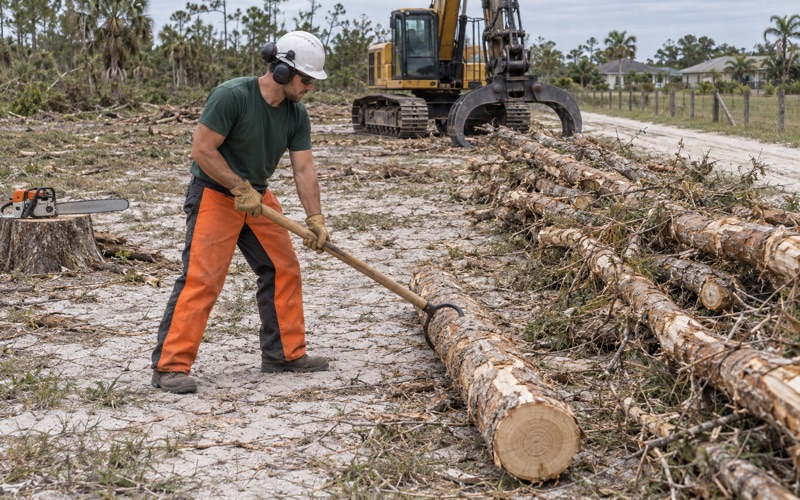
We went looking and there is nothing to find: no yard-waste gate, no transfer station and no mulch operation on Captiva or on Sanibel. Every limb, trunk section and bucket of grinding spoil generated on a job here leaves by truck, which makes the load count part of the plan rather than an afterthought.
Lee County’s fiscal-year-2026 rate for horticultural material at its Buckingham horticulture site is $43.92 per ton with a $15 minimum. That figure is knowable before the crew arrives, so it goes on the estimate as its own line instead of disappearing into a per-tree price.
The haul out, and the toll coming back
The route is fixed: the length of Captiva Drive, across Blind Pass onto Sanibel, out Sanibel-Captiva Road and Periwinkle Way, then over the Sanibel Causeway. Captiva has no bridge of its own to the mainland, so there is one way off and one way back for every truck, chipper and grinder on the job.
The causeway toll plaza runs three traffic lanes, all of them flowing westbound toward the islands, so the toll is collected coming in and not going out. Lee County’s posted transponder rates start at $6.00 for two axles and climb with axle count, which prices a chip truck towing a grinder differently than a pickup.
Thirty-two occupied homes against eleven hundred units
Captiva counts 1,176 total housing units and 32 occupied ones, with 70.5 percent of the stock held for seasonal, recreational or occasional use. Most of the island is empty for most of the year, and the person who has to approve a removal is often not the person who noticed the tree leaning.
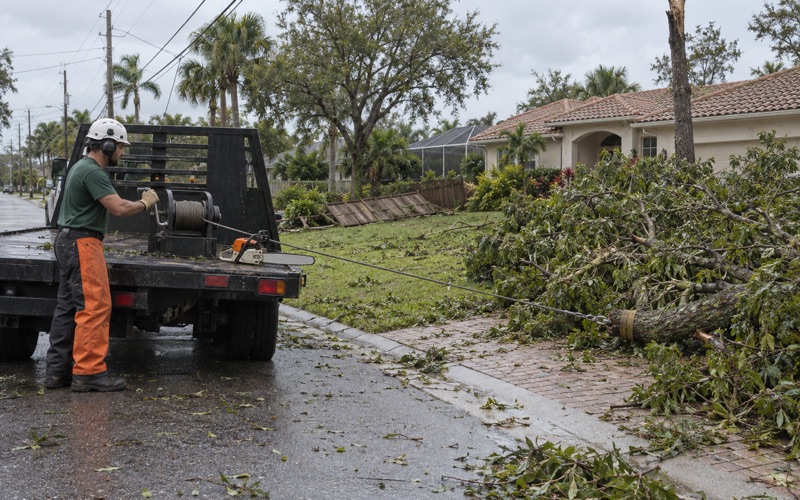
That shapes scheduling more than the forecast does. We work from the written condition report so an off-island owner can decide from a document rather than a phone call, and we sell hurricane work before the season instead of promising it during one, because nobody cuts trees in a hundred-knot wind.
- 20+ Years on This Coast
- Written Condition Reports
- Four Counties Covered