Fort Myers Tree Removal Pros has handled tree removal in Cypress Lake for more than twenty years, and the first question we ask here is rarely about the tree. It is about who is entitled to approve the work: the deed holder, an association board, or the management company that maintains the ground the trunk actually stands in.
That is not a formality. Cypress Lake is unincorporated Lee County, so the Lee County Board of County Commissioners is the only general-purpose government it has, and the county’s Land Development Code is its code. There is no city hall to call and no separate municipal tree ordinance sitting on top of it.
We run four counties on one service map and four different permit regimes, so we give you a straight account of which one your address sits under before we price anything. On any tree we recommend removing, you get a written, dated condition report, so the reasoning exists on paper before the saw does.
Who signs off on a removal here
Attached and detached ownership at close to parity
The housing in Cypress Lake does not resolve into a single pattern. There are 9,380 housing units in the CDP and only 2,049 of them are one-unit detached; another 1,454 are one-unit attached, and 4,555 sit in buildings of two or more units.
Owner-occupancy splits almost evenly across the two single-unit forms: 1,520 owner-occupied one-unit detached against 1,206 owner-occupied one-unit attached. Two people on the same street can both own their homes outright and still hold completely different authority over the tree in front of them.
The county threshold most quotes get wrong
Lee County’s Vegetation Removal Permit Informational Guide, maintained by Lee County Community Development, states that a permit is required for removing native vegetation and trees under the Tree Protection section of the Land Development Code, Chapter 14. It then names exactly when. For single-family residential property, the trigger is clearing on five acres or more within unincorporated Lee County.
An ordinary lot in a built-out area of 3.83 square miles is a small fraction of that. The common vendor sentence that you need a permit to take a tree down in Lee County is therefore wrong for a typical detached lot here, and it is the county’s own threshold that says so, before Florida Statutes section 163.045 is reached at all.
When the ground is shared, the permit comes back
The same guide requires a Vegetation Removal Permit when clearing trees from multi-family properties and common elements. A tree in a villa courtyard, on a condominium common element, or in an association-maintained buffer sits on the permitted side of that line, while an identical tree fifty feet away on a detached lot does not.
Covenants are a further layer, and section 163.045 does not reach them: it applies only to a single-family detached building on a lot actively used for single-family residential purposes, and it binds a local government rather than a private association. Where a community carries a required preserve tract, work inside it runs under an Indigenous Management Plan per Land Development Code Chapter 10-701, which is a management regime rather than yard work.
Looking for tree-removal closer to Cape Coral? See Cape Coral Tree-Removal.
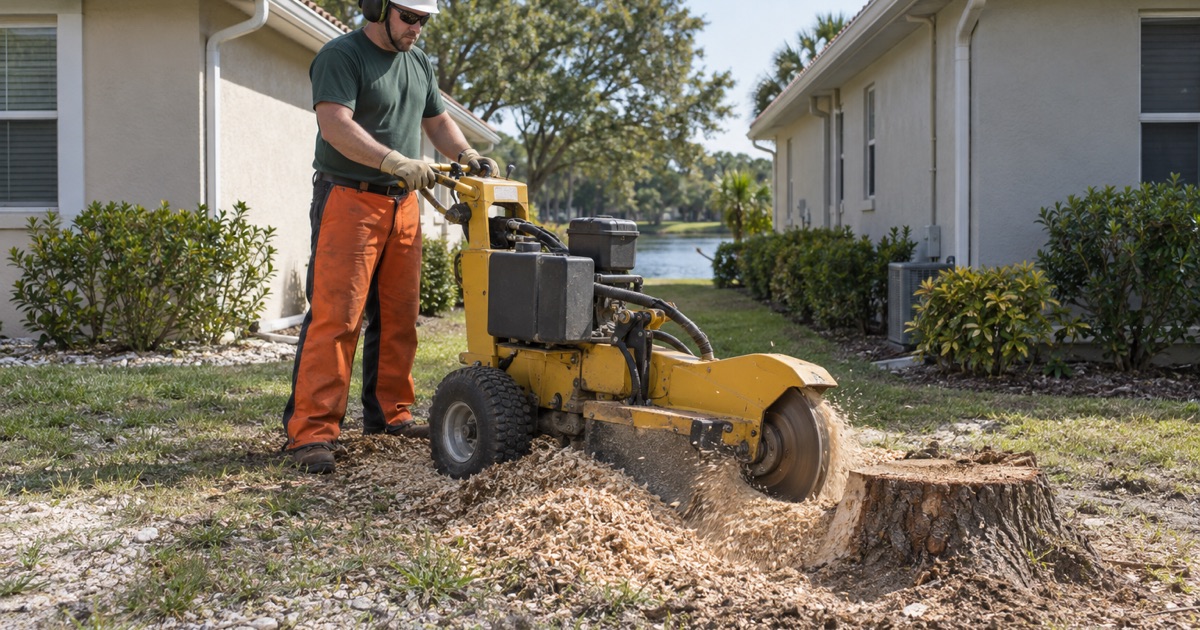
Made ground, and what a stump grinder finds in it
The survey here reads Matlacha-Urban land complex
Sampled against the SSURGO soil survey for Lee County, the Census internal point for this CDP falls in Matlacha-Urban land complex: component Matlacha, taxonomic subgroup Alfic Udarents, drainage class somewhat poorly drained, hydrologic group B, representative slope one percent. We read that as the character of the area, never as a reading of one parcel.
It matters because Matlacha is not a natural profile at all. The series is mapped on anthropogenic features, filled and disturbed low broad flats and depressions, which is another way of saying that the ground was placed here rather than formed here.
Twenty to forty-eight inches of dredge and fill
The Official Series Description gives the parent material as 20 to 48 inches of material produced by dredge and fill operations over sandy marine sediments. The typical pedon runs gravelly fine sand with mixed colors, shell and limestone fragments from the surface to about 36 inches, over a buried dark gray fine sand at 36 to 41 inches.
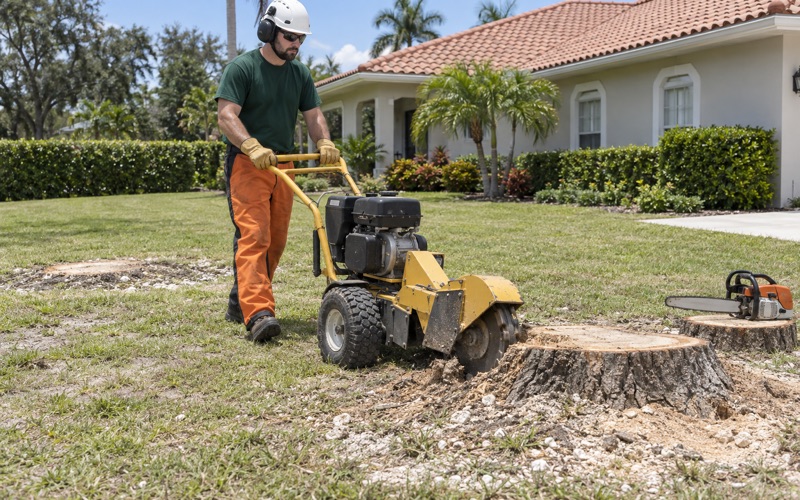
Grinder teeth in that material work through shell and rock fragments instead of clean sand, and they wear at a rate that belongs on the estimate. Root plates develop in placed fill rather than in native horizons, so what a below-grade cut meets is often wider and shallower than the trunk suggests.
Water, not hardpan, is what stops the machine
The series puts the seasonal high water table between 18 and 42 inches, and notes that in most years it sits 24 to 36 inches below the surface of the fill for two to four months. That is squarely inside the depth a stump grinder is asked to reach.
Twenty-plus years on this coast has taught us to quote a grind by what the hole will actually hold rather than by a nominal number. Where the fill is wet close to the target depth, we say so before the machine arrives and agree the finish depth then, not afterward.
Access, absent owners, and where the debris goes
Machines matched to the gate, not to the yard
With 1,270 units in buildings of three or four and 2,103 in buildings of five to nine, a great deal of the work here happens between structures rather than in open yards. We measure the gate, the side yard and the overhead before we commit to any piece of equipment.
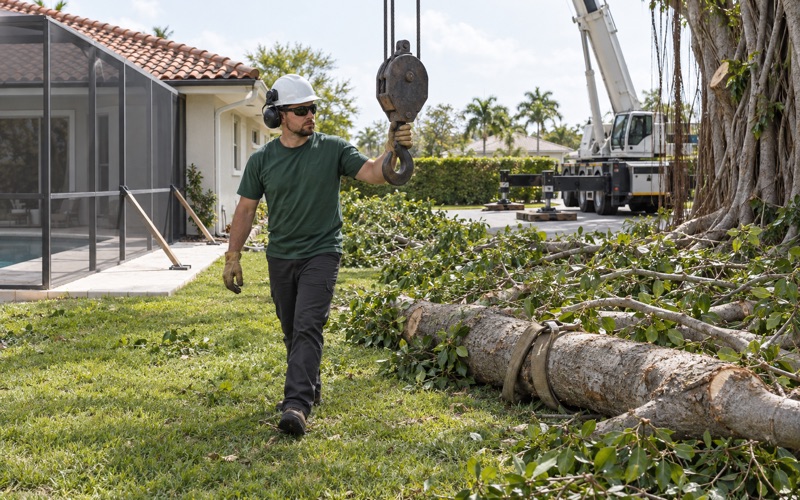
That can mean a thirty-five inch grinder walked down a side yard, a spider lift set on a courtyard slab, or a crane pick over a screen cage where there is no ground route at all. A grapple saw truck is faster where the drive allows it and worse than useless where it does not.
More than two thousand units empty for much of the year
Of the 2,627 vacant units counted here, 2,052 are held for seasonal, recreational or occasional use. A failing tree over a walkway is often reported by a neighbor, a caretaker or a property manager rather than by the person whose name is on the deed.
Our dated condition report is built to travel for exactly that reason. An owner a thousand miles away can read the reasoning behind a recommendation, and a board can put the same document in front of the members who are being asked to pay for the work.
Hauling and disposal on their own line
Unincorporated Lee County gives residents one curbside yard waste collection each week, with material in a container of 50 pounds or less, or tied into bundles no heavier than 50 pounds and no longer than 6 feet. Nothing in that allowance accommodates a removal.
Removal debris goes to the gate instead. Lee County’s FY26 horticultural waste rate at Buckingham Horticulture is $43.92 per ton with a $15 minimum, against $69.83 per ton for municipal solid waste, and we keep hauling and disposal on a separate line of the estimate because that gate rate changes at every county line we cross.
What we will and will not do to a tree
A hazard finding is a document, not an opinion
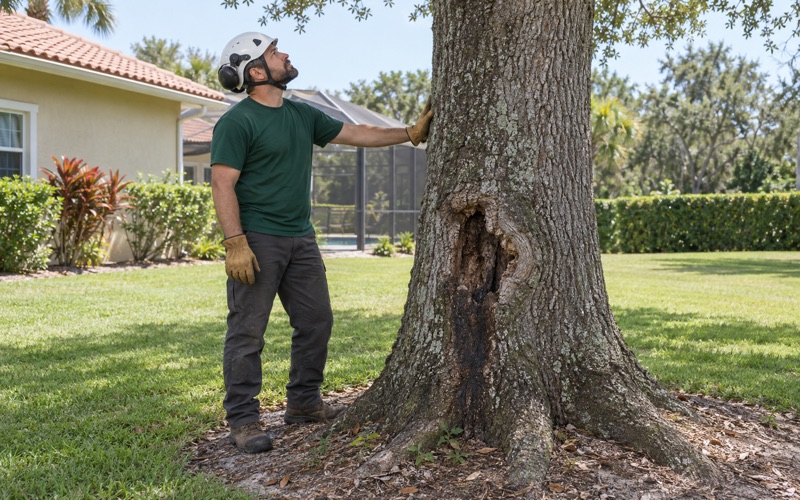
Where a permit does apply, the county guide sets out the conditions under which a Vegetation Removal Permit can be issued for a protected tree, per Chapter 14, Article V, Section 14-412. Those include a safety hazard to pedestrian or vehicular traffic, a threat of disruption to public utility service, a hazard to existing buildings, obstruction of reasonable access, disease that endangers people or other trees, and a tree so weakened by age, storm, fire or other injury as to jeopardize life and limb.
Staff inspect the site, and the administrator may require a protected tree to be relocated on the same parcel in lieu of removal. Our assessments follow the ISA Best Management Practices for Tree Risk Assessment, Second Edition 2017, and we say plainly that Florida issues no tree or arborist contractor license at all rather than implying that one exists.
Palms are quoted as palms
A sabal palmetto is not a small tree. There is no branch collar, no cambium to compartmentalize a wound, one growing point at the very top, and a trunk that will never add diameter again, so the pruning logic that suits a laurel oak does not transfer to it.
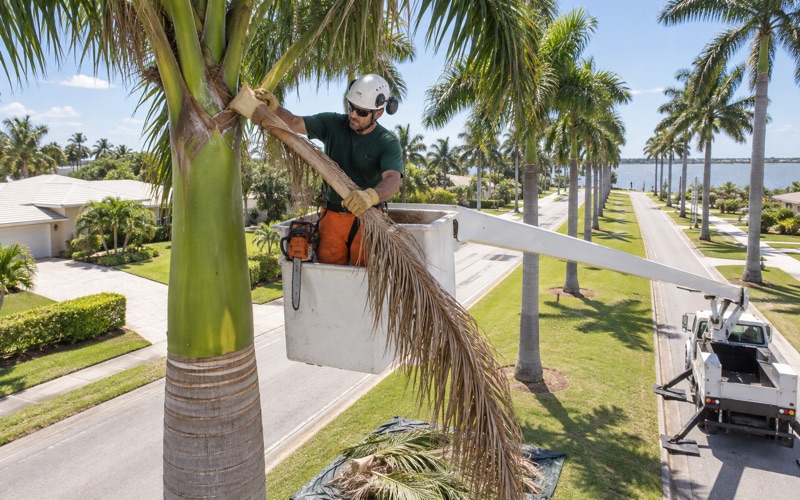
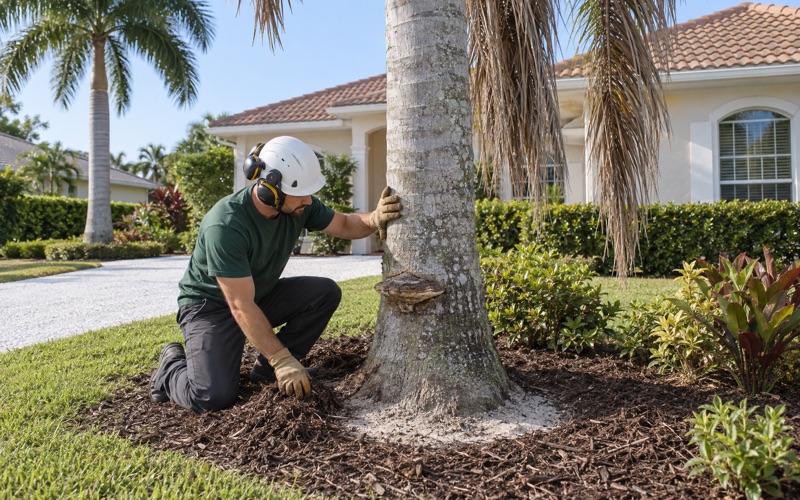
We price palms by clear trunk feet and inspect for what actually kills them on this coast: Ganoderma butt rot, lethal bronzing, spear leaf collapse, palmetto weevil. A palm showing Ganoderma zonatum at the base is a removal conversation rather than a trimming one.
Topping, hat racking and hurricane cuts are refused
We do not top hardwoods, hat rack palms, or make hurricane cuts, however the job is described when it is asked for. ANSI A300 governs the work and ANSI Z133 governs how the crew is kept safe, and neither leaves room for stripping a canopy and leaving the stems standing.
We will also tell you when a tree should stay, and what directional pruning or a cable would cost instead of a removal. Hurricane work is sold before the season rather than promised during it, because nobody cuts trees in a hundred-knot wind.
- 20+ Years on This Coast
- Written Condition Reports
- Four Counties Covered