
Fort Myers Tree Removal Pros handles emergency tree removal in Fort Myers, FL and across the surrounding cities on our service map, among them North Fort Myers, Cypress Lake, Cape Coral, Florida Gulf Coast University and Lehigh Acres. Twenty-plus years here means most of this work is not the storm itself but the weeks and the years after it, which is the part almost nobody writes a page about.
The useful distinction on this coast is not urgent against routine, it is what the tree is touching. A trunk across a roof, a limb hung up over a walkway and a tree leaning on a service drop are three different problems with three different first phone calls, and only one of them starts with us. Everything else can be scheduled properly, which produces a better job at a lower price.
We also sell the preventive half of this openly, because the alternative is dishonest. Hazard reduction booked in the calm months, on trees that have actually been inspected, is the work that reduces storm damage. A guarantee to arrive during a hurricane is not, and this market is full of advertisements making one.
What Counts as an Emergency, and What Does Not
On a Structure, Blocking Access, or Under Tension
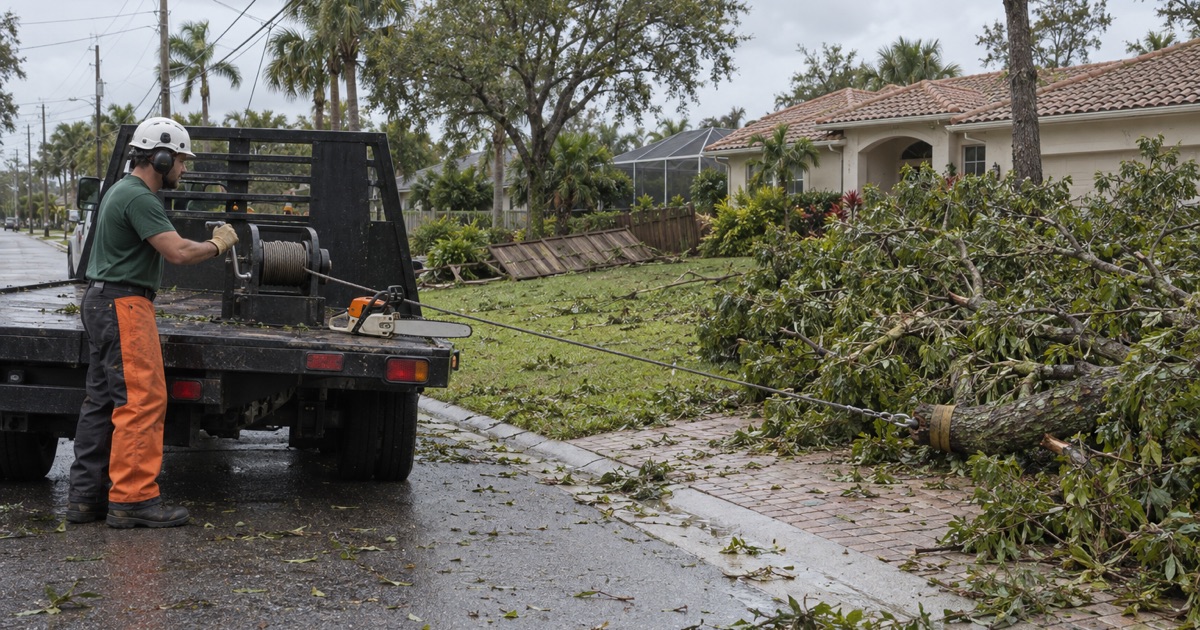
Three conditions move a job to the front: weight resting on a building, a driveway or road blocked so nobody can get in or out, and material hung up or bent and storing energy over a place people pass. A limb held in another canopy is the one homeowners most often underestimate, because it looks stable and releases without warning when something shifts.
The Call That Goes to the Utility First
Anything on or near an energized conductor is the utility’s call before it is ours, and which utility depends on the address rather than the city name. The two publish different rules about what they clear and what stops at the customer’s service drop, so the answer for one street is not the answer for the next. We work the tree after the line is confirmed clear.
What Genuinely Waits Until Daylight
Night work on a damaged tree adds risk without adding much. A tree down in an open yard, a fence crushed, a cleanly snapped limb resting on the ground: those are scheduled, done properly with the right equipment, and cost less than the same job done by flashlight. We will say which category your situation falls into rather than billing the urgency.
After the Storm: Two Different Kinds of Damage
Reading a Root Plate That Moved
The finding that matters most after a blow is at ground level. Soil heaved or cracked on one side of the trunk, a visible gap on the tension side, structural roots lifted clear, a trunk that has changed its angle against a fixed reference: those say the plate moved. A long-standing lean with settled, undisturbed soil around the flare usually says it did not.
Delayed Failure Two Summers Later
Storm surge salt inundation is a slow mechanism and it is the one this market keeps being surprised by. Gumbo limbo came through the 2004 hurricane with one of the strongest survival records on this coast, and is now among the most affected species on Sanibel, toppling in ordinary summer storms because standing salt water rotted the root plates long after the wind had gone.
Hangers, Split Unions and Stored Energy
The post-storm canopy holds three things worth naming: detached limbs lodged in the crown, unions that split without separating, and stems bent into a load that releases when the wrong cut is made. Each is worked from above or with a lift rather than from underneath, and a stem under tension is cut in a sequence that keeps it from splitting up the trunk.
Who Pays, and What a Policy Actually Covers
The Debris Removal Sublimit
Florida property forms carry a small, separate allowance for removing wind-downed trees, and it is written per form rather than per state. One carrier publishes five hundred dollars and states it cannot be increased; another caps a thousand per occurrence and five hundred per tree. Neither figure goes far on a mature oak, so it is worth reading the line before the storm rather than after it.
Screen Enclosures and What Falls Outside
A screen pool cage is one of the most commonly damaged structures here and one of the least reliably covered, with at least one major form in this market covering it not at all. That asymmetry is why preventive work over an enclosure usually pays for itself, and why a crane pick priced above a straight drop is frequently the cheaper decision once the cage is in the arithmetic.
- 20+ Years on This Coast
- Written Condition Reports
- Four Counties Covered