Fort Myers Tree Removal Pros has been doing tree removal in Estero for more than twenty years, and the honest opening answer for most callers here is that two documents govern the same tree and they no longer read the same way. One of them is the Village’s own code. The other is a state statute that was rewritten after that code was adopted.
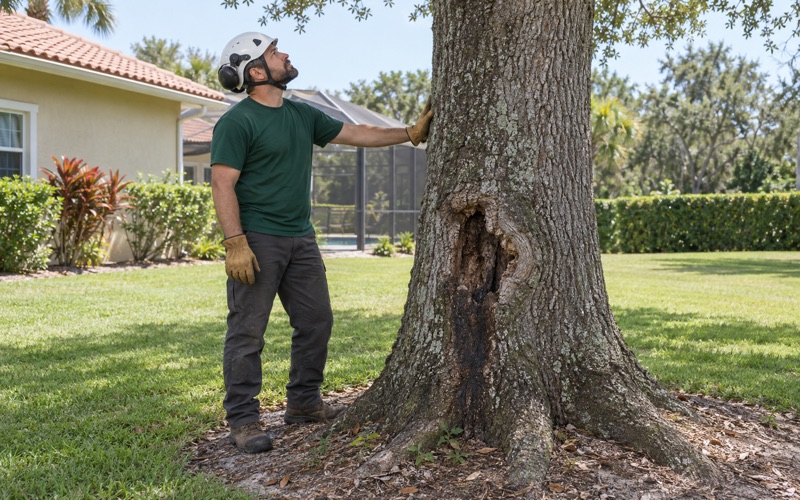
Which of the two reaches your property turns on what kind of building sits on the lot, not on how bad the tree looks from the driveway. We settle that question before we quote, because a removal started on the wrong assumption is not something a crew can put back afterward. Every tree we recommend taking down gets a written, dated condition report first.
Our service map crosses four counties and four separate tree-permit regimes, and we give a straight account of which one an address actually sits under rather than quoting the strictest one to stay safe. Florida issues no tree or arborist contractor license at all, and we would rather tell you that plainly than print a word the state does not award.
A village younger than most of the houses in it
Estero is not an old municipality, and that single fact explains why the tree rules here are harder to research than they look. The Village incorporated on 31 December 2014, and it did not have a land development code of its own for another six years.
Where the rules lived before 2021
The Village’s charter was created by the Legislature as chapter 2014-249, Laws of Florida, effective only upon approval by a majority of the qualified electors residing within the proposed corporate limits. In its early years the Village legislated by amending Lee County code provisions it had carried forward. Ordinance 2019-19 is titled, plainly, “Amending Special Events Permitting Provision of Lee County Code.”
The practical consequence lands on anyone reading about tree rules in Estero online. Material written before 2021 may be describing Lee County’s code, and that is a different document with different thresholds. We check the date on anything a customer hands us, and we check whether it describes the county or the Village.
What Section 2-505.D protects
The Village adopted its own Land Development Code on 27 January 2021. Tree removal sits at Section 2-505.D, the Tree Removal/Vegetation Permit, keyed to a category the code calls a tree worthy of preservation. Deliberately cutting down, destroying, removing, relocating, defoliating or otherwise damaging one without first obtaining that permit is prohibited.
The code carries the construction-phase machinery that goes with it. Trees worthy of preservation and other protected trees have to be marked and barricaded before land clearing, and a preserved tree destroyed during construction has to be replaced with the same species at equivalent dbh caliper before a certificate of occupancy or compliance issues. On a build site that replacement obligation is usually the expensive half.
Who signs the authorization
Authorization for Tree Removal is handled by the Village of Estero Community Development Department, which publishes an Application for Vegetation Removal in its own building-permit document library. That is the office to deal with whenever the Village’s process is the live one.
On a great many Estero lots it is not the live one, and the published Village process is still what a resident finds first when they search. We would rather walk through why it does and does not reach a particular parcel than let a homeowner file an application nobody can require of them.
Looking for tree-removal closer to Fort Myers Beach? See Tree-Removal Services in Fort Myers Beach.
A code that quotes a standard the state has since replaced
The Village’s exemption language for residential property is not a typo and it is not sloppiness. It is a timing problem: the code was written before the statute it repeats was amended, and it still reads to the older text.
The words in the local code
As codified, the residential exemption says no notice, application, approval, permit, fee or mitigation is required for pruning, trimming or removal of a tree on residential property when the owner obtains documentation from an ISA-certified arborist or a Florida licensed landscape architect that the tree presents a danger to persons or property.
That phrase, presents a danger, was the statutory wording in effect when the code was adopted in January 2021. It is the phrase a homeowner will find if they read the Village’s code today. It is not the test that governs.
The standard actually in force
Florida Statutes section 163.045 was amended by chapter 2022-121, effective 1 July 2022, and that phrase was replaced with a defined standard. The tree must pose an unacceptable risk, meaning removal is the only means of practically mitigating its risk below moderate, as defined by the ISA Best Management Practices Tree Risk Assessment Second Edition 2017.
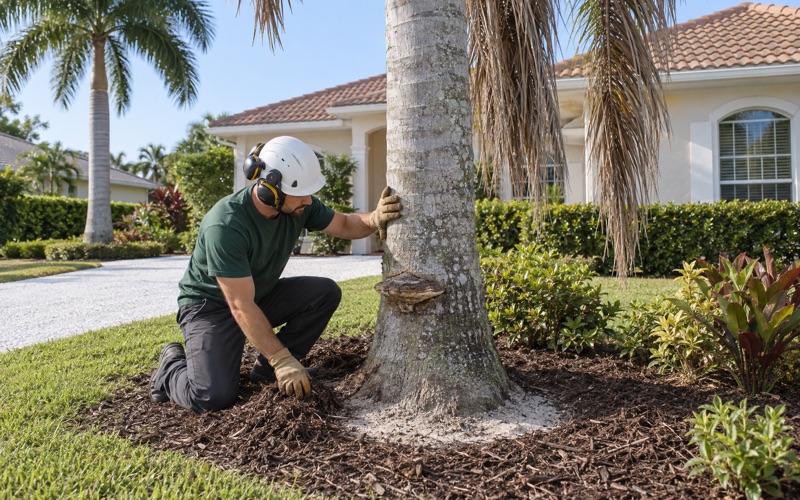
That definition is a method, not an adjective. A note saying a tree looks dangerous satisfies nothing, and we will not write one. The assessment has to reach a rating and show why directional pruning, a cable or a crown reduction would not bring the risk down far enough, which is also how we end up telling people a tree should stay.
Whether your lot is in scope at all
The statute defines residential property narrowly: a single-family, detached building located on a lot that is actively used for single-family residential purposes. By structure type the Village holds 12,115 detached single-family units out of 26,937 (ACS 2024 five-year, B25024). The 3,634 attached single-family homes, the units in two-or-more-unit buildings and the 2,447 mobile homes sit outside it.
Common-element tracts, vacant lots and commercial parcels sit outside it too, and on every one of those the Village’s Section 2-505.D process is what governs. The statute also binds the Village rather than a private covenant, and much of Estero lies inside chapter 190 community development districts, where a tree on common area is the district board’s decision rather than the homeowner’s.
What actually changes about the work on this ground
Two things decide how an Estero removal gets priced and staged, and neither of them is the tree. One is who owns the buried and overhead services around it; the other is where the debris is allowed to go.
The utility answer is not one answer
Bonita Springs Utilities, Inc., a not-for-profit member cooperative founded in 1970, states that its franchise service area includes the City of Bonita Springs, a portion of the Village of Estero and unincorporated south Lee County. Lee County Utilities serves the northern portion of the Village, and the reported dividing line is Williams Road.
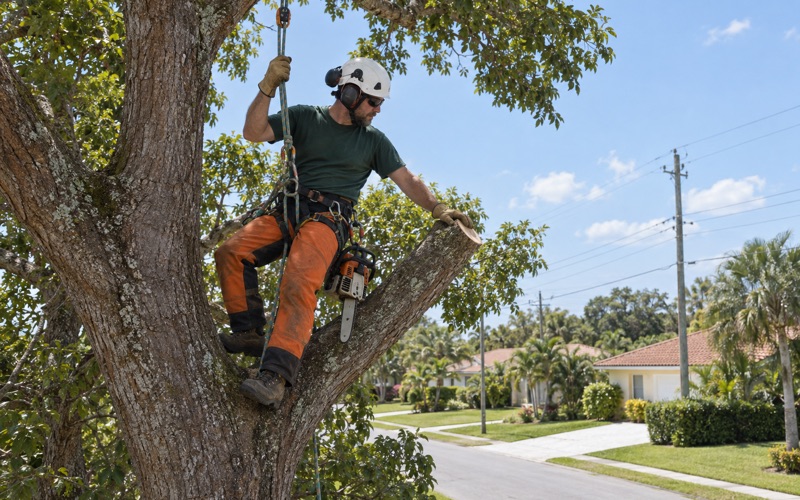
Reported is the operative word, so we verify by service address rather than assuming, because an Estero address alone does not settle it. Electric is Florida Power & Light, established by exclusion: LCEC’s own list of the communities it serves does not name Estero. Who owns the meter, the lateral and the reuse main decides how we rig a pick.
Debris leaves by the gate, not the curb
Estero is on the Lee County Solid Waste residential schedule with one curbside yard-waste collection each week, and the allowance is a small one. Material has to be in a container of 50 pounds or less, or securely tied into bundles no heavier than 50 pounds and no longer than six feet. Up to 50 pounds of unbundled palm fronds may be set at the curb.
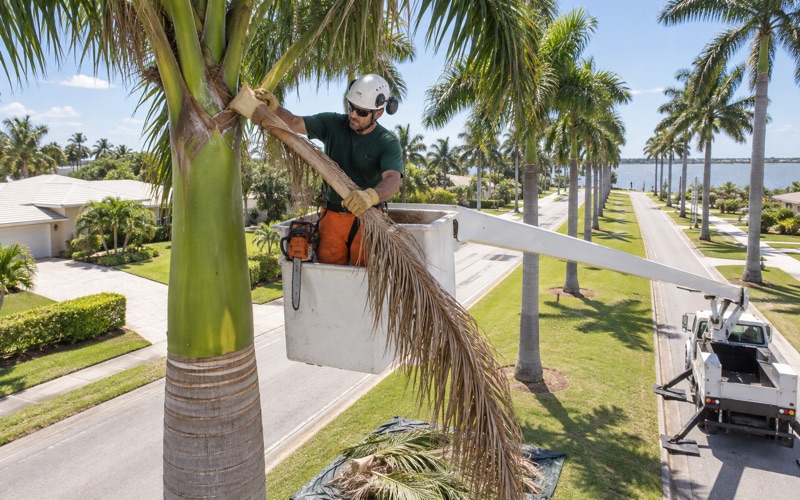
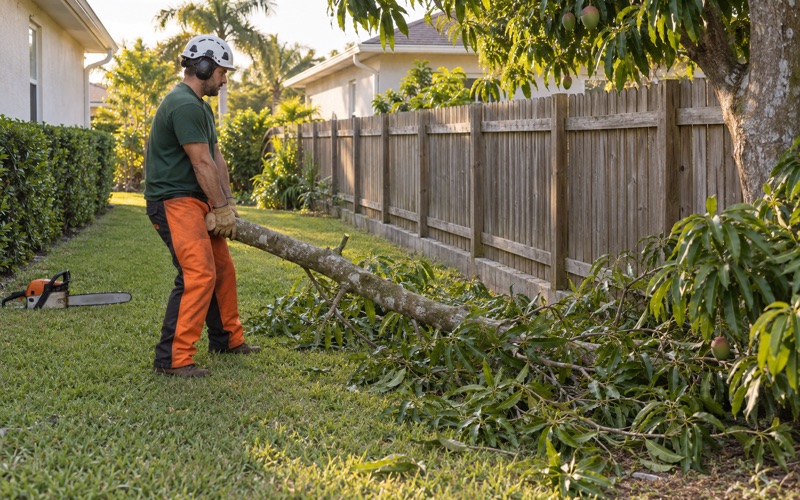
A mature laurel oak, or the crown taken off a storm-damaged palm, exceeds a week of that by an order of magnitude, so removal debris goes to the disposal gate instead. Lee County’s FY26 horticultural waste rate is $43.92 per ton with a $15 minimum. Hauling and disposal sit on their own line of our estimate, because the gate rate changes at every county line we cross.
What stops a grinder in Estero
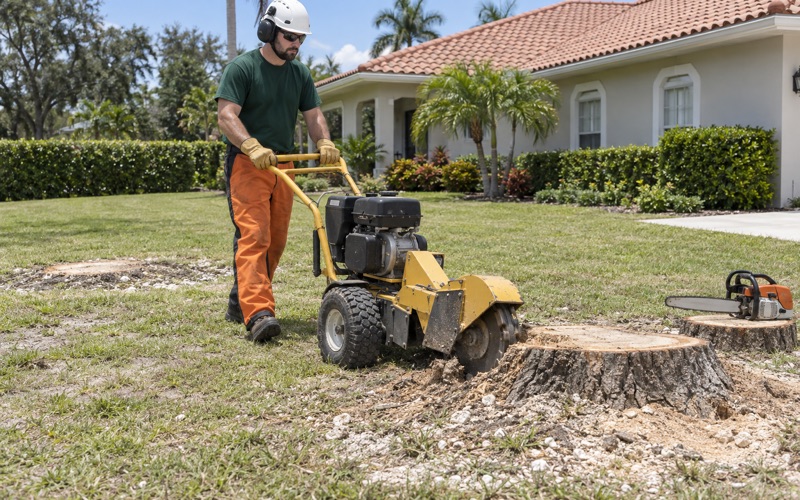
Twenty years on this coast have taught us that the water table, rather than any hardpan, is what ends most stump grinding days. Two very different soils were measured inside this one Village: one poorly drained with a cemented spodic horizon and no rock within reach, the other with limestone close enough that a below-grade cut can find it inside the stump’s own root plate.
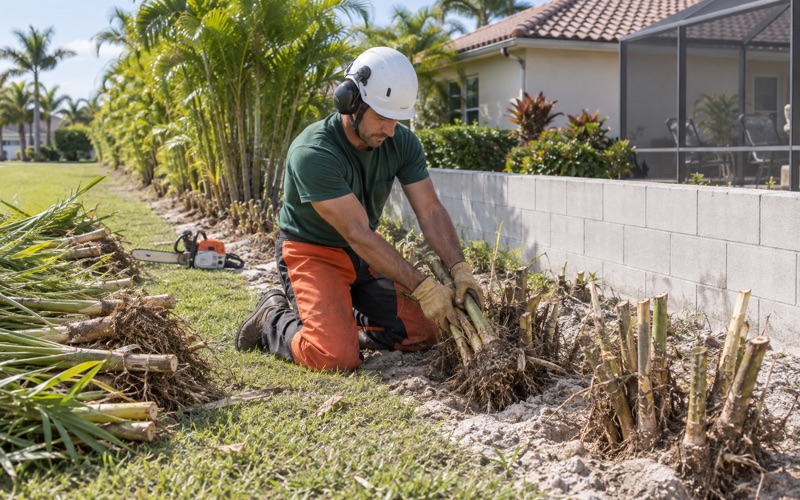
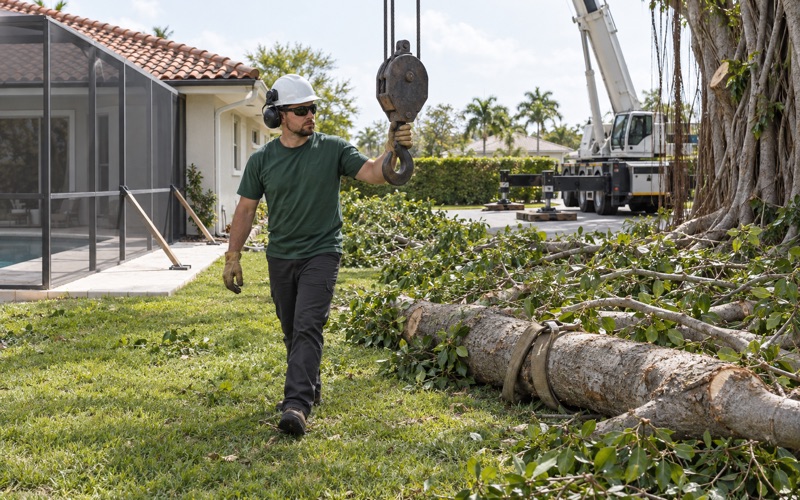
So we look at the specific address before promising a depth or a machine. A thirty-five inch grinder goes down a side yard gate; a crane pick goes over a screen cage. Palms are quoted as palms, with no branch collar, no cambium, one growing point and a trunk that will never thicken again.
The river, the bay, and a name that belongs to two places
Some of what a search engine returns for the word Estero was measured somewhere else entirely, and some of what stands on an Estero shoreline is not the Village’s call at all. Both are worth knowing before a crew shows up.
The storm figures that get misfiled here
The most quoted hurricane damage numbers attached to the word Estero were measured on the barrier island of the same name, the one occupied by the Town of Fort Myers Beach. That is a separate incorporated municipality with its own government and its own ordinances, and the National Hurricane Center published no comparable figure for the mainland Village.
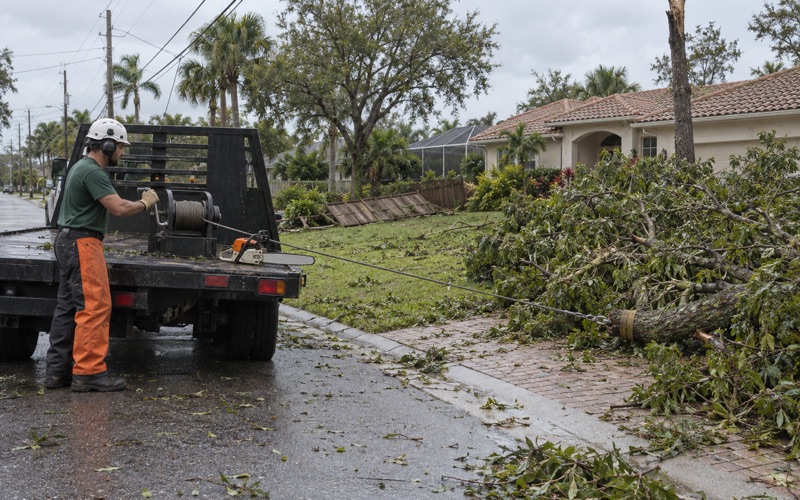
We raise it because those numbers get quoted back at us during estimates for mainland properties they never described. Storm work here is sold before the season rather than promised during it, and topping, hat racking and hurricane cuts are refused on hardwoods and on palms alike, however the job is asked for.
Shoreline and mangrove work is a state matter
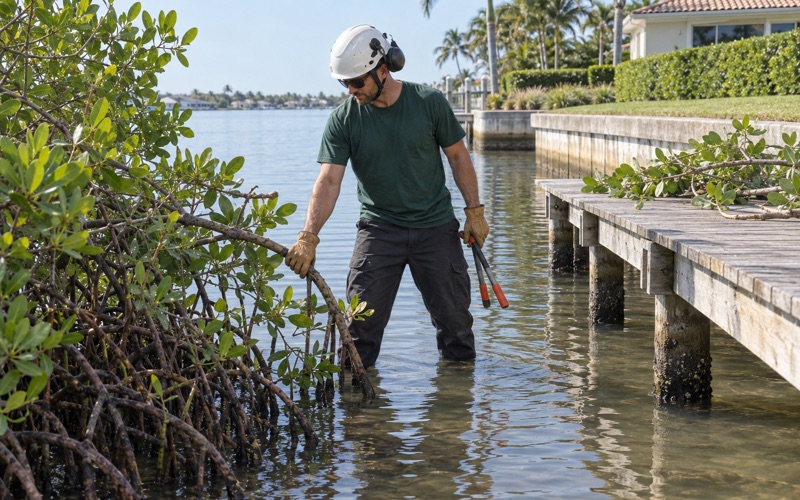
The Estero River runs to Estero Bay, and Estero Bay Aquatic Preserve sits at the Village’s western edge under the Florida Department of Environmental Protection. It was Florida’s first aquatic preserve, created in 1966 and now covering 13,829 acres. Where mangroves stand on tidal shoreline, the rules are the Mangrove Trimming and Preservation Act at sections 403.9321 through 403.9333.
Only seven local governments statewide hold delegated mangrove authority and the Village is not one of them, so a mangrove permit for an Estero shoreline is a DEP South District permit rather than a Village one. A crew that treats a riparian parcel here as an ordinary suburban yard is one cut away from a state enforcement matter.
Trees planted here by people who imported them
In 1894 Dr. Cyrus R. Teed founded the Koreshan Unity settlement on 300 acres south of the Estero River, and between 1894 and 1908 its members landscaped the grounds with sub-tropical species collected from around the world. A monkey puzzle tree and African sausage trees were among them, specimens that drew Thomas Edison and the botanist Henry Nehrling.
The last remaining members donated the land to the Florida state parks in 1961. We mention it because the planted vocabulary around Estero really is unusual, and an unfamiliar specimen is a reason to identify a tree correctly before pricing anything, not a reason to take it down. That identification is the first line of the condition report.
- 20+ Years on This Coast
- Written Condition Reports
- Four Counties Covered