Fort Myers Tree Removal Pros has spent more than twenty years on tree removal in Florida Gulf Coast University and the rest of this coast, and at an address like this one the first move is never the saw. It is reading whichever document actually governs the vegetation on that particular ground, because the answer here is not the answer a mile down the road.
We carry four counties on one service map, and each of them runs a different tree-permit regime with its own thresholds, its own protected species and its own paperwork. Telling a caller plainly which regime their address sits under is part of the estimate rather than an extra. On state university ground that question has a different answer again, and it is worth giving straight.
So this page is the honest version of this place instead of a homeowner script with a new name dropped into it. The ground here is a state university campus, the vegetation on it answers to environmental permits, and the buyer is an institution rather than a family with a leaning oak over the carport.
The document that governs a tree on this ground is an environmental permit
A federal dredge-and-fill permit and a district conceptual permit
The University’s Campus Master Plan records that the site was studied in detail before anything was built on it: vegetation mapping from newly flown aerial photography, on-site flagging of jurisdictional wetland boundaries, binding jurisdictional determinations, surveying of those lines, and wildlife surveys. That work fed the U.S. Army Corps of Engineers dredge and fill permit application and the South Florida Water Management District conceptual permit application, both filed in February 1994 and since granted.
Then the plan states the thing that settles the question. The USACE and SFWMD permits define the way in which the campus must be developed and the natural environment maintained, and the plan adds that no development outside the initial conceptual permit is proposed or contemplated. Most of its conservation policies simply point back at provisions those two permits already fix.
Reading the instrument before the work is priced
Lee County Community Development handles planning, zoning, development services, permitting, plan review, inspections and code enforcement for the unincorporated parts of the county, and its tree protection rules live in Chapter 14 of the Land Development Code. That is the county’s general authority over unincorporated ground. Land held by a state university is a separate conversation, and we treat it as one rather than assuming either way.
Any particular project’s standing has to be checked against the campus development agreement in force at the time, and we have not read it. What we can do is name the document that has to be read, say so before a number is attached to the job, and decline to guess on somebody else’s compliance record.
A written, dated condition report before the saw
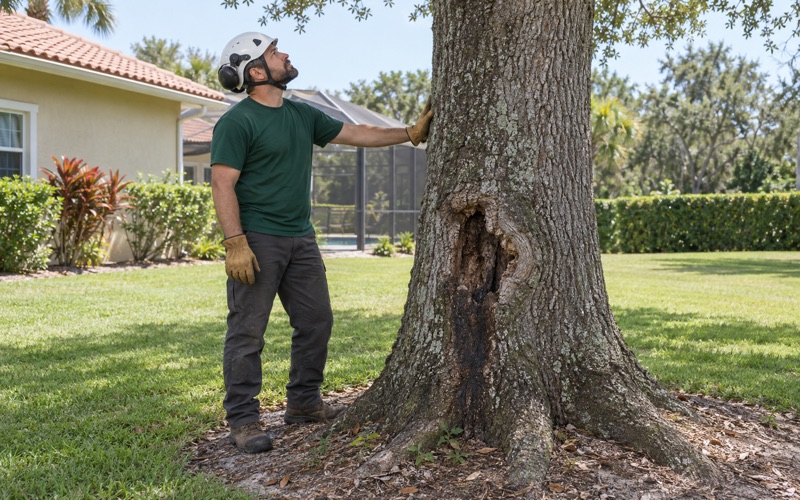
Every tree we recommend taking down gets a written, dated condition report first: what we measured, what we saw at the root collar and in the crown, and why removal follows from it. On permitted ground that record matters more rather than less, because the reasoning has to survive being read later by somebody who was never standing under the tree.
We will also say when a tree should stay. If the honest answer is directional pruning to ANSI A300, a cable through co-dominant stems with included bark, or a root collar excavation with an air spade instead of a removal, that is what the report recommends and what we price against a removal.
Looking for tree-removal closer to Lehigh Acres? See Tree-Removal Services in Lehigh Acres.
A statute, a master plan, and a landowner that is a board
Florida Statutes section 1013.30 and the campus development agreement
Section 1013.30 requires each university board of trustees to prepare and adopt a campus master plan, keep a copy of it on the university’s website, and draft a proposed campus development agreement for each host local government within 270 days after the plan is adopted. Subsection (18) provides that once the agreement is executed, campus development may proceed without further review by the host local government where it is consistent with the adopted plan and that agreement.
The University’s own Campus Master Plan cites section 1013.30 by name in three separate policies, covering amendments to the capital improvements schedule and the phasing of potable water and sanitary sewer. The statute is not something an outside crew introduces here; it is already part of the planning vocabulary on this ground.
Coordination with Lee County, and a board of trustees as landowner
The same plan directs the University to provide Lee County and off-campus service providers with updated capital improvement projections every year. That is coordination with a host local government, and it reads differently from standing at a permit counter. Fire protection comes from the San Carlos Park Fire Protection and Rescue Service District, an independent Lee County fire control district whose reported response time to the campus runs under five minutes.
The landowner itself is a Board of Trustees of thirteen members, six appointed by the Governor and five by the Board of Governors of the State University System, plus the sitting chair of the Faculty Senate and the president of Student Government. A landowner shaped like that does not settle a tree question in a driveway on a Saturday. It settles one through a facilities office, a purchase order and a paper trail.
A grounds organization that is already here
Physical Plant runs this landscape through its Grounds Department, whose staff provide daily services including campus litter removal and inspection of the entire campus for immediate landscape and irrigation issues. The same department runs a relocation program the University calls the Tree Orphanage, which has moved 116 sabal palms, 8 live oaks and 2 cypress trees out of building sites and into other parts of campus.
Physical Plant is also the office responsible for managing and monitoring the campus wetlands to achieve compliance with Army Corps of Engineers, Department of Environmental Protection and South Florida Water Management District requirements. Relocation ahead of removal, permit-driven vegetation management and a native planting policy are the habits of this ground, and we have no relationship with the University to suggest otherwise.
Working inside the perimeter road
Cypress domes, oak hammocks and pine flatwoods
The campus began as 760 contiguous acres and now exceeds 800, organized around an academic core of roughly 150 acres bounded by a perimeter road, with named districts including South Village, North Lake Village, the Northwest District solar field and the Outreach District. The signature habitats the University names for itself are pine flatwoods, oak hammocks, marshes, cypress swamps and estuaries.
Cypress domes sit on campus, one of them across from The Water School, alongside freshwater marshes, the campus Nature Trail with its ADA-compliant section, the half-acre student-run Food Forest near the Sugden Welcome Center, and Stewart Slough behind the recreational fields, draining toward the Estero River. Bald cypress is named among the trees here, and none of those features is ground a crew treats as ordinary turf.
Felda fine sand, depressional, and what it does to a machine
Sampled against the Lee County soil survey, the internal point of this place falls in map unit 49, Felda fine sand, depressional: very poorly drained, hydric rating yes, hydrologic group A/D, negligible runoff and high corrosion potential to steel. The Felda series description puts the seasonal high water table within 12 inches of the surface for two to six months in most years, and ponding at zero to 24 inches in depressional areas for more than six months a year.
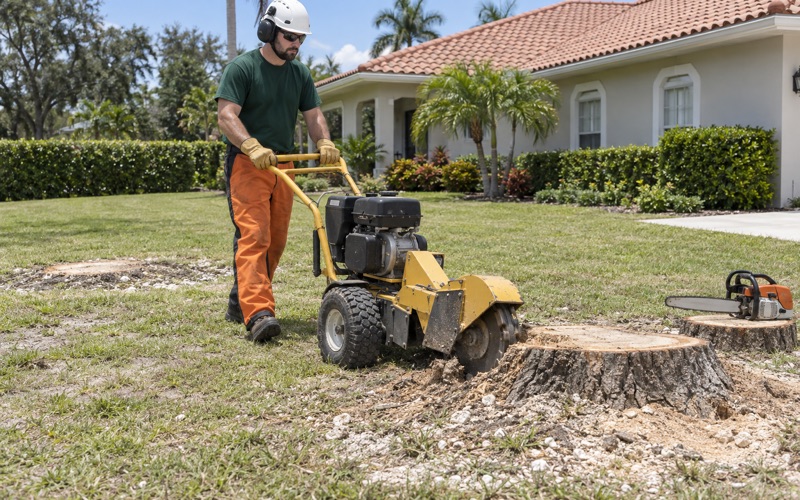
That is the whole access problem in one map unit. Twenty years on this coast have taught us that the water table, not any hardpan, is what stops a stump grinder most months, and on hydric ground inside a permitted wetland system the rutting is a compliance question before it is an equipment question. Machines get matched to the approach: a narrow grinder where the gate is narrow, a spider lift or a grapple saw truck where tracking a bucket over soft ground would leave a mark somebody has to report.
What runs under a permitted landscape
Electric service is Florida Power & Light, and the master plan establishes easements for FPL underground cables coordinated with other utilities, with distribution developed in continuous loops for reliability. Potable water and sanitary sewer come from Lee County Utilities under a formal service agreement, while chilled water is produced on campus at a central energy plant in the South Village District.
Underground primary electric, chilled-water mains and a permitted surface water management system in the same ground make a locate ticket a real piece of work rather than a formality. Stump grinding gets planned around all three, including where a below-grade cut is safe to take and where the honest recommendation is to leave the stump and grind another day.
Who buys tree work at this address, and what they buy
109 housing units, every one of them rented
This place holds 4,836 people, and 4,376 of them, just over 90 percent, live in group quarters that are counted as population but not as housing. The housing that does exist comes to 109 occupied units, every one of them renter-occupied, with zero owner-occupied units and nothing vacant. Even the 38 detached units here are rented.
So there is no homeowner customer on this ground, and a page that addressed one would be false in a way anyone can check in a single lookup. The decision-maker is institutional, which is why we itemize hauling and disposal on their own line of an estimate: the gate rate for horticultural waste changes at every county line we cross, and a facilities office needs that number separated rather than buried.
Exotic removal rather than curb appeal
The vocabulary that fits this ground is exotic removal, invasive control, preserve delineation and permitted mitigation. Campus policy directs the preservation and restoration of wetland areas and upland buffer areas by removing exotic vegetation and keeping those areas free of exotic infestation, and states the intent to remove from campus grounds all non-native or invasive plants flagged as noxious weeds or prohibited plants by the state. Brazilian pepper, melaleuca and Old World climbing fern are the named targets.
Two consequences follow for anyone working here. Restoration and enhancement plantings are to be native species, so a replacement is not a free choice; and preservation and restoration areas are to be marked clearly by signage or other physical indicators, which makes them the last place on this ground to stage chips or leave a brush pile. The plan’s own stormwater guidance names the regular collection and proper disposal of yard debris in the same breath.
Storm season, and the forecast zone this address actually sits in
A point query for this campus returns public forecast zone FLZ265, Inland Lee, which is also its fire weather zone, under the Tampa Bay Area office at Ruskin. Coastal Lee is a separate zone, FLZ165, and the line runs between this ground and the communities a short drive west, so a wind advisory or a red flag warning can be issued for one and not the other. Quoting the coastal product at this address is quoting the wrong document.
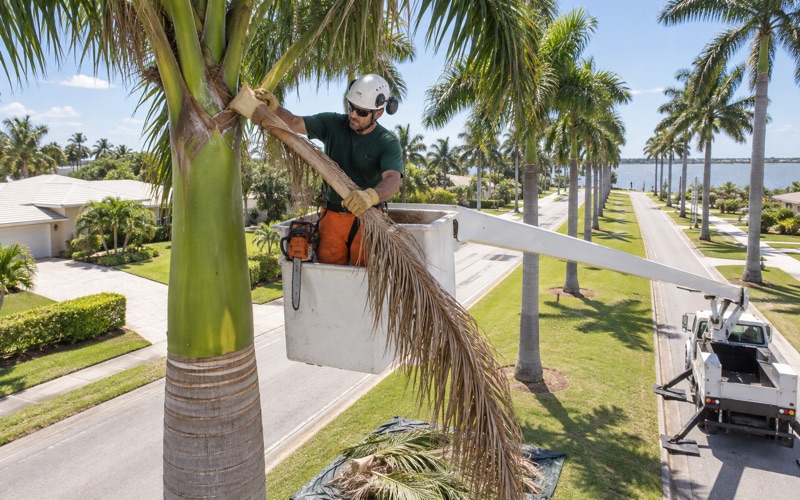
We sell hurricane preparation before the season rather than promising it during one, because nobody cuts trees in a hundred-knot wind. Topping, hat racking and so-called hurricane cuts are refused here on hardwoods and on palms alike, however the job is asked for, and palms are quoted as palms: no branch collar, no cambium, one growing point, and a trunk that will never thicken again once it is damaged.
- 20+ Years on This Coast
- Written Condition Reports
- Four Counties Covered