Fort Myers Tree Removal Pros has handled tree removal in Fort Myers Beach for more than twenty years, and the first thing we tell a caller from this island is that the address answers to a tree code of its own. Fort Myers Beach is an incorporated town with its own Land Development Code, and the tree article inside it is not Lee County’s.
That distinction is most of the planning work here. We run one service map across four counties and four separate tree-permit regimes, and the only version of that conversation worth having is a straight account of which one your particular address sits under, rather than a general answer about Southwest Florida.
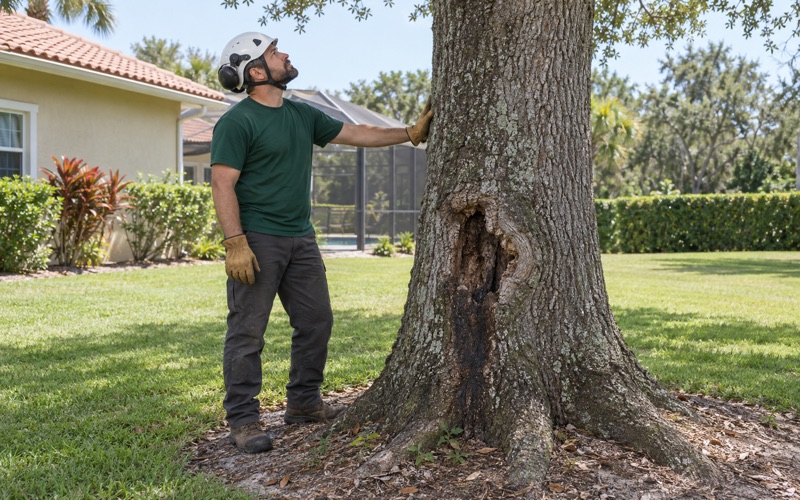
Before a saw leaves the truck we put the reasoning in writing: a dated condition report on any tree we recommend removing, worded so a town reviewer can follow it as easily as you can. Florida issues no tree or arborist contractor license at all, so we tell you that plainly instead of implying one exists. When the honest answer is that the tree should stay, the report says so, and prices pruning to ANSI A300 or a cable instead.
The town’s tree article, and the switch built into it
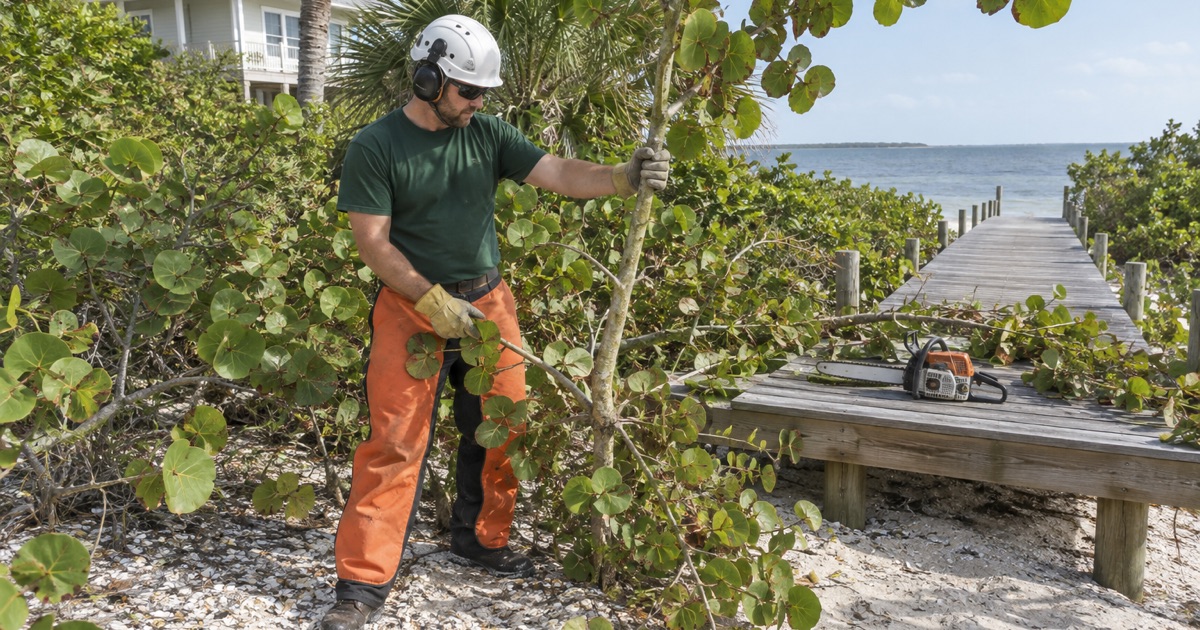
The Town of Fort Myers Beach keeps its tree rules in Chapter 14, Article V of its Land Development Code, running from section 14-371 through 14-384, with the permit sections at 14-411 and 14-412. Two features of that article change how a removal gets planned here, and both of them catch out crews who have only worked under county rules.
Thirty days, at the director’s discretion
Section 14-378, suspension of article during emergency conditions, lets the director suspend enforcement of the tree article for a period of 30 days upon the declaration of a state of emergency under Florida Statutes chapter 252, to expedite the removal of damaged and destroyed trees.
Read the permissive wording. The suspension is discretionary rather than automatic, and no crew gets to assume it is running. We name the mechanism when a storm is on the board, then check whether the director has actually invoked it, because guessing wrong means unpermitted work on a protected tree.
Section 14-377 means two different things
The Town article’s section 14-377 is titled Indigenous vegetation. In the Lee County Land Development Code, section 14-377 is Exemptions from article: same chapter number, same article title, two governments, two entirely different provisions.
So we name the code every time we name a number. A quote or a permit narrative that cites 14-377 without saying whose 14-377 it is tells a reviewer nothing, and on a barrier island the wrong one points at exactly the vegetation the job was supposed to leave alone.
What the town counts as a tree
The Town’s own vegetation removal permit application sets the threshold: a tree is a living, woody, self-supporting plant ten feet or more in height, with one or more well-defined main stems or trunks, and any one stem or trunk four inches in diameter at breast height, measured 54 inches above natural grade.
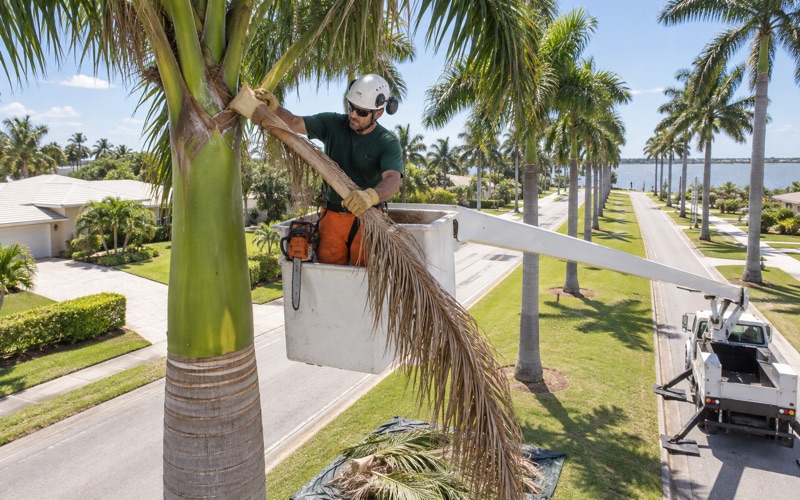
Section 14-374 then declares the palms listed at 14-380(c), among them cabbage palm, coconut, Florida royal and silver palm, to be trees for the article’s purposes. We quote palms as palms regardless, with no branch collar, no cambium, one growing point and a trunk that will never thicken again, but here the permit question is answered by a list rather than by botany.
Looking for tree-removal closer to Alva? See Alva Tree-Removal.
Three protected trees a year, and the edges of that allowance
Past that list, the question becomes how many. The Town’s process carries published thresholds: three protected trees or fewer draws an on-site examination by the director’s designee in place of a tree location map, while more than five requires an approved site plan before any permit issues, and a requested site inspection happens within seven to ten working days.
The single-family allowance
Section 14-382(c) states that no permit is required for the removal of up to three protected trees during any one-year period on a lot that is being used lawfully as a single-family residence or mobile home. Section 14-376(a)(5) says the same for subdivided lots, and sends vacant lots and lots whose building is being replaced back to 14-382(c).
The allowance runs per lot per year, not per job, so we ask what has already come down in the past twelve months before we scope anything. Section 14-380(b) covers the other direction: species not named on the protected list may be removed without a permit, provided the work does not disturb surrounding protected trees or protected indigenous vegetation.
The register that takes the allowance back
Section 14-376(b) withdraws the exemptions for one class of tree. Exemptions (1), (3), (4) and (5) do not apply to any tree cited in the Florida champion tree register, Big Trees: The Florida Register, published by the Florida Native Plant Society or its successor.
That is a named register with a named publisher, and it removes the exemption from a rights-of-way crew, a utility crew, a surveyor and a homeowner alike. Checking a specimen live oak or gumbo limbo against it takes minutes, and the only wrong time to run that check is after the fact.
Dead, damaged, hazardous: the conjunctions decide
The damaged-tree exemption at section 14-376(a)(2) is narrower than it sounds. It covers a protected tree that is dead, or that has been destroyed or damaged by natural causes beyond saving, or that is a hazard as the result of an act of God and constitutes an immediate peril to life and property.
Dead stands on its own. Damaged does not, because it has to be damaged beyond saving, and hazardous does not either, because the hazard has to arise from an act of God and be an immediate peril at the same time. That is where a dated report and the ISA Best Management Practices Tree Risk Assessment, Second Edition 2017, do real work rather than decorative work.
What a mistake costs, and what protects the trees that stay
Two more of this article’s numbers belong in the bid rather than in a reviewer’s file. One protects the trees left standing while work goes on around them, and the other prices what happens when a protected tree comes down without a permit.
Barriers in feet, and hand labor inside them
Section 14-383(a) requires protected trees to be marked and barriers erected before land clearing: at or greater than a six-foot radius around all species of mangroves and protected cabbage palms, the full dripline of protected native pines, and two-thirds of the dripline of all other protected species. Section 14-374 defines that barrier as a structure at least three feet high, built of lumber no smaller than one inch by one inch.
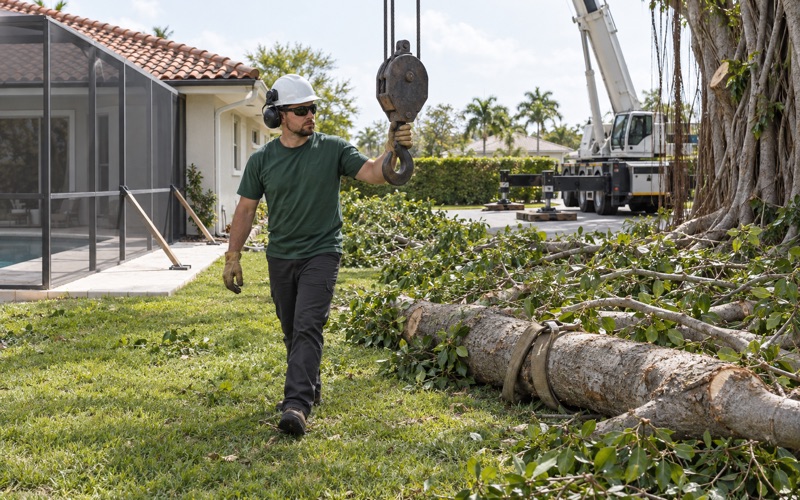
Inside it, section 14-383(e) requires landscaping work to be done with hand labor, and 14-383(d) prohibits unnecessary fire or burning within 30 feet of a protected tree’s dripline. The Town’s application adds that barricades must be in place at inspection, with a re-inspection fee of sixty dollars if they are not. It is also why we match machines to the gate, a thirty-five inch grinder down a side yard or a crane pick over a screen cage, rather than to the tree alone.
Three for one, at six feet, nursery grown
Section 14-384(a)(1)a. computes restoration stock on a three for one basis against the total number of unlawfully removed trees, and requires the replacements to be nursery grown, containerized and no less than six feet in height. Section 14-384(a)(2) adds a guaranteed 80 percent survivability for no less than five years, plus a five-year maintenance provision to control invading exotics.
Section 14-375(b) makes the arithmetic worse, since each tree removed without a permit is a separate offense, and 14-384(a)(5) raises a presumption that unidentifiable removals were of a similar species and mix to those on adjacent properties. There is no inexpensive version of an unpermitted removal on this island.
Mangroves, and where the permit actually comes from
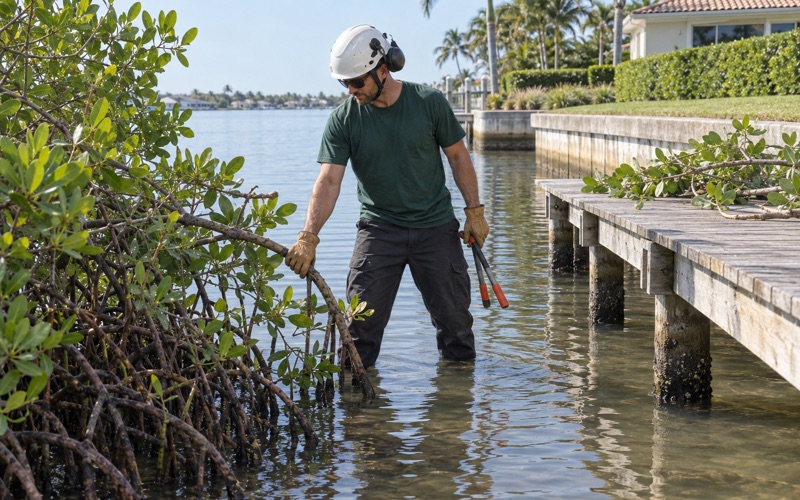
Chapter 14, Article VI, sections 14-451 through 14-456, is titled Mangrove Enforcement, and its stated purpose is to establish enforcement procedures and restoration standards for violations of the state Department of Environmental Protection’s mangrove protection rules, supplementing that department’s own enforcement mechanisms. Section 14-455 points the permit itself at the state department, not at Town Hall.
The Town’s side is the consequence. Section 14-453(c) makes each mangrove altered a separate violation, and 14-454(b)(1) sets three replacement mangroves for each one altered, container grown, at least a year old, 24 inches tall and planted three feet on center. Mangrove work on this island runs through the state program under the Mangrove Trimming and Preservation Act, and that is where we route it.
The seaward side, the storm record, and the ground underneath
The seaward edge of a Fort Myers Beach property answers to more than the tree article. Two other articles of the same chapter reach vegetation directly, and the storm record adds a set of published numbers that get misquoted more often than they get read.
Dune vegetation is a separate body of law
Section 14-3(a) makes it unlawful, on a beach, upon a dune or in the water adjacent to a beach, to plant vegetation other than dune vegetation, or to destroy or harm a dune or remove dune vegetation. The dune vegetation defined at section 14-1 includes sea oats, saw palmetto, seagrape, cabbage palm, cocoplum, green buttonwood and southern wax myrtle.
The overlap is what has to be planned around, because a seagrape or a cabbage palm on the seaward side can sit under the tree article and the beach and dune article at the same time. Article II adds a sea turtle nesting season of May 1 through October 31, with lighting and equipment restrictions that decide when a machine can stage rather than whether the tree comes out.
What the storm record publishes, and what it does not
The National Hurricane Center’s tropical cyclone report for Hurricane Ian publishes inundation of 10 to 15 feet above ground level on Fort Myers Beach and Estero Island from the September 28, 2022 landfall. FEMA’s release of May 18, 2023 for DR-4673-FL reimbursed $6,230,192 for debris removal in Fort Myers Beach, itemizing 81,303 cubic yards of construction and demolition debris against 3,819 cubic yards of vegetative debris collected from roads and public property.
Neither report carries a canopy-mortality figure, so we do not quote one. What those numbers do support is the shape of that cleanup, and what we still watch for on a tree that came through it: storm surge salt inundation and delayed post-storm mortality, assessed on a schedule, with hurricane work sold before the season rather than promised during it.
The ground, the haul, and the question we will not answer for you
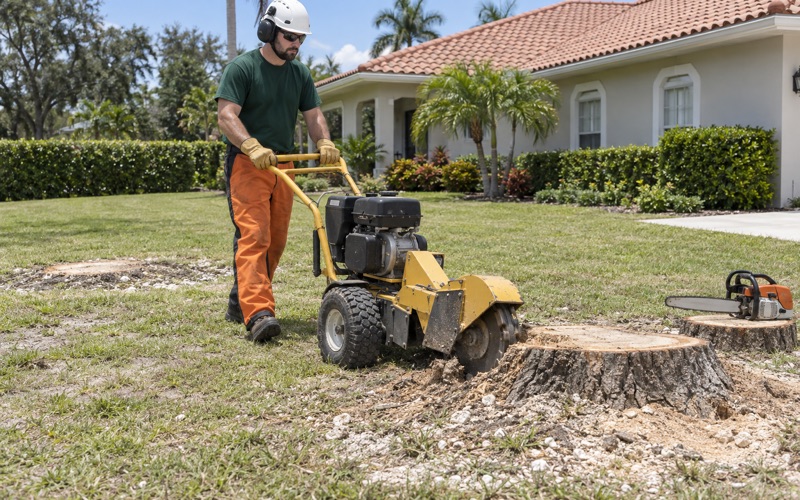
What stops a stump grinder here is not rock. It is a seasonal high water table sitting close to grade for much of the year, and sand and shell that give a root plate almost no purchase, so the depth of the below-grade cut gets decided at the hole rather than over the phone.
There is no disposal gate of any kind on Estero Island, so every load crosses the bridge and hauling and disposal sit on their own line of the estimate, at the horticultural waste gate rate of whichever county receives it. One more line we will not guess at: the Town’s 50 percent rule guidance is written about buildings, and it does not settle whether ordinary site work such as a tree removal enters that cumulative figure, which makes it a question for the Town’s Building Services rather than for us.
- 20+ Years on This Coast
- Written Condition Reports
- Four Counties Covered