Fort Myers Tree Removal Pros has worked tree-removal in Immokalee for more than twenty years, and the first thing we settle on a call from here is not the tree. It is the map. Our service area crosses four counties and four separate tree-permit regimes, and the useful first answer is which one your address actually sits under.
In this community that question has an unusual answer, because part of the planning area is not under county land-use law at all. Getting it wrong costs a fee, a rejected submittal, or a crew standing on ground the county has no say over and never did.
So we settle the authority before we price the saw work. What follows is how removal actually runs here: who signs off, what the permit costs by the acre, the obligation the county never lifts, and where the material goes once the trunk is down.
Land inside the planning area that the county code does not reach
This is an unincorporated community: no city hall, no mayor, no municipal tree ordinance. The Collier County Land Development Code and the Growth Management Plan are the land-use law here, except across one boundary the county draws on its own map and then steps back from.
The Seminole Reservation sits outside the county’s code
Collier County’s adopted master plan states that the Seminole Reservation within Immokalee comprises approximately 600 acres of largely undeveloped land owned by the Seminole Tribal Council, on the east side of First Street south of SR 29. It is not controlled or regulated by the Growth Management Plan or the Land Development Code, and appears on the Future Land Use Map for illustrative purposes only.
That land was signed into federal trust for the Tribe in 1989. A county vegetation removal permit does not reach it and county code enforcement does not either, so work there is authorized through the Tribe rather than at a county permit counter.
Everywhere else, a plan written for this place alone
Off the reservation this is ordinary unincorporated Collier County under Ordinance 04-41, as amended. The county has treated the community as its own planning problem for decades: a local planning commission formed in 1965, separate zoning and subdivision regulations until 1982, and the first Immokalee Area Master Plan adopted as a comprehensive plan element in 1991.
That plan is still live, most recently amended by Ordinance 2023-58, adopted November 14, 2023. It defines the urban area, its land use districts and four named overlays and features, which is why a rule that holds three miles away may not hold on a given street.
Fire protection crosses the boundary by contract
The Immokalee Fire Control District was created in 1955 by Chapter 1955-30666, Laws of Florida, and is governed by five elected commissioners. It covers 234 square miles from three stations, with apparatus that includes brush trucks, and it provides contract fire protection to the Tribe’s reservation and casino inside its boundaries.
The district is classified under NFPA standards as a combination of urban, suburban and rural demand zones. Outside the urban core that means rural response times, which is why we will not leave a compromised stem standing overnight beside an occupied structure.
Looking for tree-removal closer to North Fort Myers? See Tree-Removal in North Fort Myers.
A vegetation permit priced by the acre, not by the tree
Removal of protected vegetation off the reservation runs through a Collier County vegetation removal permit, under Land Development Code sections 3.05.01 through 3.05.05 and Chapter 4 E.4 of the county Administrative Code. The fee is not charged per tree, which surprises the one-tree caller and the five-acre owner in opposite directions.
What it costs, and what the submittal asks for
The county charges $250.00 up to the first acre and $50.00 per acre for each additional acre or fraction of one, to a maximum of $3,000.00. One tree and one acre cost the same at the counter, and a large parcel stops getting more expensive once the cap is reached.
The submittal wants an aerial photograph with a generalized vegetation inventory, and a site plan showing the location and species of all protected vegetation. Large stands of a single species, such as cypress heads, may be indicated as a group with an approximate number or area.
Where state law preempts the permit, and who it leaves out
Florida Statutes section 163.045 preempts that permit, and any notice, application, approval, fee or mitigation requirement, when the owner holds signed documentation from an ISA-certified arborist or a Florida licensed landscape architect that the tree presents an unacceptable risk. The statute confines itself to a single-family, detached building on a lot actively used for single-family residential purposes.
Here that limit does real work. Mobile homes are 21.1% of housing units, renter-occupied units outnumber owner-occupied ones, and approximately one-half of the urban area is zoned and actively used for agriculture. Rental parcels, mobile homes, farmed ground and vacant lots all sit outside the statute.
The report we write before the saw comes out
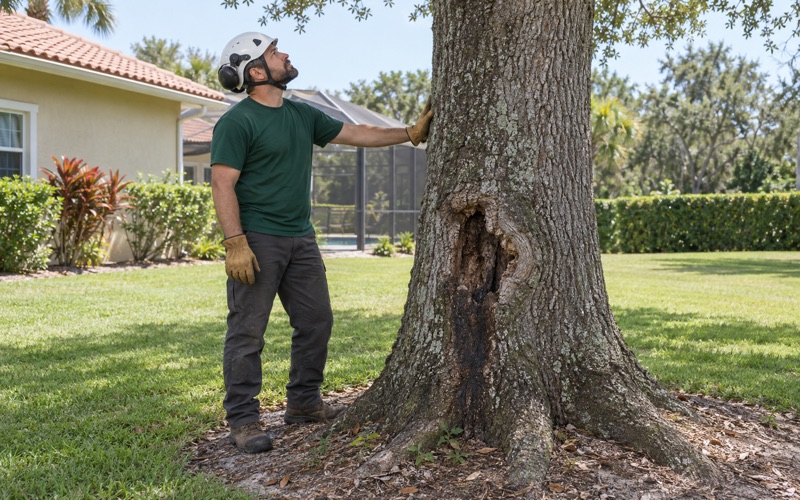
Any tree we recommend removing gets a written, dated condition report first, worked against the ISA Best Management Practices Tree Risk Assessment, Second Edition 2017, with diameter at breast height and the observed defect recorded. That document is what a section 163.045 claim stands on where the parcel qualifies.
Florida issues no tree or arborist contractor license at all, and we say so plainly rather than implying one. The same report is where we tell you a tree should stay, and what directional pruning to ANSI A300 or a cable would cost instead of a removal.
Exotic removal is an obligation held in perpetuity
Collier County does not treat prohibited exotic vegetation as a job that finishes. The code requires its removal in perpetuity, and it requires a written plan for keeping the ground clear, which changes what an honest clearing quote covers here.
A maintenance plan, implemented yearly at a minimum
The code requires a maintenance plan describing specific techniques to prevent reinvasion in perpetuity, submitted before the local development order is issued and implemented on a yearly basis at a minimum. That is an obligation attached to the land, not a line on one invoice.
We quote the initial clearing and the recurring return separately so neither is mistaken for the other. Previously farmed and disturbed ground reinvades fastest, and a parcel cleared once and left alone will not read as compliant a year later.
Mechanical clearing carries three conditions
Under section 3.05.05 E an owner may clear exotic vegetation by mechanical means, such as a bush hog or bobcat, only where the work will not damage the root zone within the drip line of native trees and other vegetation, will not affect listed species on the property, and will not result in wetland impacts.
The species pressing hardest on this ground are Brazilian pepper, melaleuca, Australian pine and earleaf acacia, and they crowd in exactly where equipment is easiest to run. Hand work under a slash pine or laurel oak canopy is slower, and it goes on the estimate as its own line.
Wetland ground inside the Lake Trafford overlay
The master plan’s Lake Trafford and Camp Keais Strand System Overlay identifies wetlands that require greater protection measures than wetlands elsewhere in the Immokalee Urban Designated Area. Essential services inside it are limited to those needed for public safety and those serving permitted uses, including private wells and septic tanks.
Those additional protections do not apply to land inside the overlay that had been legally cleared of native vegetation as of the plan’s adoption, but they do apply to all new development and redevelopment. Whether a parcel falls inside it changes the answer before anything is priced.
The ground, the wires, and where the material goes
Two site conditions decide most of what a crew can do here, and neither shows from the road: how much water is sitting in the sand under the root plate, and what is strung over the work area. A third sets the price, which is the gate the debris passes through. Collier’s storm-debris program excludes agricultural land, lot clearing and vacant lots outright, so across much of this map it is not an option at all.
Sand, a spodic horizon, and a water table in the root zone
The Immokalee series, the USDA soil series that carries this community’s name, is a sandy, siliceous, hyperthermic Arenic Alaquod: dark fine sand over a thick gray to white sand horizon, with the spodic horizon 76 to 127 centimeters down and loamy fine sand below it. No limestone appears in that profile. The series takes its name from this community, though its type location is in Okeechobee County.
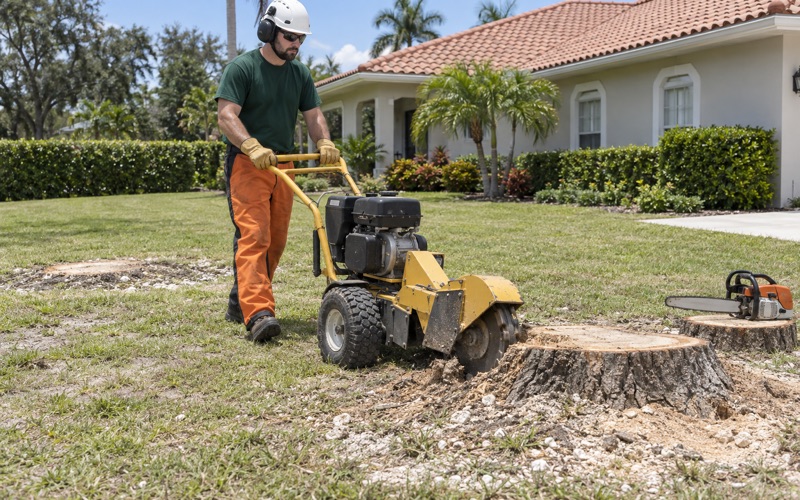
The seasonal high water table sits 15 to 46 centimeters below the surface for one to four months of the year, and drops below 60 inches only in dry periods. That water, not any hardpan, is what stops a stump grinder most months. Root plates here tip in saturated sand rather than shear over rock, and we match the machine to the gate rather than to whatever is already on the trailer.
Only line clearance qualified arborists work near the lines
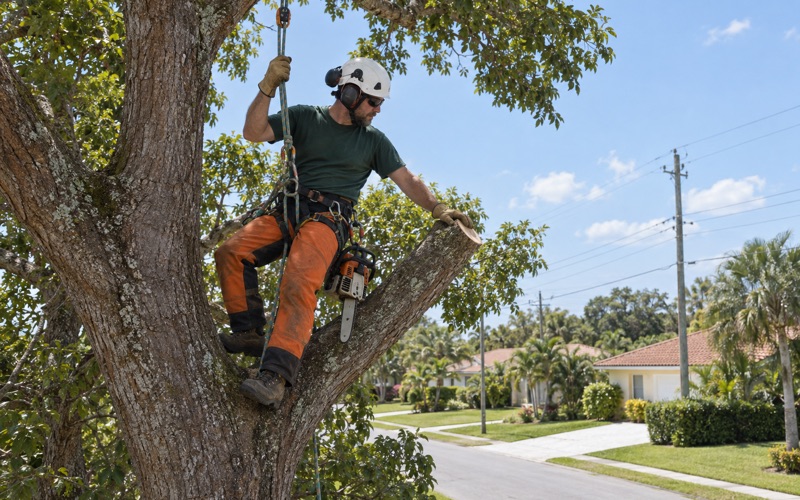
Electric service here is Lee County Electric Cooperative, which names this community in its own service list. LCEC states that per OSHA and ANSI standards, only line clearance qualified arborists may work within ten feet of electric lines, and it offers a free site visit and consultation before private tree work inside that envelope.
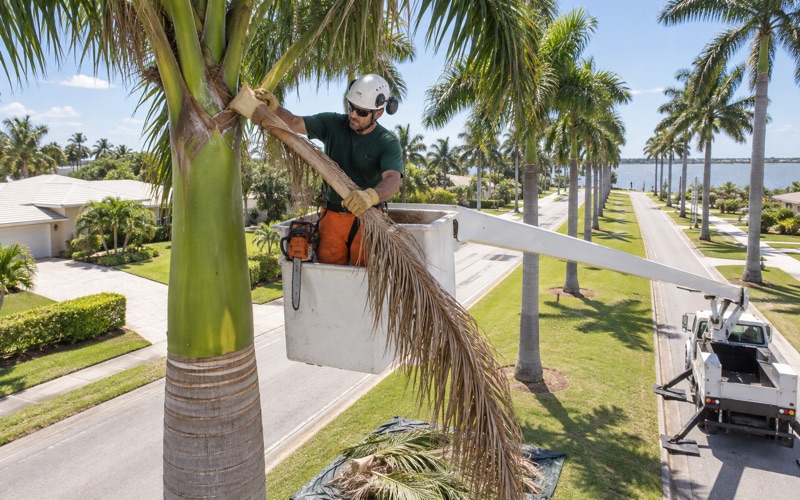
LCEC does not maintain trees off the customer service drop, and on rented and mobile-home parcels that drop is often the only wire between a tree and the meter. We work to ANSI Z133 around it, and we will not hat rack a canopy to buy clearance, on hardwoods or on palms.
The transfer station gate, and material that cannot leave
Disposal runs through the Immokalee Transfer Station at 700 Stockade Road, one of only two Collier County facilities that accepts commercial yard waste. The horticultural waste gate rate is $57.50 per ton commercial and $55.75 per ton residential, and mixed loads of biomass with other waste are refused. Hauling and disposal carry their own line on our estimate, because that rate changes at every county line we cross.
Curbside collection is a household program and no whole tree fits it: bundles under 4 feet, under 50 pounds, and no branch larger than 4 inches. Citrus is its own question, since fruit, trees and plant material inside a residential citrus black spot quarantine area may not be moved outside it, though nothing the state publishes requires removing a residential citrus tree.
- 20+ Years on This Coast
- Written Condition Reports
- Four Counties Covered