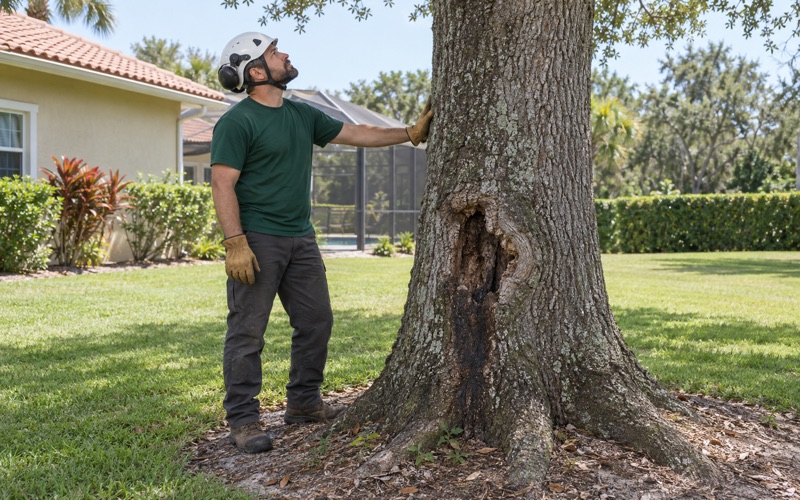
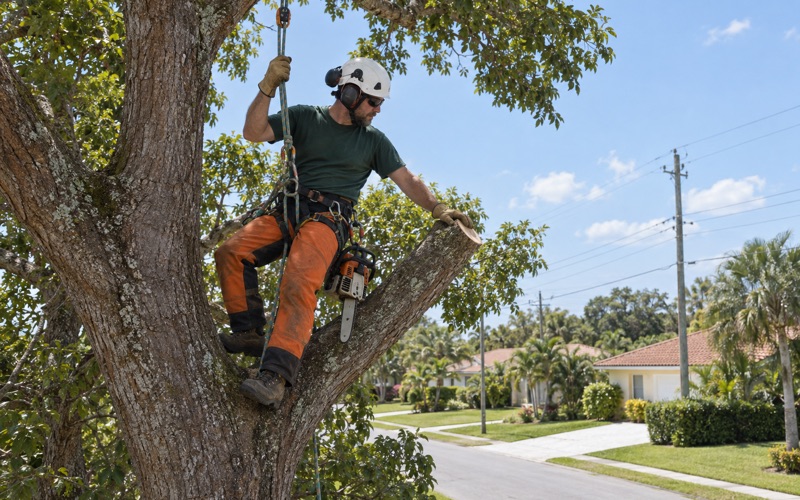
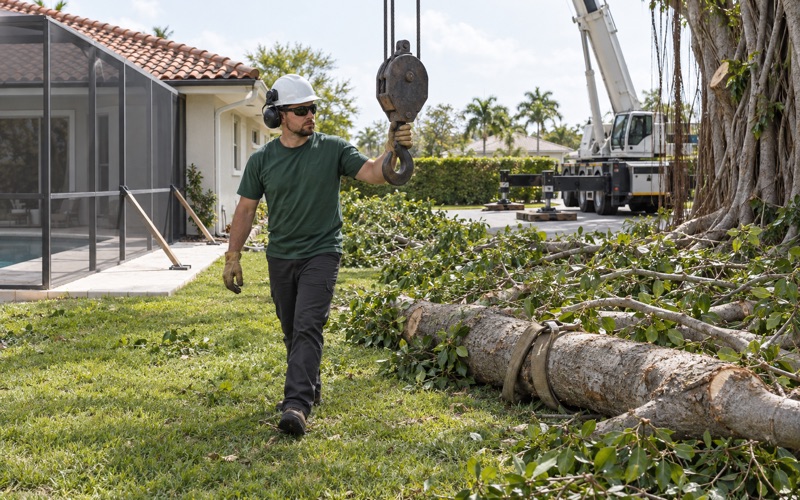
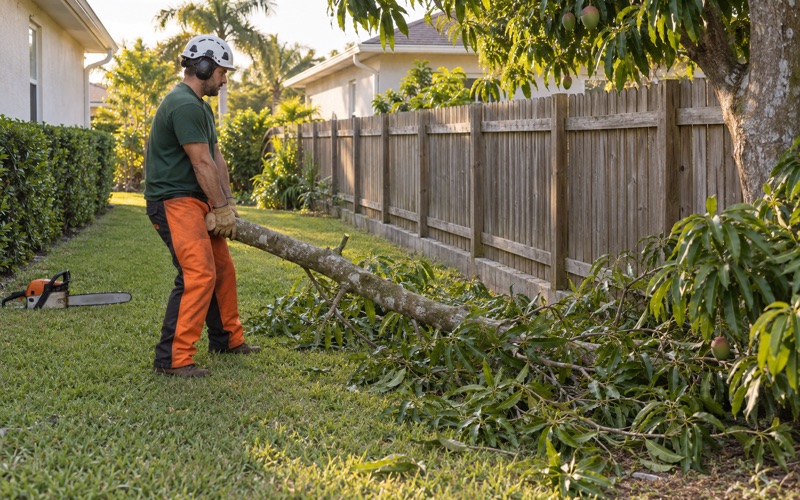
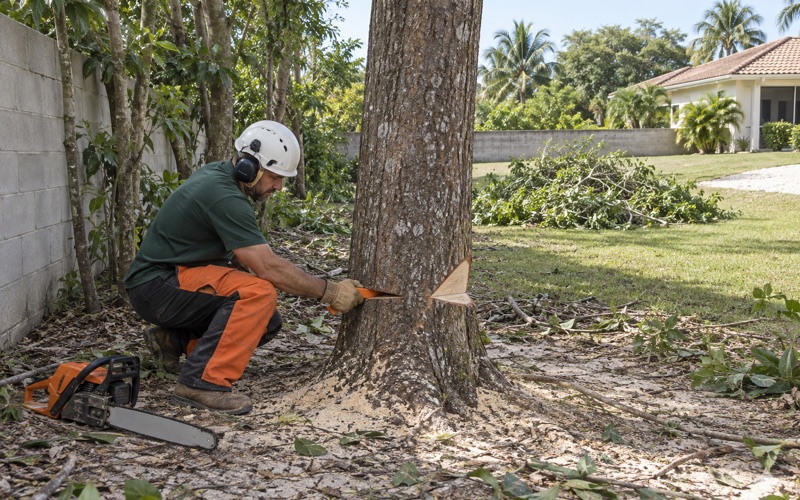
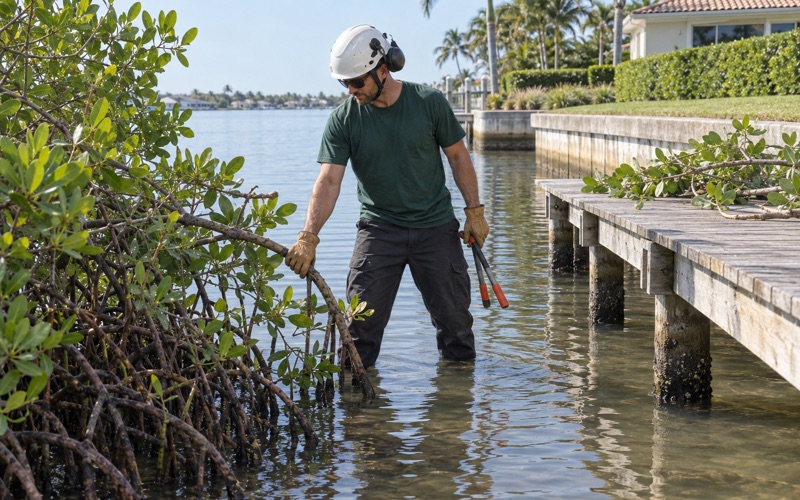
Fort Myers Tree Removal Pros has handled tree removal in LaBelle for more than twenty years, and the first thing we tell a caller here is that this city writes its own tree law. A removal that is a phone call and a morning’s work a few miles out of town becomes, inside the city limits, a permit file with a named officer on top of it.
Our service map covers four counties and four different tree-permit regimes, and we would rather spend ten minutes telling you plainly which one your parcel answers to than quote work we cannot lawfully start. LaBelle is incorporated, and that single fact decides the question here.
Before any saw comes out we put a written, dated condition report in your hands, so the reasoning for a removal exists on paper before the tree is gone. Florida issues no tree or arborist contractor license at all, so there is no state credential for us to wave at you. What we carry is ISA certification, general liability, workers’ compensation, and crews that work to ANSI Z133.
An ordinance about oaks, and nothing but oaks
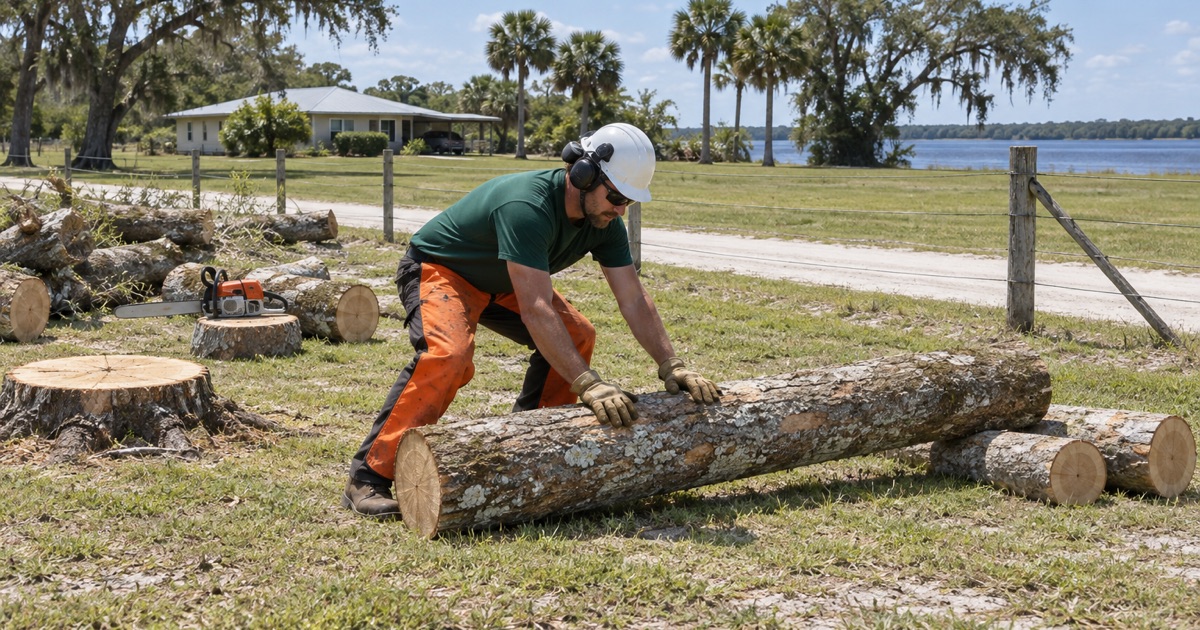
Most towns that regulate trees regulate trees generally; LaBelle does not. Its protection runs to a single genus, it names the three species it means, and it fits in one section of the Land Development Code.
Ordinance No. 2021-01 and section 4-80.16
The City Commission adopted Ordinance No. 2021-01 on 11 March 2021, amending Chapter 4 of the Land Development Code to create Section 4-80.16, Tree protection. Section 4-80.16.4 carries the operative line: a significant oak tree may not be removed or relocated without a tree removal permit.
Section 4-80.16.2 settles the question a homeowner asks next. The section applies to all development and redevelopment of land within the city, including the development and redevelopment of single-family dwellings on existing lots of record. The single-family track has its own check box on the city’s application form.
Live oak, laurel oak, water oak, and everything else on the lot
Section 4-80.16.1 names the canopy it protects as the native oak trees commonly known as live oaks, laurel oaks and water oaks, and the required replacement is a live oak specimen. LaBelle calls itself The City Under the Oaks, and the ordinance is that motto written as code.
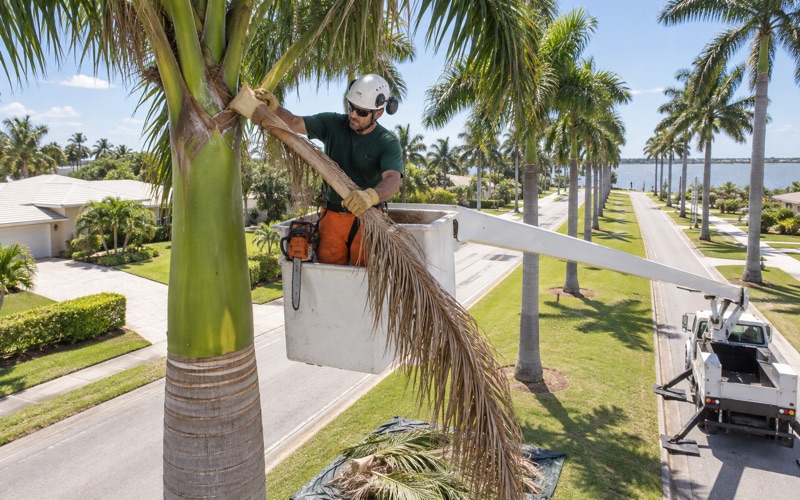
Nothing in the section protects a sabal palmetto, a slash pine, a cypress or an exotic like Brazilian pepper. Palms we quote as palms rather than as small trees: no branch collar, one growing point, and a trunk that will never thicken again. We do not top or hat rack anything here, hardwood or palm, however the job is asked for.
A city parcel and a county parcel are not the same job
Unincorporated Hendry County publishes no tree, vegetation or land clearing application at all. Inside the LaBelle municipal boundary the city’s oak code governs and the county’s code does not, which is the sharpest practical difference on our map. We attribute every rule we quote to the city or to the county, by name.
The boundary also moves. The city annexes unincorporated land, so ground that answered to the county one month can sit under the city’s oak code the next, and we check the jurisdiction as it stands today.
Looking for tree-removal closer to Naples Park? See Tree-Removal in Naples Park.
Two routes to an approved removal
The code offers an applicant two doors, and they are not equivalent in time, cost or paperwork. One is a decision by a single city officer; the other is a hearing in front of the elected commission. We will also tell you when the better answer is to keep the tree, and what directional pruning to ANSI A300 or a cable would cost instead.
Administrative approval by the Superintendent of Public Works
Under Section 4-80.16.4.1 the Superintendent of Public Works, or their assigns, may approve a removal administratively where the oak meets at least one of four criteria, on top of the mitigation the code requires anyway. Three are what you would expect: a safety hazard from structural damage or from the tree’s own health, weakening by disease, age, storm, fire or injury, and disfigurement past a healthy specimen.
The fourth is worth knowing before you call your agent. Removal is a recognized ground for administrative approval where it is required in order to obtain property insurance, with proof in writing. An insurer’s written demand carries weight in this city that it does not carry in most.
Who has to sign the letter
The verification the city wants depends on the claim, and substituting one for the other is how an application stalls. For structural damage, Section 4-80.16.4.1(b)(2) requires written verification from a certified engineer in the State of Florida, sealed by the engineer of record. An arborist’s opinion does not satisfy that line.
For a decline-in-health claim the city’s list is wide: an official horticulturalist with IFAS, a certified horticulturalist, a master gardener, a landscape architect certified in the State of Florida, a certified arborist or an urban forester. That list belongs to the city, not to the state, and a letter written to it is not the documentation Florida Statutes section 163.045 describes.
The commission hearing, and the two exceptions the code lists
Where administrative approval is not available, Section 4-80.16.4.2 lets an applicant apply to the City Commission, which must find that the tree prevents reasonable development of the site, that relief elsewhere in the code is no reasonable alternative, and that mitigation is demonstrated. The city’s own form puts this route at roughly two to three months from start to finish.
Only two exceptions to the permit requirement exist. A dead oak needs no permit, but it is the Superintendent of Public Works or a designee who determines that it is dead, not the homeowner and not us. The second is a waiver of permit issuance for damaged trees, which the mayor or commission must unlock by declaring a state of emergency and which expires when they decide the emergency has ended. Storm damage is not a standing exemption here.
What mitigation and filing actually cost
Two numbers decide most LaBelle removals, and neither is the price of the cut. The first is what the replacement oak must be on the day it goes in the ground; the second is the adopted fee schedule, which treats a homeowner and a developer very differently.
The replacement tree has a size at planting
Section 4-80.16.5 is specific. The replacement must be a live oak specimen, and at the time of planting it must stand at minimum ten feet tall, carry a four-foot spread and a four-inch caliper, measured at breast height. It must be balled and burlapped, tree spaded or containerized, and set in approximately the same location unless that would be unreasonable.
Approved removals are replaced on an inch-for-inch basis, measured as diameter at breast height, so a twenty-four inch oak means six of those four-inch live oaks. Where an applicant proposes payment in lieu of replanting, the commission has to approve it, and the code sets the mitigation fee at $150 per inch of significant oak removed, which is $3,600 on that same tree.
A fee ladder that runs from nothing to five thousand dollars
Resolution No. 2024-02 sets the adopted schedule. Under Significant Tree Removal/Replacement it lists a single-family residential lot at no fee, an administrative application at $500, a public hearing application at $1,000, and a public-private partnership application on city-owned property at $5,000 as a deposit only.
Anything requiring a public hearing also carries an advertisement fee invoiced by the city, and the form states the applicant is responsible for all expenses for advertisements and outside consultants. The break a homeowner gets is on the filing fee, not on the application and not on the mitigation.
The file stays open after the tree is planted
Section 4-80.16.5 has the Superintendent of Public Works or a designee inspect the property once mitigation planting is complete, reinspect approximately one month later, and then return at four-month intervals to confirm compliance. A crew that drops replacement oaks in the ground has not closed the file.
Section 4-80.16.6 also bars attachments or wires other than those of a protective and nondamaging nature on any tree, not only on a significant oak. A violation is declared a public nuisance, with a corrective window of not less than ten and not more than thirty days.
What changes about the work at a LaBelle address
Past the permit, three things about this town change how we price and stage a job: an unresolved question in state law, ground that is wet in the months the oaks are least stable, and a disposal gate we pass through at cost. All three appear on the estimate.
The city code and Florida Statutes section 163.045
Florida Statutes section 163.045 bars a local government from requiring a notice, application, permit, fee or mitigation to prune, trim or remove a tree on residential property where the owner holds signed documentation that the tree poses an unacceptable risk. That means an onsite assessment performed to the ISA Best Management Practices, Tree Risk Assessment, Second Edition (2017), by an ISA-certified arborist or a Florida licensed landscape architect.
The city’s tree code contains no reference to section 163.045, no use of the phrase unacceptable risk, and no exemption keyed to that documentation. It was adopted in March 2021, before the statute’s 2022 amendment, and Section 4-80.16.2 affirmatively extends it to single-family dwellings on existing lots of record. The accommodation the city has published is the fee waiver, not a permit exemption, and we tell you what each document says rather than picking a side.
The statute also does not reach everyone. It defines residential property as a single-family detached building on a lot actively used for single-family residential purposes, and a manufactured home is not that, which matters in a town where roughly one owner-occupier in three lives in one. Those lots change the staging too: carports, awnings, screen rooms and at-grade hookups decide where an outrigger or a crane mat can sit.
Wet sand, not hardpan, is what stops the grinder
The soil series mapped through these flatwoods carry a seasonal high water table close to the surface. Felda sits within twelve inches of the surface for two to six months in most years; Riviera sits within ten inches for two to four. The restrictive clay horizon in both begins well below two feet.
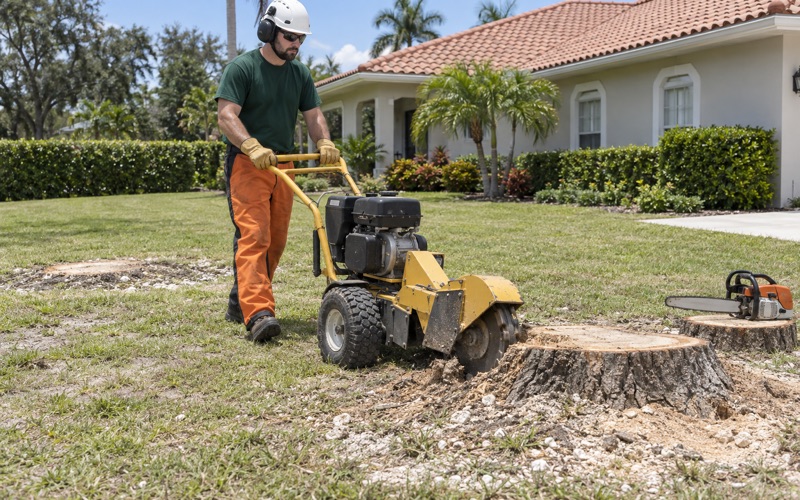
Set that against a stump grinder’s below-grade cut of roughly twelve to twenty-five inches and the arithmetic is plain. The hard layer sits under the wheel’s reach, so it is not what stops us; the water table is inside it. We cut wet sand much of the year, and those are the months when a mature oak’s root plate has the least holding.
Hauling, and the gate the debris goes through
The city’s contractor collects residential waste once a week and horticultural waste twice a month, plus up to two cubic yards of construction and demolition debris. Two cubic yards is not a tree, and twice a month is not the cadence a removal runs on. Nothing from an oak removal leaves on your curb.
It goes instead through the LaBelle Transfer Station at 1280 Forestry Division Road, inside the city and operated by Lee County Solid Waste, where the current card prices commercial horticulture at $48.92 per ton with a $15.00 minimum charge. Hauling and disposal sit on their own line of our estimate, because the horticultural waste gate rate changes at every county line we cross.
- 20+ Years on This Coast
- Written Condition Reports
- Four Counties Covered