
Land and lot clearing has been part of what Fort Myers Tree Removal Pros does for twenty-plus years in Fort Myers, FL, along with the surrounding cities on our map including North Fort Myers, Cypress Lake, Cape Coral, Florida Gulf Coast University and Lehigh Acres. That ranges from a quarter-acre infill lot with thirty years of volunteer growth on it to acreage being prepared for a build, plus the selective clearing that leaves specific trees standing.
The reason this work goes wrong locally is jurisdictional rather than mechanical. Clearing a parcel is frequently a different application from removing a tree, drawn by lot size and location instead of tree count, and the four counties we cross answer the question in four different ways. One county publishes no vegetation application at all; another prohibits clearing a lot with no active intention to develop, in those words.
So a clearing estimate from us starts with which code reaches the parcel, what the survey and the walk-through say is protected, and where the material is going. Grubbing, protected species work, debris handling and finish grade are separate lines, because bundling them is how a cleared lot turns out not to be ready for anything.
Lot Clearing Is Its Own Permit
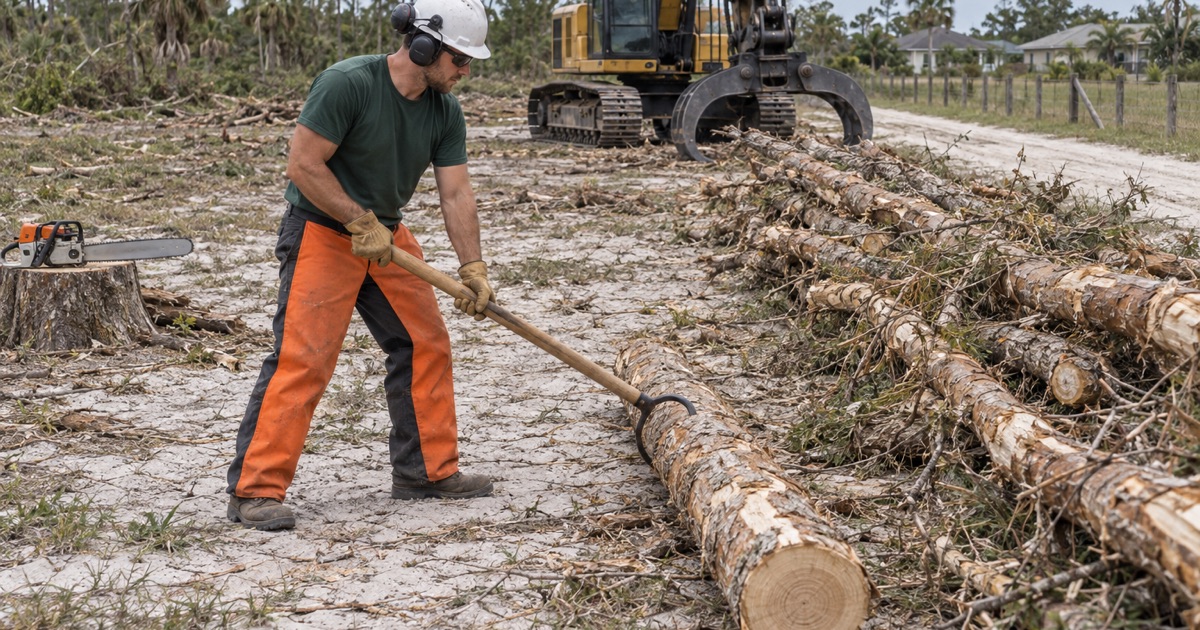
Where Clearing and Tree Removal Split Apart
Removing a tree is a question about that tree; clearing is a question about the parcel, and the codes treat them that way. The statutory route that lets a homeowner remove a hazardous tree reaches a single-family detached building on a lot in active residential use, which a vacant parcel awaiting development is not. Vacant land is the clearest case where the local code governs from the first cut.
Lee County’s Single-Family Clearing Thresholds
Lee County’s clearing categories are drawn by size and location rather than by how much vegetation is standing. Its single-family clearing category is limited to parcels over five acres, two or more acres on Pine Island, or any lot on a barrier island, so an ordinary residential lot is none of those and falls somewhere else in the schedule. Reading that fee schedule carefully is what stops a late surprise.
Speculative Clearing, and Where It Is Prohibited
Charlotte County’s own tree permit brochure names speculative clearing, defined as prepping a lot with no intention to develop, and prohibits it outright. That is unusually direct code language and it changes the sequencing of a project: the development approval comes first, and the clearing follows it. A crew that clears ahead of the paperwork creates a problem the landowner inherits.
What a Cleared Lot Actually Requires
Grubbing, and the Root Diameter That Defines It
Clearing takes the vegetation off; grubbing takes out what is under it. The city’s technical specification for site clearing defines that as all stumps, buried logs, roots larger than an inch and a half, matted roots and organic material, which is a measurable standard rather than an instruction to tidy up. Organic material left in a fill zone settles later, and settlement under a slab is not a cheap correction.
Protected Species and What Has to Stay
Which trees are protected is a code question and a species question at once, and it is cheapest to answer before the site plan is fixed. A protected species assessment can also raise questions about wildlife use of the parcel that nobody wants surfacing at the excavation stage. We flag what looks protected during the walk-through and put it in writing with the rest of the scope.
Trees Kept Through Construction, and Their Root Zones
A tree marked to stay survives the build or it does not, and the deciding factor is usually the root zone rather than the trunk. The city’s own specification is explicit: do not cut roots an inch and a half and larger without approval, keep wheeled and tracked equipment outside the drip line, and backfill exposed roots immediately. Barriers set on day one are what make that possible.
Invasives, Natives and the Species Question
Brazilian Pepper, Melaleuca, Australian Pine, Carrotwood
These four turn up on almost every neglected parcel in this service area, and each comes back if the clearing is superficial. Brazilian pepper resprouts vigorously from cut stumps, melaleuca releases seed when stressed, Australian pine leaves a shallow plate that fails in wind, and carrotwood spreads by fruit. Identifying which is present decides whether one pass will hold.
Native Stock Worth Keeping on a Cleared Lot
Not everything on an overgrown parcel is a liability. Mature slash pine, live oak, gumbo limbo and cabbage palm are frequently worth designing around rather than removing, both for the finished property and because retained canopy can count toward what the local landscape code will otherwise require you to plant. That trade is worth pricing before the machines start.
Mangroves and the Shoreline Edge
Where a parcel runs to open water, the last few feet are governed by a different statute entirely. Mangroves sit outside the state tree preemption on purpose, under the Mangrove Trimming and Preservation Act with its own trimming allowances and its own professional mangrove trimmer program, and in this ring only the City of Sanibel holds delegated state authority over them.
Debris, Machines and Moving the Material
Where the Material Goes, County by County
The three routes are chip and spread on site, haul to a horticultural waste facility, or process for a chip market, and the cost gap between them is large on an acreage job. Charlotte County charges one horticultural waste rate regardless of material and roughly doubles it for loads originating outside the county, so the same trailer prices differently depending on which side of the line the parcel sits.
The Hendry County Franchise Problem
Unincorporated Hendry County treats hauling waste for remuneration or other consideration in any form as a franchise matter under its own ordinance, which reaches the carrying rather than the dumping. It is one of six distinct refusal shapes we have had to work around across these four counties, and it is the reason disposal is quoted per address instead of per cubic yard.
Grade, Water and the Wet Season
Finish grade is easier to hit on dry ground, and this ground is not dry for several months of the year. A water table within six to eighteen inches of the surface means tracked equipment ruts and smears the surface, which costs more to correct than the delay would have. We will tell you when the schedule rather than the scope is the thing to change.
Access and the Machine List
The equipment that can reach the parcel decides the method, and on infill lots the constraint is usually the approach rather than the work area. Where a mulcher or a grapple can get in, the job is fast; where it cannot, the material comes out in smaller loads and the price reflects it. We measure the approach, the turning room and the staging area before quoting anything.
- 20+ Years on This Coast
- Written Condition Reports
- Four Counties Covered