Fort Myers Tree Removal Pros handles tree removal in Lehigh Acres with twenty-plus years on this coast, and the first thing we look at on a job here is usually not the tree. It is where the customer’s ground stops. On a platted Lehigh Acres lot the back strip is frequently not the homeowner’s property at all, which changes who has to agree to the work before a saw starts.
That second land manager is the Lehigh Acres Municipal Services Improvement District, and it is a permitting body rather than a courtesy call. A crew that sets outriggers on that strip, stages a chipper across it, or lays a top down on it is using land the district controls, and the district requires a permit of anyone making use of its lands.
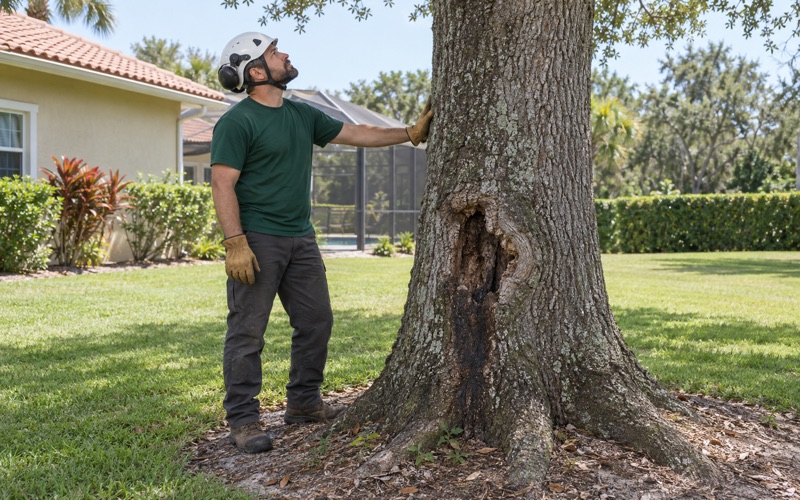
So our estimates read differently here than a few miles away. Hauling and disposal get their own line, we name the authority the address actually answers to, and any tree we recommend removing comes with a written, dated condition report, so the reasoning exists before the saw does. Topping, hat racking and hurricane cuts we refuse, on hardwoods and palms alike.
The district behind your back fence
Lehigh Acres is unincorporated. There is no city hall, no municipal tree ordinance and no city arborist to call, and the land running behind tens of thousands of residential lots belongs to an independent special district rather than to the county or to the person mowing up to it.
Established by the Legislature in 2015
The Lehigh Acres Municipal Services Improvement District was established on June 10, 2015 by the Florida Legislature as the successor to the East County Water Control District, and its territory spans unincorporated Lee County and a portion of Hendry County. Its responsibilities run from drainage and flood control to conservation and mitigation, roads and bridges and parks, and its office sits at 601 East County Lane.
The district describes its rights-of-way as entrusted to it by all that pay assessments to it. That is the plainest available answer to who owns the strip: everyone paying into the district, collectively, and not the household whose fence happens to back onto it.
Nearly all of it borders a residential lot line
The district’s own statement is that nearly all of its rights-of-way border residential property lines, and that it is the resident’s responsibility to be aware of where their property ends and the district’s begins. On most removals here, that makes the far edge of the drop zone a question to answer rather than an assumption to make.
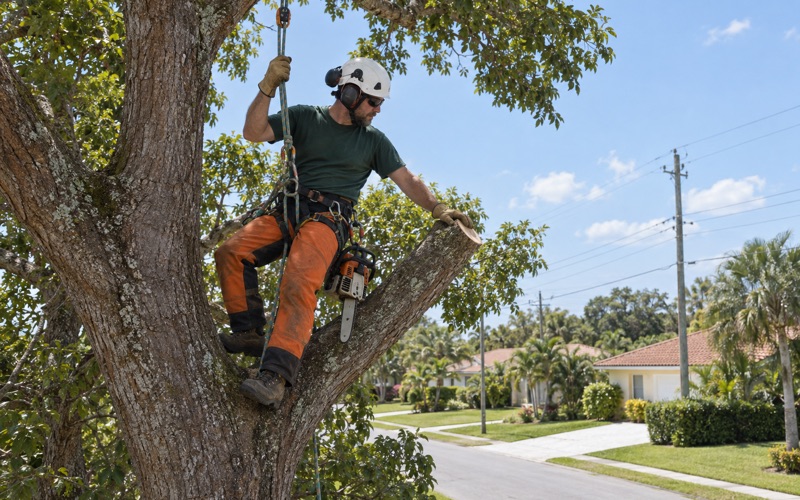
We treat the line as unknown until somebody has looked. A survey or a recorded plat settles it, and settling it beforehand costs less than settling it afterward. It also decides method: whether there is a drop zone big enough to fell into, or whether every piece is roped and lowered back into the yard it grew in.
An encroachment is any obstruction
The district defines an encroachment as any obstruction in a right-of-way, and it names environmental encroachments explicitly as trees, flowers, plants, dirt and yard waste that find their way onto district land. It warns that the rising level of encroachments threatens to delay proper maintenance of both its waterways and its rights-of-way.
For tree work the consequence is narrow and useful. Brush pushed back over the line, grinding spoil left where it fell, or a pile staged overnight on the maintenance strip all meet that definition, and none is how a site gets left when we finish.
Looking for tree-removal closer to Punta Rassa? See Punta Rassa Tree-Removal.
A district permit on top of the county’s
Two separate bodies can have a say in the same removal here, and they are asking different questions. The district’s interest is its land and its drainage works; the county’s interest is the tree itself. Neither answer stands in for the other.
What the district permits
The district requires that a permit be obtained by any person, company, corporation, association or governmental agency desiring to connect to, cross under or over, place structures upon, or otherwise make use of the lands or the drainage and water management facilities of the district. The requirement reaches new or improved commercial, industrial and multi-family projects, and single-family parcels exceeding one acre.
The district also states that its permits convey no property rights, nor any other rights or privileges beyond those specified in the permit. Permission to cross is permission to cross, and it is not an easement anybody keeps afterward.
What the county reviews
The land use law at every Lehigh Acres address is the Lee Plan, adopted by Ordinance Number 89-02 as amended, together with the Lee County Land Development Code, both of which apply throughout the unincorporated area of the county. Chapter 14, Article V is the tree protection article, and section 14-411 carries the criteria a protected tree removal is reviewed against.
The vegetation removal permit and the notice of clearing come from the Lee County Department of Community Development, whose published submittal requirements form is what a crew is genuinely working against. Its trigger for a single-family site plan is acreage rather than tree count, at five acres or more in the unincorporated county, and the platted lot here is a fraction of that.
The statute that can switch a county permit off
Florida Statutes section 163.045 bars a local government from requiring a notice, application, approval, permit, fee or mitigation to prune, trim or remove a tree on residential property where the owner holds signed documentation from an ISA-certified arborist or a Florida licensed landscape architect that the tree poses an unacceptable risk. Subsection (3) bars a replanting requirement along with it.
The statute defines residential property narrowly, as a single-family detached building on a lot actively used for single-family residential purposes. With 25,564 owner-occupied one-unit detached homes here that covers most of the local job book, but it does not reach attached dwellings, unbuilt lots or commercial parcels, and it does not override a homeowners association covenant.
Florida issues no state tree or arborist contractor license at all, and section 163.211 preempts local occupational licensing, with pre-2021 grandfathered licenses expired on July 1, 2025. We say so plainly instead of advertising a credential that does not exist, because what carries weight here is ISA certification backed by verifiable general liability and workers’ compensation.
Water, and what it does to the work
The community is laid out around an open canal and lake grid, that grid is district infrastructure, and trees line most of it. Water also sits close under the surface here for months at a stretch, which is the biggest single difference between grinding a stump on this coast and grinding one anywhere with rock beneath the sand.
Harns Marsh and 578 acres of stormwater works
Harns Marsh lies in eastern Lee County off Sunshine Boulevard, and in the early 1980s the district transformed 578 acres of farmland into an active stormwater facility that filters water and reduces flooding to the Orange River. Its water control structures support snail kites, limpkin and more than 140 species of animals.
It is open to foot traffic from dawn until dusk, closed during high water events, and the district is explicit that it is not a park and has no facilities on site. It is working drainage infrastructure first, which is the part that matters when vegetation is cut anywhere that drains toward it.
The canal and lake grid, and the trees along it
The open canals and lakes behind residential lots are district rights-of-way, and material cut near that water or dropped into it becomes the concern of the Lee County Hyacinth Control District, the independent special district charged with aquatic weed control countywide. That is a separate body from the county and from code enforcement, and it is not the homeowner’s problem to solve.
So we rig away from open water wherever the geometry allows. Where it does not, the pick gets planned before the day rather than improvised, because a grapple saw truck or a crane set on a canal bank is a scheduling decision with a cost attached.
What the water table does to a grinder
Across the flatwoods of this region the limiting layer under a lawn is a restrictive horizon and a seasonal high water table, not shallow bedrock. Roots plate out laterally in saturated sand above that layer, so a grinder meets a wide shallow root plate instead of a deep taproot, and a saturated season is when whole plates lift rather than when trunks break.
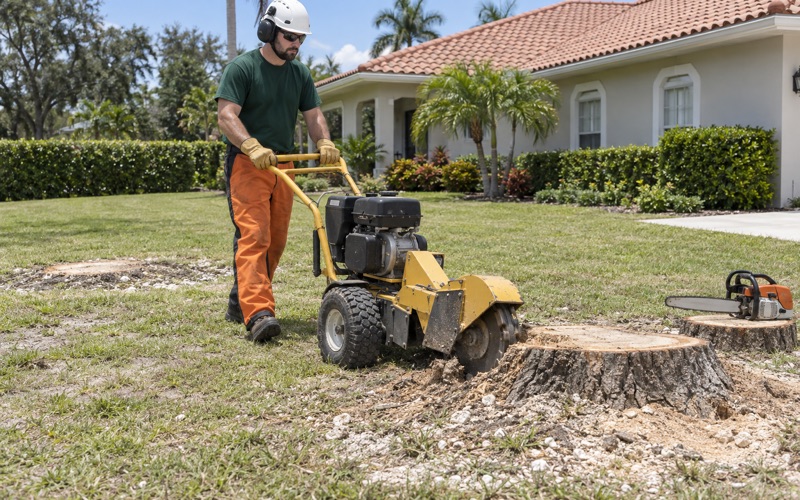
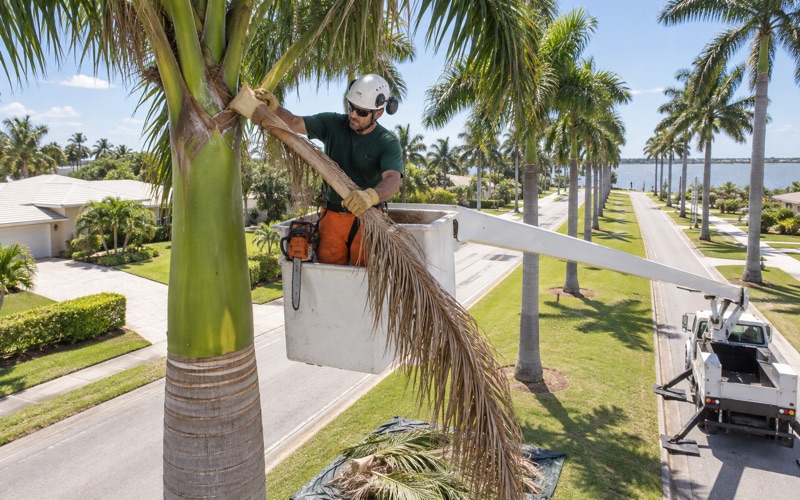
That shapes both halves of the job. Our below-grade cut is priced against the plate rather than trunk diameter alone, and a leaning tree in a wet month is genuinely a different tree in a dry one. Palms get quoted as palms for a related reason: no branch collar, no cambium, one growing point, and a trunk that will never thicken again.
Utilities, debris, and the lines on the estimate
Two things regularly surprise people about what a removal costs here, and neither is about the tree. The first is that the answer to who trims the line over it is address-specific in Lehigh Acres. The second is that the disposal gate charges by weight.
One place, two electric utilities
LCEC, a not-for-profit electric distribution cooperative serving more than 240,000 customers in Southwest Florida, names Lehigh Acres on its own service list with the qualifier parts of, and publishes no map of which parts. The remainder of the community is Florida Power and Light territory, and neither utility publishes the internal dividing line in any form a homeowner or a crew can read.
So we ask which utility bills the address rather than inferring it from the street. It decides who is responsible for the conductor above the work, and guessing at it is not a small error.
The two utilities do not say the same thing
LCEC states that it does not maintain trees from the customer service drop. FPL treats the service drop as the customer’s responsibility within 10 feet, publishes a trim cycle of every three years on feeders and every six years on laterals, states that on scheduled clearing all resulting tree debris will be removed, and states that after a storm it will leave debris where the tree fell.
Those policies must never be crossed over. Quoting the debris promise to a cooperative customer, or the service-drop disclaimer to an FPL customer, is a factual error about who owes what at that address. We would rather read the bill than assume, and would rather tell you the debris is yours than let you find that out after a storm.
Where the debris actually goes
Residential yard waste here runs on Lee County’s rules, in 50 lb bundles of 6 ft maximum length with 50 lb of unbundled palm fronds accepted, and contractor-generated debris is not what curbside collection exists for. What comes off a removal goes over a scale instead.
Lee County Solid Waste’s FY26 rate card charges commercial horticulture at $43.92 per ton with a $15.00 minimum charge at the Buckingham horticulture operation, 10500 Buckingham Road in Fort Myers. That is why hauling and disposal sit on their own line rather than disappearing into a lump sum: the gate rate is weight-driven, and it changes at every county line we cross.
- 20+ Years on This Coast
- Written Condition Reports
- Four Counties Covered