Fort Myers Tree Removal Pros has handled tree removal in Naples Park for more than twenty years, and the job here is shaped less by the trees than by the plat they stand on. This is a compact grid of detached houses on small lots, which changes the equipment, the staging and — more than anywhere else we work — the paperwork.
Most of what a homeowner here reads about removing a tree comes from Collier County, and most of it stops short of the part that matters. The county publishes a vegetation removal process; the state legislature has taken a large share of residential property back out of it. Which of those governs your yard depends on the building you live in.
We work four counties and four different permit regimes, so the first thing we give you is a straight answer about which one your address sits under. After that comes a written, dated condition report on any tree we recommend taking down, so the reasoning exists on paper before a saw touches it.
A 1951 plat, and what it leaves a crew to work with
Naples Park opened on 4 November 1951, built by M. H. Davis Properties, Inc., with lots advertised as low as $149 and drawn for buyers of modest or retirement income. Seventy-odd years later the plat is still the operative document on a removal here, because it decided how much room sits between one house and the next.
Detached, and packed tight anyway
The American Community Survey five-year estimates put 84.7 percent of Naples Park housing units in the one-unit detached category, and count 1,322 owner-occupied detached homes inside the CDP’s 1.23 square miles of land. That combination is unusual. Detached normally implies elbow room; here it describes small houses packed tightly across a small footprint.
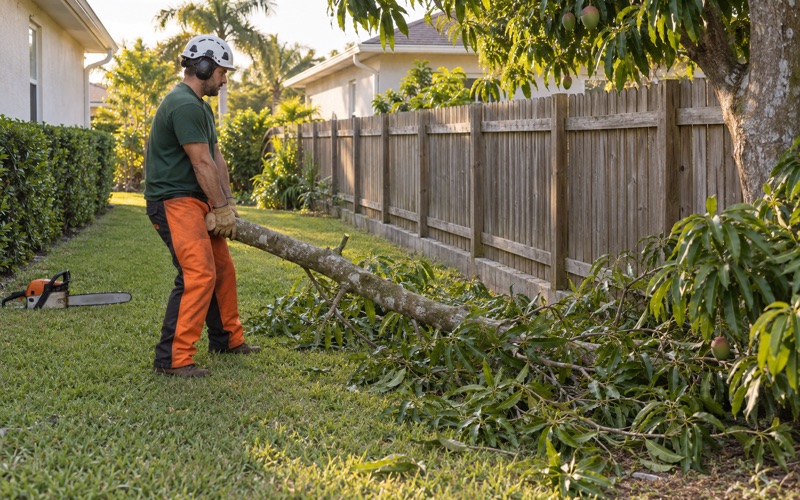
For our purposes that is an access constraint dressed as a suburb. The grid runs numbered east-west avenues between 91st and 111th Avenue North, bounded east by U.S. 41 and west by Vanderbilt Drive, and almost every removal is worked from a side yard with a neighbor’s roof a few feet off the drop zone.
Machines matched to the gate
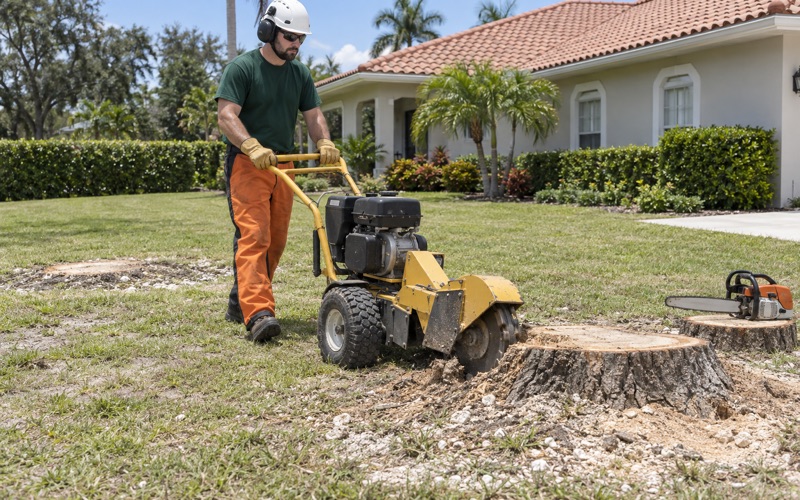
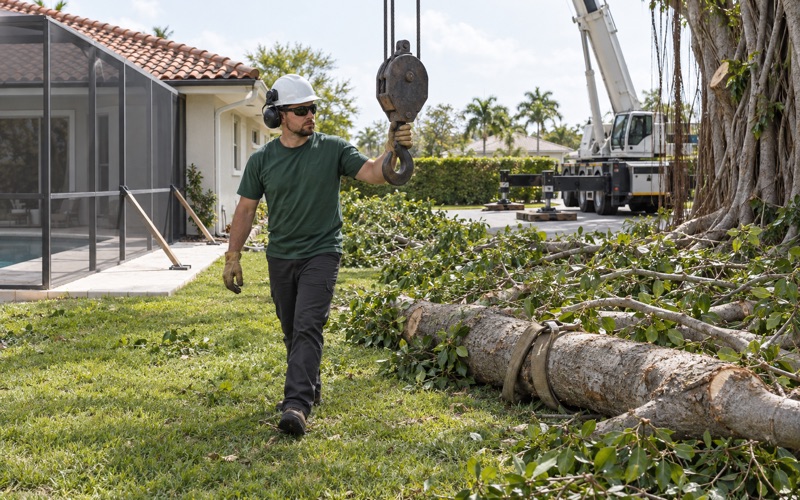
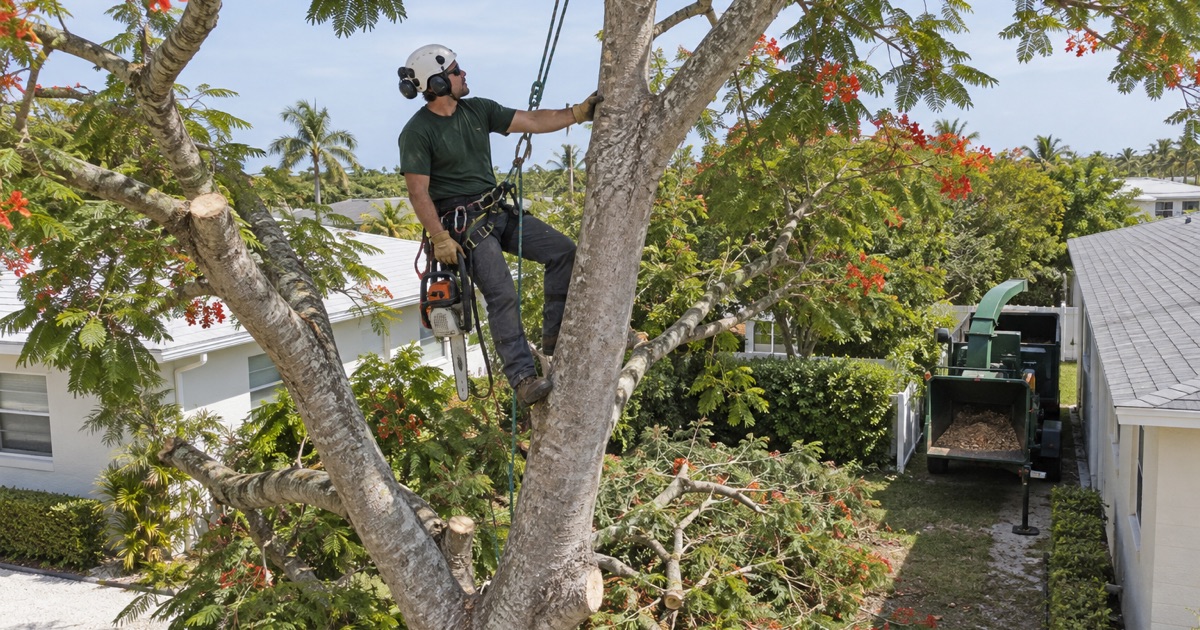
We size equipment to the opening, not to the tree. A thirty-five inch grinder fits down a side yard that will not take a standard machine, and a crane pick lifts a section over a screen cage instead of dragging it through one. Where a spider lift can reach the canopy from a driveway, that is the cheaper answer.
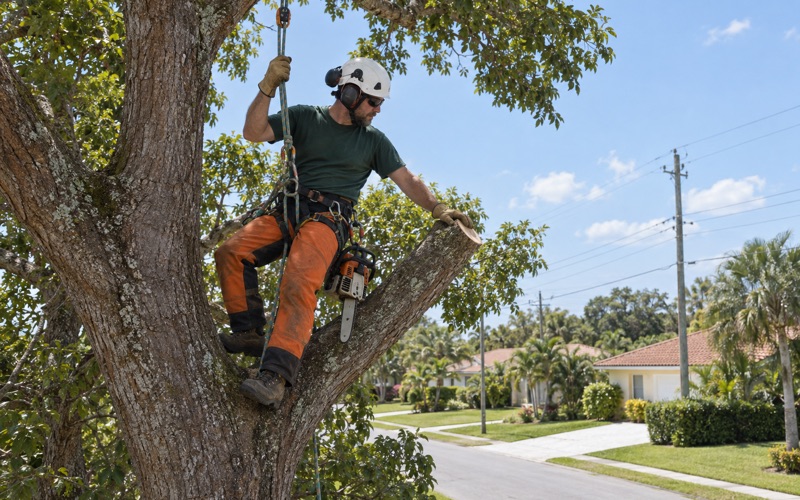
Rigging on lots this tight is an ANSI Z133 question before it is a price question, and directional pruning under ANSI A300 often removes the hazard without removing the tree. We will say so when that is the case, and quote the pruning or a cable instead.
A continuous grid with no way around
There is no through collector inside these 1.23 square miles, so a chipper parked on an avenue blocks the only route your neighbors have. We schedule around that rather than discover it: street occupancy, the drop zone and the neighbor conversation are part of the estimate here, not a surprise on the morning of the job.
Overhead adds a second owner to the question. Florida Power & Light serves this area and treats the service drop as the customer’s responsibility within ten feet of the house, so which side of that line a limb sits on decides whether the utility clears it or we do.
Looking for tree-removal closer to Immokalee? See Tree-Removal Services in Immokalee.
A county form that never mentions the statute
The document most Naples Park homeowners find first is a Collier County form, and read on its own it says a permit is required. Read against state law, it is incomplete on the exact point that matters most to a detached single-family lot. Both statements are true at the same time.
There is no city hall here
Naples Park is an unincorporated census designated place, not a municipality. The Collier County Supervisor of Elections names three municipalities in the county — the City of Naples, the City of Marco Island and Everglades City — and this is not one of them. There is no mayor, no council and no municipal tree ordinance at this address.
Collier County is the general-purpose local government here. The Board of County Commissioners adopts the Land Development Code, and the Growth Management Community Development, Development Review Division administers it. Anyone quoting a City of Naples ordinance at a Naples Park address is quoting the wrong government.
LDC section 3.05.00, and what the affidavit leaves out
Collier County’s Vegetation Removal Affidavit, revised 8 April 2025, states that vegetation removal regulations sit in Land Development Code section 3.05.00, and that it is unlawful to remove or otherwise destroy vegetation without first obtaining a vegetation removal permit from the Development Review Division. The form also warns that it is not itself an authorization to clear.
What it never mentions, anywhere on the page, is Florida Statutes section 163.045. That omission is not a trap and we do not hide it from customers — it is simply why a homeowner here can read the county’s own paperwork carefully and still reach the wrong conclusion about their own yard.
Where the state preemption actually bites
Section 163.045 bars a local government from requiring notice, an application, approval, a permit, a fee or mitigation for pruning, trimming or removing a tree on residential property when the owner holds documentation from an ISA-certified arborist or a Florida licensed landscape architect that the tree poses an unacceptable risk. Subsection (3) forbids a replanting requirement. It binds a local government, so it binds Collier County here exactly as it binds a city elsewhere.
The definition is narrow: a single-family, detached building on a lot actively used for single-family residential purposes. That narrowness is why this is the one place on our map where the exemption reaches most of the housing — but it follows the building, not the neighborhood, so a duplex, a converted attached unit or a vacant platted lot on the same avenue falls outside it.
Credentials, in a state that issues none
The most common question we get after the permit question is who is allowed to do the work. In Florida the honest answer is shorter than customers expect, and it changes what you should be asking a contractor for. Nobody in this trade can hand you a state credential, because the state does not issue one.
No state license exists, and the county cannot create one
Florida issues no tree or arborist contractor license at all. Florida Statutes section 163.211 preempts local occupational licensing, so Collier County cannot license tree work either, and no company operating in Naples Park holds a state or county credential for it. Any firm implying otherwise is describing something that does not exist.
What is real is general liability coverage and workers’ compensation you can verify by certificate, and the ISA credential of whoever signs a risk assessment. We hand you the insurance certificates before a contract rather than a word that has no state meaning.
The signature the statute actually wants
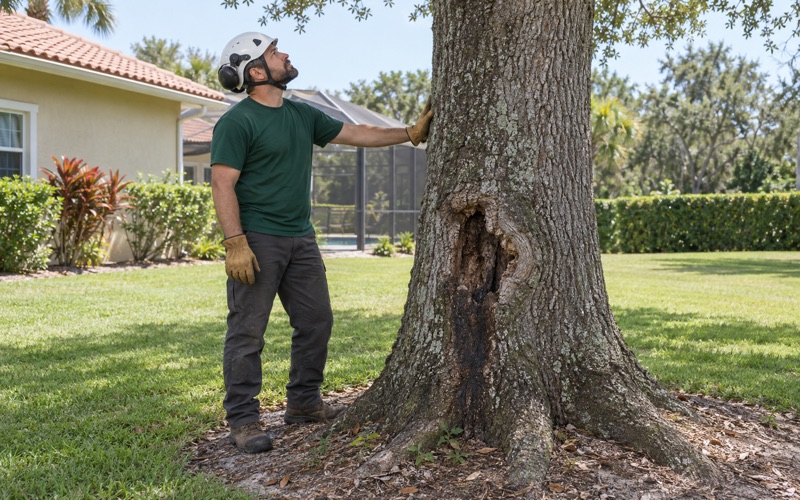
Because section 163.045 accepts documentation only from an ISA-certified arborist or the landscape architect it names, certification is the statutory gatekeeper here whether or not anyone calls it a license. The standard behind that signature is ISA Best Management Practices — Tree Risk Assessment, Second Edition 2017, where unacceptable risk means removal is the only practical way to hold the risk below moderate.
That is also why our condition reports are written and dated. If the statute turns on documentation in the owner’s hands, the document has to exist as a document — not as something a crew leader said in a driveway — and you keep a copy whether the tree comes down or stays.
Cuts we will not make
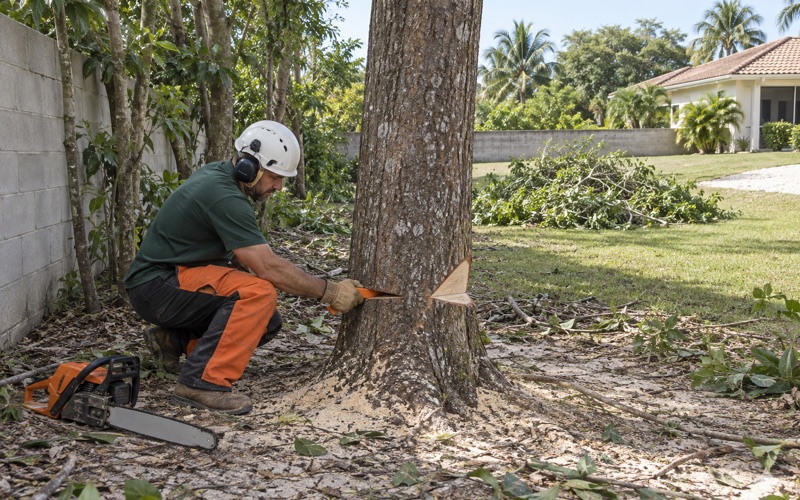
Topping, hat racking and the so-called hurricane cut are refused here, on hardwoods and on palms alike, however the job is written up. ANSI A300 has no category for them, and on palms UF/IFAS work found that hurricane-cut crowns were more likely to snap off than fuller ones.
Hurricane preparation is sold before the season rather than promised during it. Nobody cuts trees in a hundred-knot wind, and a crew that says otherwise in July is selling a queue position, not a service.
Ground, palms, and where the wood goes
Two things decide what a removal here costs after the felling itself: what a grinder meets under the sod, and what the disposal gate charges for the wood. Neither is visible from the curb, and both move the number enough that we price them on their own lines. Twenty-plus years on this coast have made both predictable enough to quote honestly.
Shallow sand over limestone
Coastal Collier County ground is shallow sand over limestone rather than deep sand. The shallow series described for this stretch of coast carry a lithic contact seven to twenty inches down, with hard fractured limestone around sixteen inches in the typical profile; the deeper ones put limestone twenty to forty inches down. Rock sits inside a stump grinder’s rated cut on both.
We will not pretend to know which of those sits under one particular lot, so we quote grinding with the chance of rock in it and say so before the machine arrives. A water table within a foot of the surface for months at a time is the other half of it, and it is what lets a whole root plate lift in wind instead of the stem breaking.
Palms, quoted as palms
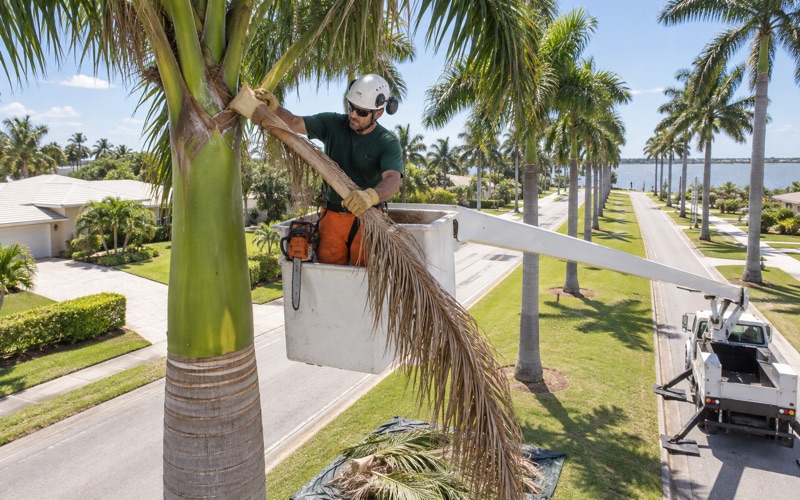
A large share of the work on this grid is palms, and a palm is not a tree in any structural sense: no cambium, no branch collar, no compartmentalization, one growing point, and a trunk diameter fixed for life. Nothing about a palm heals, so nothing about pruning one buys the recovery a hardwood gets.
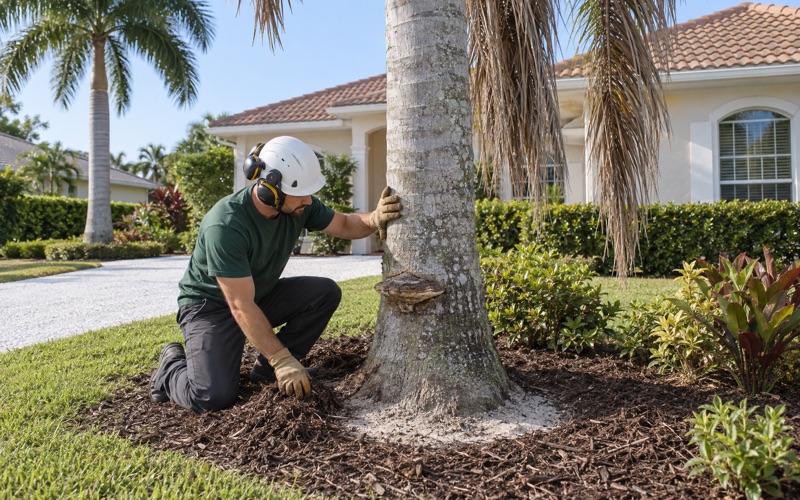
Ganoderma butt rot is the clearest example. Ganoderma zonatum is untreatable, occupies the lower four or five feet of trunk, cannot be confirmed until the conk forms, and once it is confirmed the palm has to come out and the stump has to be ground. On lots this size the grinding, not the felling, is the access problem.
The disposal gate, on its own line
There is no free disposal for removal wood in Collier County. Horticultural waste crosses the landfill gate at $55.75 per ton residential and $57.50 per ton commercial, and the county drop-off centers cap horticultural material at one cubic yard, which no removal job on this grid will ever meet. Municipal solid waste has to move by an authorized hauler unless a self-hauler permit has been issued.
That is why hauling and disposal sit on their own line of every estimate we write: the gate rate changes at each county line we cross, and a lump-sum price hides it. Ordinary curbside collection here is a different system entirely — the county’s franchise hauler for the Naples area is Waste Management, and routine yard waste is not storm debris.
- 20+ Years on This Coast
- Written Condition Reports
- Four Counties Covered