Fort Myers Tree Removal Pros has handled tree removal in North Fort Myers for more than twenty years, and the first question on a job here is usually not about the tree. It is about who is allowed to say yes to the work. That has a different answer on a park lot than it does on a deeded yard.
We settle the ownership of the ground before we put a price on anything, because across a large share of this housing stock the person standing next to the tree is not the party who authorizes its removal. Sometimes that party is a park owner. Sometimes it is a community board. Often it is named in a document nobody has opened since closing.
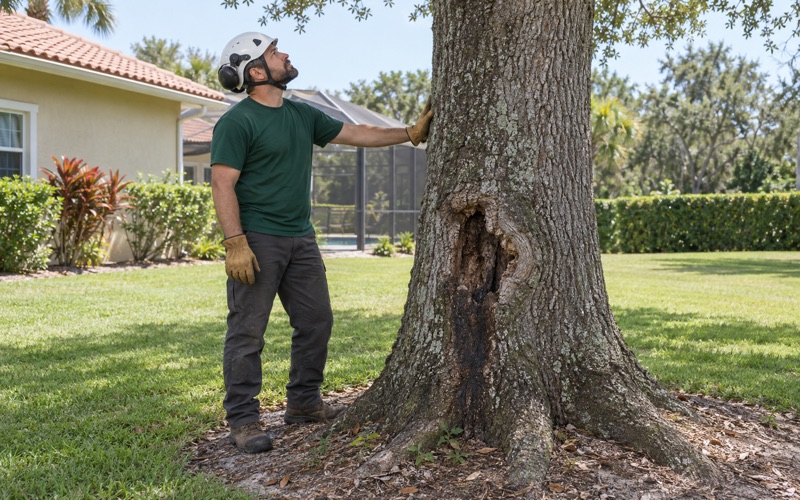
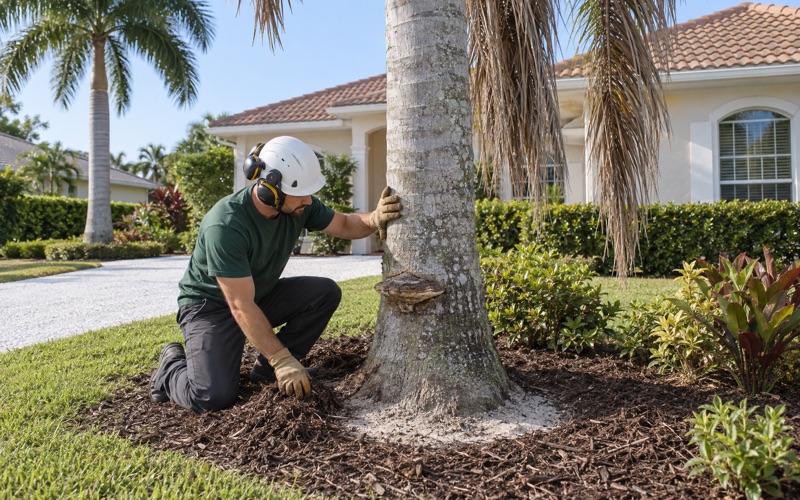
What we hand back is a written, dated condition report on any tree we recommend taking down, so the reasoning exists before the saw does and a manager or a board has something to file. Hauling and disposal sit on their own line of the estimate, and the permit question gets answered rather than assumed.
Half the homes here are not houses in the permit sense
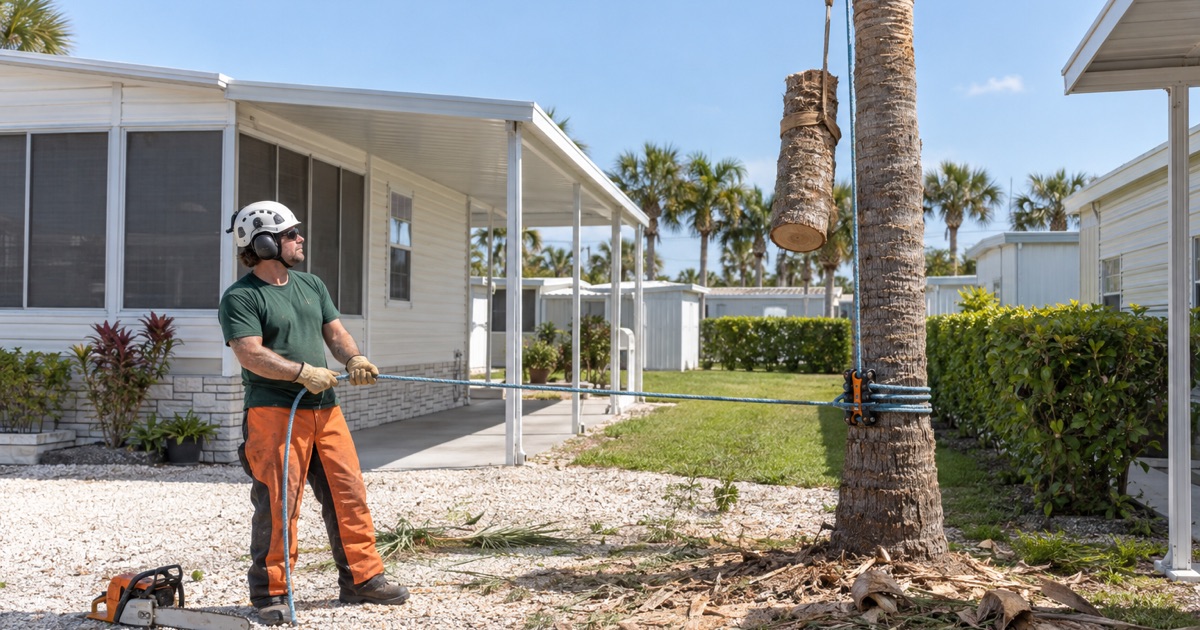
The access shape in this part of Lee County is not the one this trade normally carries, and it changes a removal before anyone rigs anything. The housing type next to the tree decides the drop, the rigging and the signature, so it is the first thing we look at.
Owner-occupied mobile homes outnumber owner-occupied houses
In the 2024 five-year American Community Survey, mobile homes are 49.1 percent of all housing units here, and the same survey counts 8,796 owner-occupied mobile homes against 7,822 owner-occupied one-unit detached homes. Lee County’s own community plan says the same thing in plainer terms: mobile homes account for over half the total housing units here, against 17 percent countywide.
So the odds favor the tree in front of us standing on a park lot, and that reorders everything downstream. About 33.8 percent of the housing units here went up before 1980, which is long enough for a laurel oak or a slash pine to get large beside a home that was placed rather than framed on site.
A park lot is a drop zone with nothing to drop into
On a manufactured-home lot the clear ground is a park lot rather than a yard. Lots sit narrow and close, the setbacks are park setbacks rather than zoning setbacks, the streets are private and often too tight for an outrigger spread, and the neighboring structure is the same short distance away on both sides.
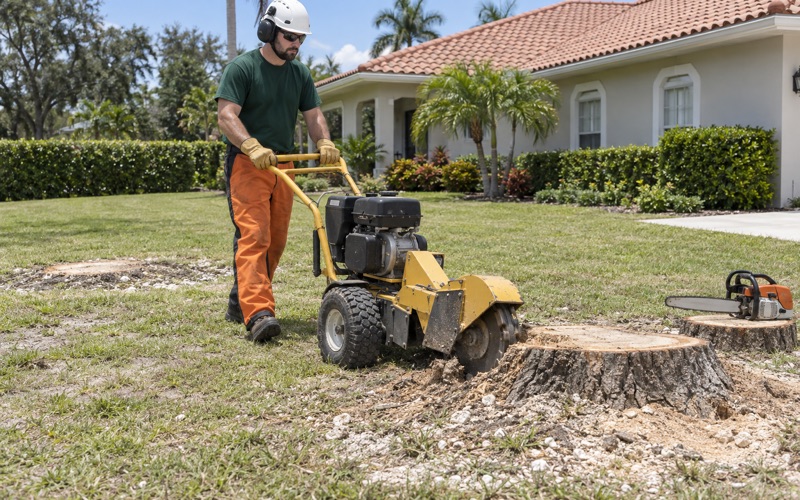
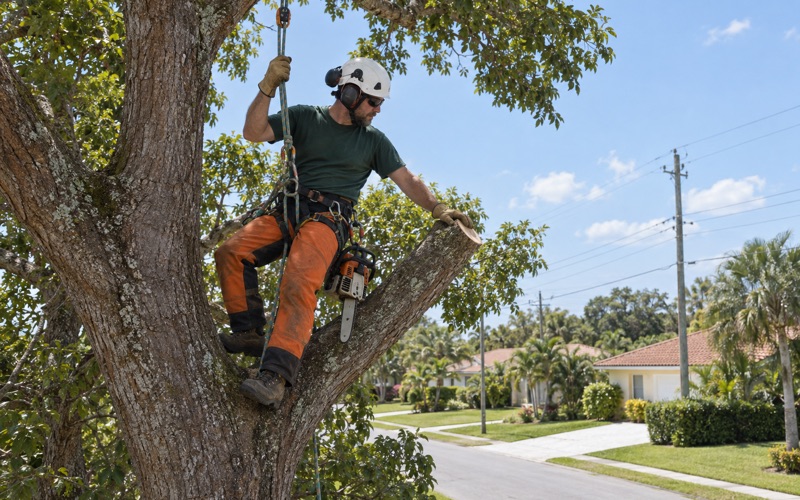
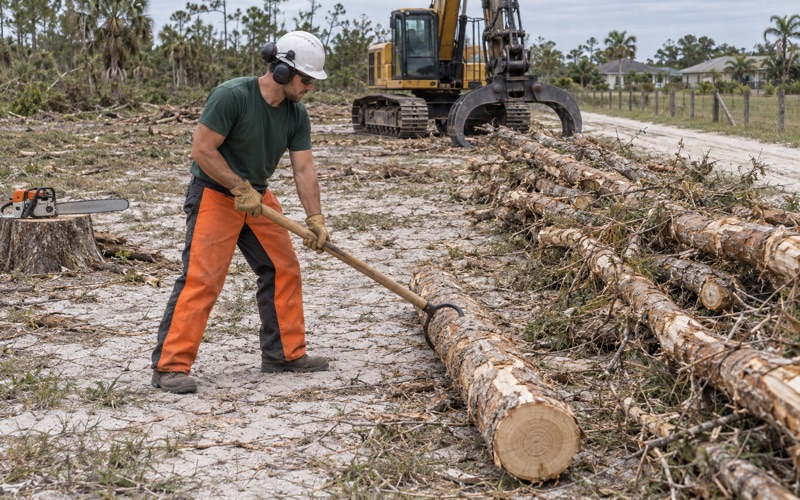
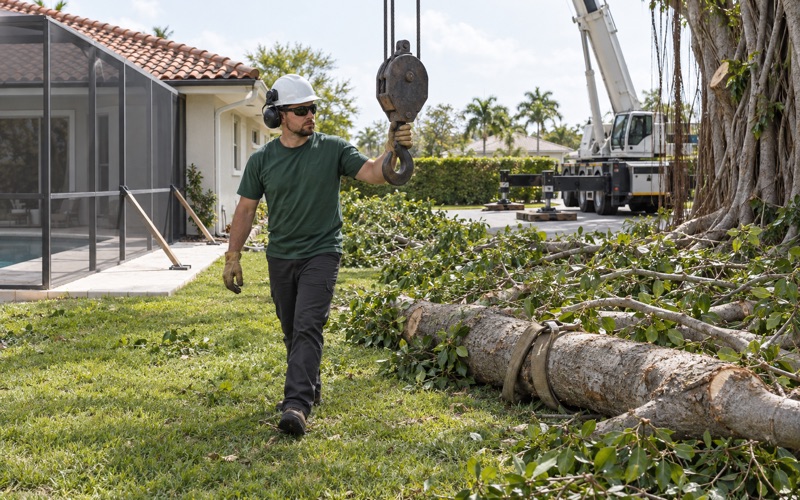
That usually means there is nowhere to put a stem, so work that reads like a small residential removal is really a rigging job or a crane pick. We match machines to the gate rather than to the tree: a thirty-five inch grinder down a side yard, a spider lift where a bucket truck will never turn, a crane set in the street when the street is the only open ground.
A panel roof will not take a point load
The structure beside the work is not carrying site-built trusses. A manufactured home typically has a light panel roof or a roof-over, and it was never designed for the point load a dropped limb or a landing pad delivers.
Damage a shingle roof would shrug off can be structural here. That is why pieces come down on a line instead of falling, and why the ANSI Z133 practices we work to protect the building as much as the crew.
Looking for tree-removal closer to Cypress Lake? See Tree-Removal Services in Cypress Lake.
Who is allowed to authorize the work
There is a chain of authority over a tree on this ground, and it does not always end with the person who called us. State law settles one part of it and private documents settle the rest, with a gap between them that catches people out.
The common areas are the park owner’s obligation
Florida Statutes chapter 723 governs mobile home park lot tenancies, and section 723.022 sets out the park owner’s general obligations. The park owner must comply with applicable building, housing and health codes, must maintain buildings and improvements in common areas in a good state of repair and maintenance, and must keep the common areas themselves in a good state of appearance, safety and cleanliness.
A tree standing in common ground is therefore the park owner’s call, and the county has a permit line built for exactly that situation: a single tree in common elements, at $30 plus $1 per tree, capped at $25 per acre, with the fee doubled when the cutting happened first. An applicant who is not the owner files a letter of authorization with it.
Chapter 723 stops at the edge of the individual lot
What the statute does not do is allocate responsibility for a tree standing on an individual rented lot. That allocation lives in the prospectus and the lot rental agreement, and those are the papers to read before anyone names a payer.
We will not give you a general rule about who pays for a lot tree, because there is not one to give. We will say that the common areas are unambiguously the park owner’s, that a resident may hold no authority to approve the work at all, and that this is better established on the phone than with a crew already parked.
The country-club communities answer to a board
The county’s plan names Heron’s Glen, Pine Lakes, Lake Fairways, Del Tura, Sabal Springs and Tara Lakes among the places where almost two-thirds of this area’s new households, housing units and population landed. Work inside communities like those gets scheduled around a board’s approval, not a single homeowner’s afternoon.
That is the practical reason our condition report is written and dated. A board needs a document it can attach to a minute, and a homeowner told no last season needs to know what to bring back.
The county is the only government at this address
North Fort Myers is an unincorporated census designated place in Lee County. There is no city hall, no municipal code and no city arborist here. The county commission’s Land Development Code is the code, and the planning area the county wrote for this place covers 25,132 acres, 4.8 percent of the county’s land, with over 10 miles of frontage on the Caloosahatchee River.
A vegetation removal permit is a county permit
Lee County Land Development Code section 14-411 requires a permit before anyone cuts down, destroys, removes, relocates, defoliates or otherwise damages a protected tree located in the unincorporated areas of the county, which is precisely what this ground is. The protected tree list sits at Appendix E of that code, and the counter is the Division of Environmental Sciences at Lee County Community Development on Monroe Street.
The fee schedule rewards reading. The clearing category for single-family work is bounded by lot size, at more than 5 acres or any lot on a barrier island, and an ordinary lot here is neither. What binds on an ordinary lot is the protected tree list. We carry four counties on one service map and four different permit regimes, and we will tell you straight which one your address sits under.
Hat racking is a citable offense in unincorporated Lee County
Section 10-421(c) permits vegetation required by the code to be pruned only to promote healthy, uniform, natural growth, and only in accordance with ANSI A300 Part 1 and the ISA pruning best management practices. Trees must not be severely pruned to hold them at a reduced height or spread, and a severely pruned tree has to be replaced by the property owner at the sizes set in section 10-420.
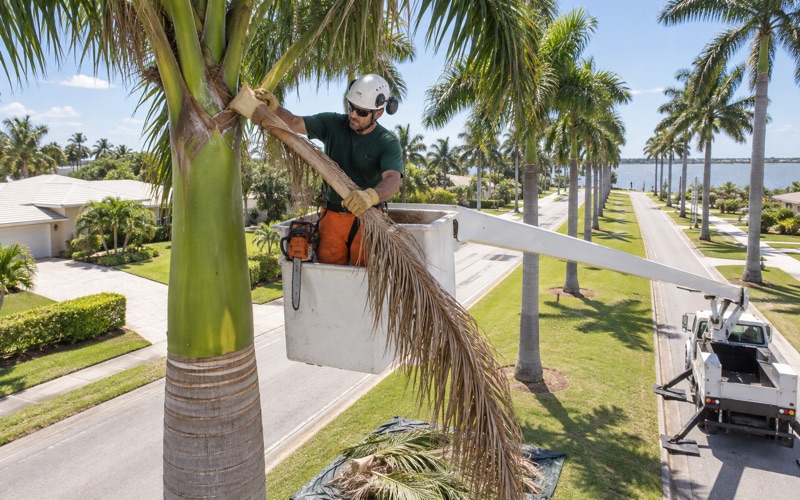
In July 2008 the county formally warned tree service contractors, property managers and lawn maintenance contractors that hat racking, topping, shaping, balling and poodle tailing would draw swift enforcement and no further warning tickets. Fines run $100 per tree for a first offense, $250 for a second and $500 for a third, issued to contractor and owner separately, with three replacement trees required for every tree pruned past saving. We refuse those cuts here, on hardwoods and on palms, however the job is asked for.
The section 163.045 shortcut reaches fewer homes here than you would think
Florida Statutes section 163.045 reaches this place, but its definition of residential property does a great deal of work: a single-family, detached building on a lot actively used for single-family residential purposes. A manufactured home on a rented park lot is not that, and the statute has not been read to cover it, so the shortcut fits a smaller share of this housing stock than the owner-occupancy figure suggests.
Section 163.211 preempts local occupational licensing, and Florida issues no state tree or arborist contractor license at all, so the county cannot issue one either. We tell customers that instead of printing a credential the state does not grant. What stands behind the work is ISA certification, verifiable general liability and workers’ compensation, and risk assessed to the ISA best management practices, second edition.
What the rest of the job costs on this ground
Cutting is one line of a removal. The wood still has to leave, the stump sits in ground that fights back at a predictable depth, and the service drop overhead has an owner.
The wood leaves on its own line of the estimate
The county’s horticultural waste gate at the Buckingham facility charges $43.92 per ton with a $15 minimum, and that is what the material off a removal costs to put down. We quote hauling and disposal separately from cutting, because the tipping gate changes price at every county line we cross and you should be able to see which half of a number is which.
Lee County’s yard waste definition was written for lawn care, not removals: vegetative matter no longer than 6 feet and no heavier than 50 pounds, in a container or in bundles tied at 50 pounds or less, with up to 50 pounds of unbundled palm fronds. Stems and rounds are not that shape, so they go on our truck and through the gate.
The grinder stops on a hardpan, or on water
Myakka fine sand puts a spodic horizon a short way down, with the Bh layers beginning around 20 inches and running to roughly 36 over sandy marine deposits that drain very poorly. The seasonal high water table sits under 18 inches for one to four months in most years and recedes past 40 inches in the dry season.
A below-grade stump cut works straight into that, and after twenty-plus years on this coast we would say the water table rather than the hardpan is what stops a grinder most months. The same layer explains a root plate with little holding it, which is why a leaning oak with co-dominant stems and included bark gets assessed at the root collar and at the union, not from the driveway.
The service drop, the palms and the season
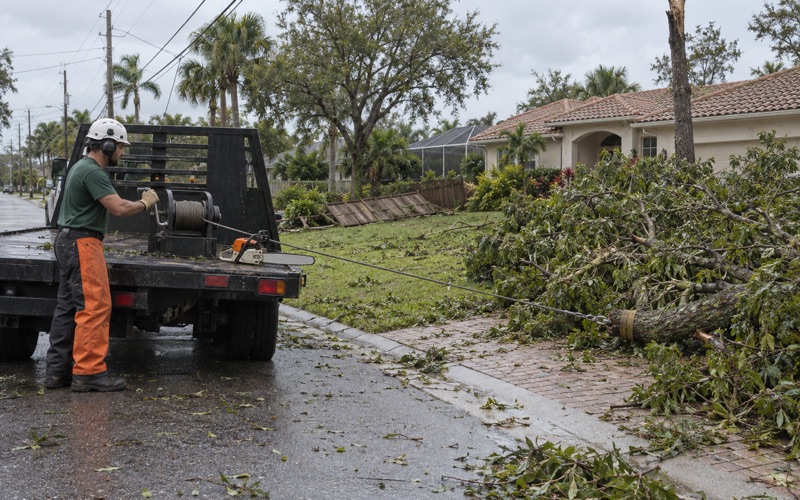
Electric service here comes from LCEC, the member-owned utility that names North Fort Myers second on its own published service list and serves more than 240,000 customers in Southwest Florida. LCEC states that it does not maintain trees from the customer service drop, and publishes no trim cycle and no debris commitment, so the span between the pole and the house is a question the property has to answer.
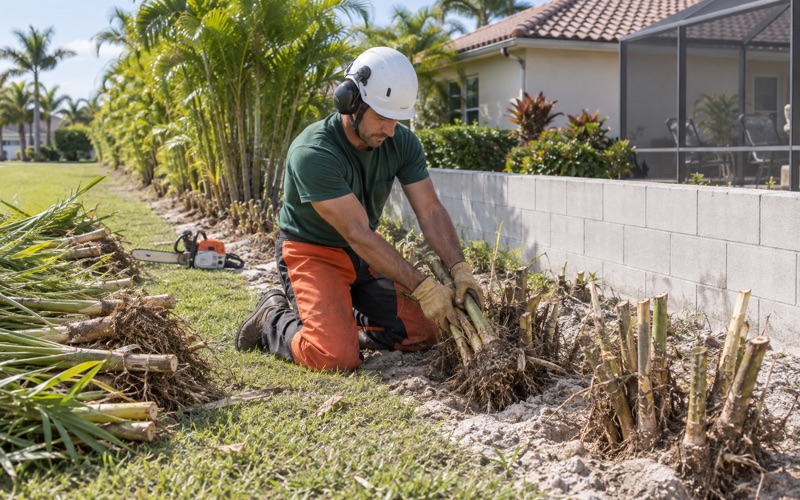
Palms get quoted as palms. A sabal palmetto has one growing point, no branch collar and no cambium to wall off a wound, and a trunk that will never add diameter again, so a cut made for appearance is permanent in a way a hardwood cut is not.
The North Fort Myers Fire Control and Rescue Service District, an independent special district with an elected five-member board and a 36-square-mile response area, counts roughly 50,000 residents year-round and close to 70,000 in winter. That swing is a scheduling fact, so we sell hurricane preparation ahead of the season rather than promising it during one, and when a tree should stay we will say so and price the pruning or the cable instead.
- 20+ Years on This Coast
- Written Condition Reports
- Four Counties Covered