
Palm tree trimming and palm removal is a distinct line of work at Fort Myers Tree Removal Pros, and after twenty-plus years in Fort Myers, FL and the surrounding cities we serve, including North Fort Myers, Cypress Lake, Cape Coral, Florida Gulf Coast University and Lehigh Acres, it is the work most often quoted wrong by somebody else. We prune palms, remove them, diagnose the diseases that end the conversation, and price the crane when the access demands one.
Everything on this page follows from one fact: a palm is not a tree. It is a monocot with a single growing point at the top of the trunk, no cambium, no branch collar, no ability to compartmentalize decay, and a trunk diameter that is fixed for life the day each section is laid down. None of the pruning vocabulary that works on an oak transfers, and a crew applying it anyway does damage that is permanent rather than temporary.
That is why a palm appears on our estimates as a palm, with its species named, its access measured and its condition described, rather than as a small tree of the same height. It is also why we decline hurricane cuts and hat racking here regardless of how the request is worded or who else in this market is selling them.
Why a Palm Is Not Pruned Like a Tree
One Growing Point, and Nothing in Reserve
A palm grows from a single apical meristem at the top of the trunk. There are no dormant buds along the stem waiting to take over, so damage to that one point is fatal and no amount of care afterward recovers it. Everything we do in a palm crown is organized around not touching it, which is a different discipline from working in a hardwood canopy where the tree has options.
A Trunk That Will Never Thicken Again
Palms lay down trunk diameter once, at the growing point, and it never increases with age. That is why stress leaves a permanent record: a period of drought, root damage or repeated over-pruning produces a narrower section the trade calls penciling, and that narrowing stays in the trunk for the life of the palm. Reading the taper tells you when something went wrong.
Green Fronds Are Working, Not Surplus
Because there is one growing point and no woody reserve, the live crown is the palm’s entire food supply, and the standard failure in this market is cutting healthy green fronds for appearance. It draws down stored nutrients, thins the next crown and shows up in the trunk a year later. Dead fronds, loose boots and seed stalks are the material that comes off without cost to the palm.
Cuts We Refuse on Palms
Hurricane Cuts and Hat Racking
A hurricane cut strips the crown back to a handful of upright fronds on the theory that less canopy means less wind load, and it is sold hard here every spring. What it actually does is remove the reserves the palm needs to survive the season it is being prepared for and expose the emerging spear. We refuse it, and we refuse hat racking on hardwoods for the same underlying reason.
Over-Lifting Above the Horizontal
The common version of over-pruning is lifting the crown so that only fronds pointing above horizontal are left, which looks tidy from the driveway and is a substantial removal of live tissue. The University of Florida names leaf removal during pruning and transplanting as a primary cause of palmetto weevil infestation, so this is not only a nutritional argument. The weevil arrives because of the cut.
Spurs on a Palm That Is Staying
Climbing spurs punch holes through the trunk, and a palm has no capacity to compartmentalize the wound the way a hardwood does, so every hole is permanent and every one is an entry point. Spurs belong on a palm that is being removed and nowhere else. The city’s own site clearing specification prohibits spurs for trimming outright, which is unusually direct language for a technical document.
Species, and What Each One Needs
Sabal Palmetto and the Boot Skirt
Florida’s state tree is the palm most often mistreated here. A cabbage palm holds the cut bases of old fronds as a persistent boot skirt, which can be left indefinitely or removed to a smooth trunk as a cosmetic choice. Its frond is costapalmate, fanning from a curved extension of the stalk, and its single bud is the swamp cabbage that harvesting the heart destroys.
Royal Palm, the Crownshaft and Self-Cleaning
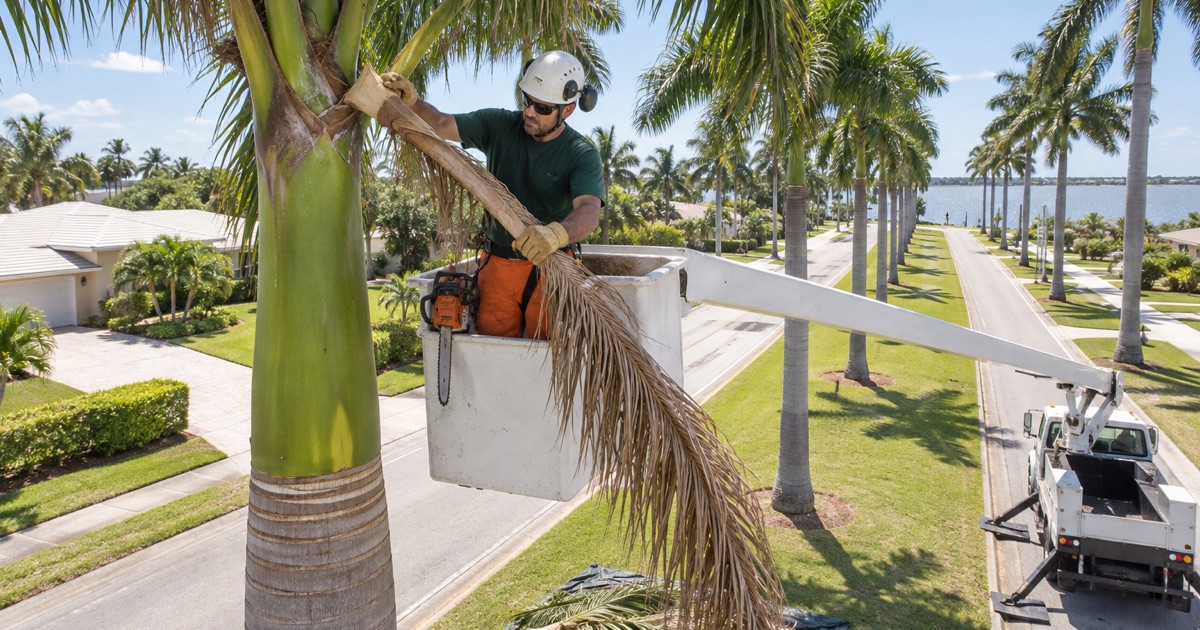
A royal palm carries a smooth green crownshaft and sheds its own spent fronds, which means routine trimming is largely unnecessary and the real question is where a shed frond lands. A mature royal is heavy, tall and straight-trunked, so removal is a crane or lift job rather than a climb and drop, and the boulevard plantings this city is named for are exactly that kind of work.
Queen Palm, Mexican Fan and the Rest
Queen palm is pinnate, fast-growing and genuinely messy, dropping fruit that stains and germinates in beds. Mexican fan palm runs very tall on a slender trunk and holds a heavy skirt of dead fronds that is a real hazard over a walkway. Identifying which is standing in front of us decides the frequency, the access equipment and the price before anything is quoted.
Palm Removal, Disease and the Crane Question
Findings That End the Conversation
A shelf-shaped conk in the lower trunk means Ganoderma butt rot, which has no treatment at any price and mandates removal and stump grinding once it appears. We say that plainly rather than selling a program of care, and we advise against replanting a palm in the same ground afterward. It is one of the few diagnoses in this trade where there is nothing to decide.
Lethal Bronzing, Spear Collapse and the Weevil
Lethal bronzing is a phytoplasma disease that runs one direction, with premature fruit drop, a bronzing progression through older fronds and a collapsed spear that will not open among the signs. Diagnostic testing through the state laboratory route is the only way to separate it confidently from nutritional decline. Palmetto weevil, the largest weevil in North America, is untreatable by the time the crown shows it.
Taking a Palm Out Over a Screen Cage
Removal is a rigging problem more than a cutting one, because a palm section is heavy, wet and does not hinge the way a hardwood limb does. Over a pool enclosure or a tile roof the answer is a crane pick or a spider lift with sections taken under control, and we measure the set-up position and the swing before quoting. Hauling goes on its own line, because the gate rate changes with the county.
- 20+ Years on This Coast
- Written Condition Reports
- Four Counties Covered