
Property line and neighbor tree work is one of the more common calls Fort Myers Tree Removal Pros takes in Fort Myers, FL and in the surrounding cities we cover, including North Fort Myers, Cypress Lake, Cape Coral, Florida Gulf Coast University and Lehigh Acres. Twenty-plus years of it has produced a simple policy: nothing gets cut across a boundary without the other owner’s written agreement, and everything we find gets written down.
The reason this work goes wrong is almost never the cutting. It is that two households are working from two different accounts of the same tree, and each has been told something slightly different by somebody who never wrote it down. A dated report with photographs replaces both accounts with one document, and a surprising number of these situations resolve at that point without a saw.
The second thing that decides these jobs is what the parcel actually is. A fee-simple house lot, an association common element and a rented lot in a manufactured home community give three different answers about who may authorize work and who is billed for it, and this service area has a great deal of all three.
Who Owns the Tree, and How That Is Decided
The Trunk Decides, Not the Canopy
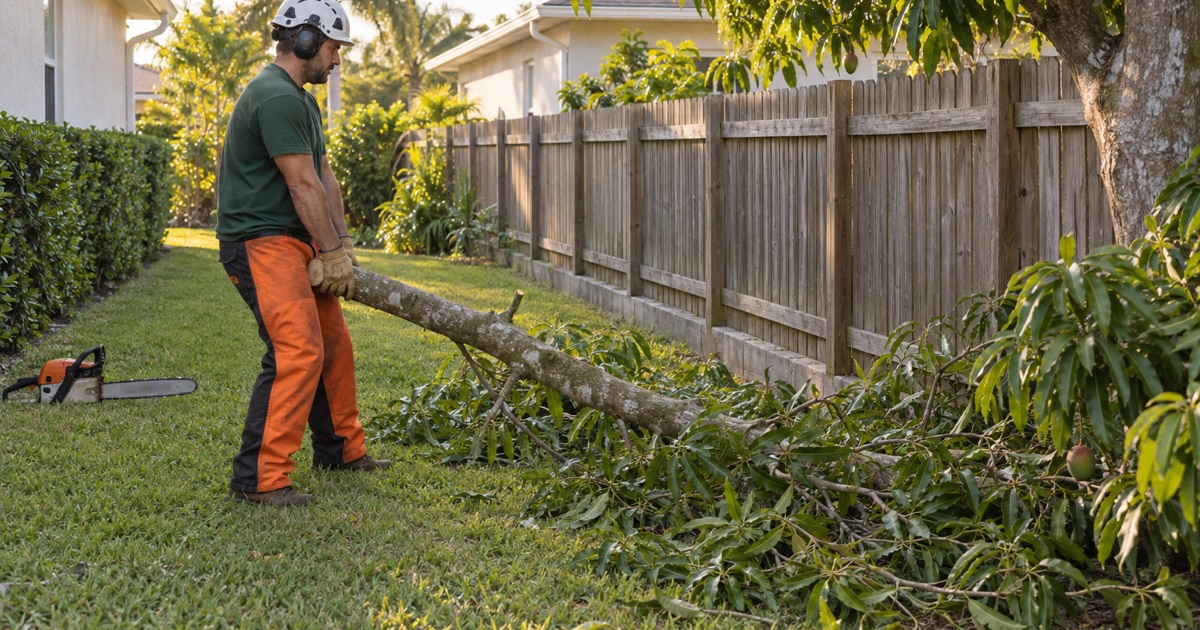
The convention this trade works to is that the tree belongs to whoever owns the ground the trunk stands on, regardless of how far the canopy or the roots travel. Overhanging limbs and roots crossing a line do not transfer ownership. We establish the trunk position first because every other question on the job depends on the answer, and we photograph it.
Trees Standing on the Line Itself
Where the trunk straddles a boundary the practical position is that both owners have an interest and neither acts alone, and that is how we treat it regardless of what either party has been told. It means one scope, agreed by both, and it means we will decline a job where only one side has signed off, even when the caller is certain the other will not mind.
Surveys, Fences and Where the Line Actually Runs
Fences here are frequently not on the line, sometimes by a meaningful distance, and an assumption built on a fence is an assumption built on somebody’s convenience from decades ago. Where the position genuinely matters to the work, a survey is the only thing that settles it. We would rather point that out at the estimate than be the reason a dispute became expensive.
Overhanging Limbs and Crossing Roots
Cutting Back to the Line
A cut made only at a boundary is usually poor arboriculture even when it is uncontested, because it heads limbs at an arbitrary point with nothing left to take over, and one-sided reduction leaves a canopy unbalanced on a coast where wind loading is the whole risk conversation. A properly placed reduction cut inside the tree achieves the clearance and keeps the tree sound.
The Cut That Damages the Tree
There is a real difference between removing enough foliage to clear a roofline and removing enough to weaken the tree, and the second is how a boundary job becomes a liability for the person who ordered it. We scope clearance work to a stated distance, take it with reduction cuts, and say plainly when the requested amount would cross from trimming into harm.
Roots Crossing Under a Drive or a Slab
Root problems on a boundary need a look before a decision. Exposing the root with an air spade shows whether it is a structural root supporting the tree or a lateral that can be cut without consequence, and that distinction is invisible from the surface. Barriers, a bridging detail in the new slab and selective pruning are all outcomes we have used instead of cutting something load-bearing.
Parcels That Are Not Simple House Lots
Associations and Common Elements
On association ground the tree is shared property and the authority sits with the board or the manager, not with the nearest resident. We ask that question at the estimate, scope the work by tree, and hand back a dated record with photographs, because a decision about a tree on common ground is routinely questioned six months later by somebody who was not at the meeting.
Manufactured Home Communities and Rented Lots
A rented lot separates the person living under the tree from the person who owns the ground it stands on, and this service area holds tens of thousands of manufactured homes. Park management, community boards and residents each ask this question differently. We establish who is authorizing and who is paying before the crew is scheduled, every time.
Commercial Neighbors and Vacant Lots Next Door
A tree on a commercial parcel or on vacant land next door sits outside the statutory route that covers a single-family homeowner, so the local code reaches it and the owner is often not local. Those jobs run on documentation and patience rather than on a same-week schedule, and the written report is what makes the conversation possible at all.
- 20+ Years on This Coast
- Written Condition Reports
- Four Counties Covered