Fort Myers Tree Removal Pros has handled tree-removal in Punta Gorda for more than twenty years, and the first thing we establish on any Charlotte County call is whose rulebook the address actually sits under. A lot inside the city limits and a lot a mile outside it answer to two different documents that do not even measure a tree the same way.
That is not a technicality that stays on paper. It decides whether a permit costs nothing or carries a fee at application, whether compliance is counted in trees or in points, and where on the trunk the tape goes. Quoting the wrong one is how a removal stalls.
We work four counties, each with its own tree-permit regime, and we keep the four straight. Every tree we recommend taking down gets a written, dated condition report first, and every estimate carries hauling and disposal on its own line, because the gate price changes at each county line we cross.
Two tree codes meet at the Punta Gorda city line
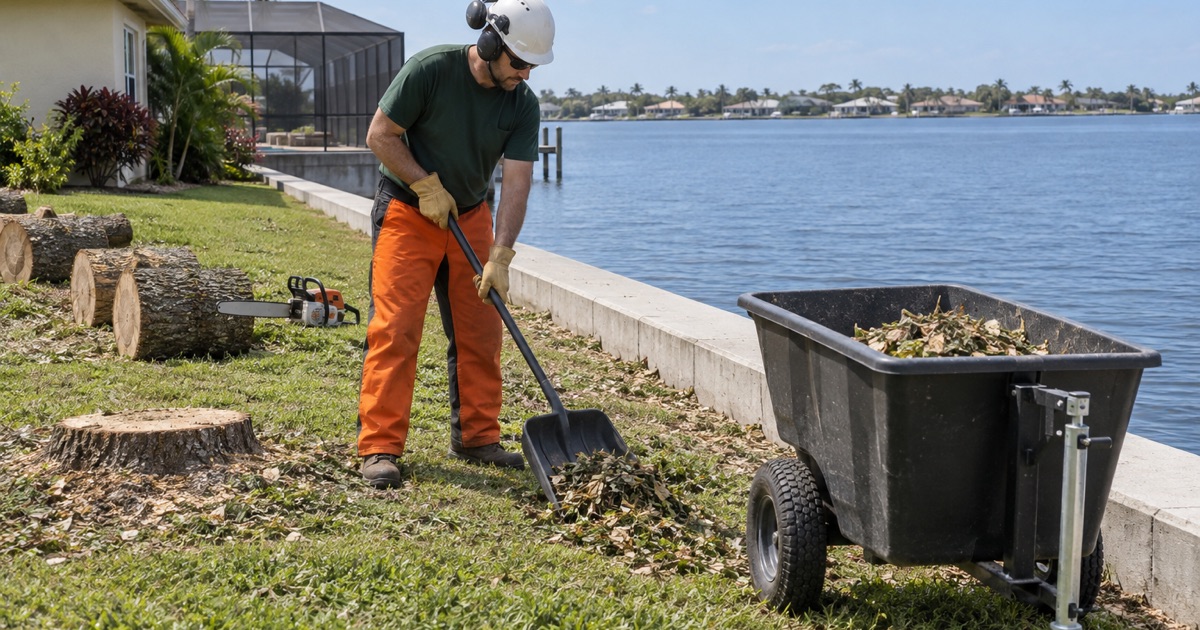
Inside the city limits the governing document is the City of Punta Gorda’s own Land Development Regulations, Chapter 26, whose landscaping standards sit in Article 12. Outside them, in unincorporated Charlotte County, a separate chapter of the county code applies. Neither stands in for the other.
Twelve inches at breast height, and a permit that costs nothing
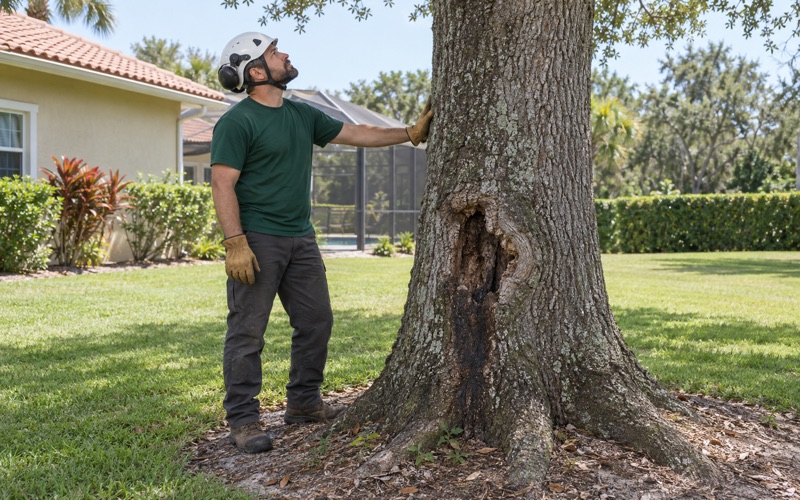
The City publishes its protected-tree trigger this way: no person shall cut down, destroy, damage, remove or poison any native or approved non-native tree twelve inches or larger in diameter at breast height without an approved tree removal permit, which it cites to Chapter 26, Section 12.3(k). Under twelve inches DBH the city trigger is not reached.
The permit itself carries no charge. The City states it may be approved where the tree is a hazard to life or property that cannot be mitigated without removal, where it is dying or dead beyond practicable restoration, or where it carries a disease transmissible to other trees. The real cost sits in the replacement obligation under Section 12.14.
Caliper measured twelve inches from grade, on the county side
Charlotte County does not measure at breast height. Its own tree permit material states that trees are measured by their caliper, the diameter of the trunk measured twelve inches from grade, and that the minimum size allowable for points is two caliper inches at a minimum height of eight feet.
The county also charges. Its published review fees run $80 plus $1 per inch removed for commercial and multi-family and $70 for single-family and duplex, and its residential tree permit page prints a $70 Natural Resources application fee due at submission. A free permit quoted on an unincorporated address is the city’s answer in the wrong place.
Two county documents that do not agree with each other
We will not pretend the county’s paperwork is internally consistent, because it is not. Its tree permit brochure cites exemption criteria to Section 3-2-193 of Article IX, Tree Requirements, while the current county zoning chapter carries tree requirements at Section 3-9-100 and Section 3-9-100.3. Both numberings are in circulation, and we say which document a citation came from rather than picking one.
The second disagreement is about when a permit is even accepted. The brochure states that a tree removal permit application will be accepted with building permit applications only, listing four exceptions; the county’s residential tree permit page describes a standalone permit allowing removal, mulching and bush hogging on a residential site. We quote both and let the county reconcile them.
Looking for tree-removal closer to LaBelle? See LaBelle Tree-Removal.
Tree points, heritage trees and the ban on speculative clearing
Outside the city, compliance is not counted the way most homeowners assume. The county’s own material puts it plainly: compliance with the code is based on the number of tree points rather than the number of trees, which turns a removal question into an arithmetic question about the whole parcel.
One tree point for every 2,000 square feet of development
The county states that one tree point is required for every 2,000 square feet, or fraction thereof, of development. Points attach to area, not to the trees standing on it, so identical lots can owe different numbers depending on how much of each is developed. Citrus trees earn no points at all.
A tree point worksheet goes in with the application, alongside a site plan and a protected species assessment where one applies. We build it from what is standing, measured at caliper.
Speculative clearing, and the heritage tree that stays
The county answers the clearing question with a flat no: speculative clearing, or prepping a lot without intention to build, is prohibited in Charlotte County. Complete property clearing without an associated building permit is prohibited as well, and heritage trees are to be preserved and not removed except on a hardship authorized by the Zoning Official.
Barricades go around the drip line before clearing and stay up through construction. Part of our job on a county parcel is saying which trees are not coming out, and what pruning or a cable costs instead.
What Florida Statutes section 163.045 takes back
State law sits over both codes. Florida Statutes section 163.045 bars a local government from requiring a notice, application, permit, fee or mitigation to prune, trim or remove a tree on residential property when the owner holds documentation from an ISA-certified arborist or a Florida licensed landscape architect that the tree poses an unacceptable risk to persons or property. Subsection (3) also bars any replanting requirement.
The limits matter more than the headline. Unacceptable risk means removal is the only means of practically mitigating the risk below moderate, assessed against the ISA Best Management Practices Tree Risk Assessment, Second Edition 2017, and the documentation has to be in hand before the work starts. Residential property means a single-family detached building, which is 5,732 owner-occupied units here in the ACS 2024 five-year estimates.
Waterfront lots, seawalls and a mangrove permit that is not local
Punta Gorda’s residential canal system connects to Charlotte Harbor, and the seawalls along it are a City responsibility administered by a City Canal Maintenance Division. That is what makes the city’s waterfront vegetation rules enforceable against a tree already standing.
Nothing but sod within 6 feet of the seawall
The City’s fence, wall and hedge provisions at Chapter 26, Section 8.5 allow hedges of any height in rear yards abutting a waterway, then draw a hard line: no hedges or other vegetation other than sod is permitted to be placed or maintained within 6 feet of the seawall. On a canal lot that makes a removal a compliance job, not a preference.
How much seawall the city holds is a question we decline to answer with a number. The City’s own channels carry more than one figure for it, and a page that picks one is guessing rather than citing.
A canopy tree a waterfront side yard cannot legally hold
The City’s approved canopy tree table at Section 12.15(b) carries a limit above it: not permitted in side yards when less than 20 feet of clearance is available or yards abutting a waterway. With the seawall rule, those two sentences decide what can stand on the water side of a great many lots here.
The same section sets a floor on replacement stock, disqualifying any tree or palm below two and one-half inches DBH or under 10 feet in height. Palms are listed alongside trees there, which settles whether a palm counts long before the botany does.
The mangrove answer here runs to the state
Neither Charlotte County nor the City of Punta Gorda appears on the Florida Department of Environmental Protection’s list of local governments holding delegated mangrove trimming authority. That list has seven entries and none of them is in this county. Delegation is authorized under Florida Statutes section 403.9324, so a shoreline trimming question here runs to the state under the Mangrove Trimming and Preservation Act, not to a local counter.
Two landfalls at this city, and what leaves the property afterward
Punta Gorda is the county seat of Charlotte County, and it is one of the few places on this coast to have taken the eyewall of two hurricane landfalls. That history is why we sell hurricane work before a season rather than promising it during one.
What the wind record actually says, and what it does not
The National Hurricane Center’s report on Hurricane Charley records a landfall near Cayo Costa at 1945 UTC on 13 August 2004 at 130 knots, then a second landfall near Punta Gorda an hour later at 125 knots. It states that Charley’s eye passed over the city, that the eyewall struck it with devastating results, and that the storm caused catastrophic wind damage in Charlotte County.
Two details go unquoted and both matter. The extreme winds were confined to a very small area, within about 6 nautical miles of the center, and the wind sensor at the Punta Gorda ASOS site stopped reporting after a sustained 78 knots gusting to 97, a floor rather than a ceiling. Hurricane Ian put a second landfall here at 125 knots on 28 September 2022.
The gate at Zemel Road, on its own line of the estimate
The Charlotte County Landfill sits at 29751 Zemel Road with a Punta Gorda mailing address. Its published tipping fees effective October 1, 2026 are $48.90 per ton for waste generated in county and $97.78 per ton for waste generated out of county, plus a scale usage fee of $11.55, and the gate closes at 4:30 p.m. on weekdays.
The rate sheet carries no separate row for yard trash, brush, tree debris or mulch, and the county’s earlier sheet had the same shape, so the absence is structural rather than a gap in our reading. A grapple load of trunk rounds crosses that scale at the same in-county rate as household garbage.
The standards we cut to, and the ground under the grinder
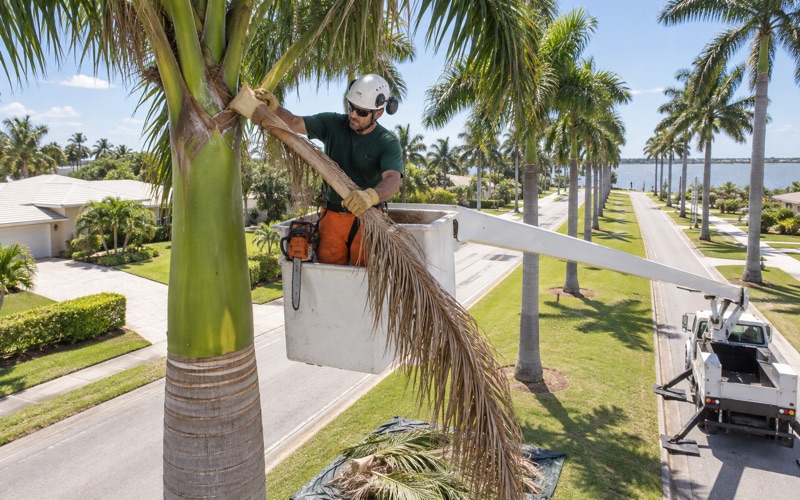
We prune to ANSI A300 and work to ANSI Z133, and we say so because at least one page ranking for permit questions in this market still requires pruning to National Arborist Association standards, a body that has not existed under that name since 2003. Topping, hat racking and hurricane cuts are refused here, on hardwoods and on palms alike.
Florida issues no tree or arborist contractor license at all, and under Florida Statutes section 163.211 the licensing of occupations is preempted to the state, with any grandfathered local licensing expiring on July 1, 2025. What we can put in front of you instead is ISA certification, verifiable general liability and workers’ compensation.
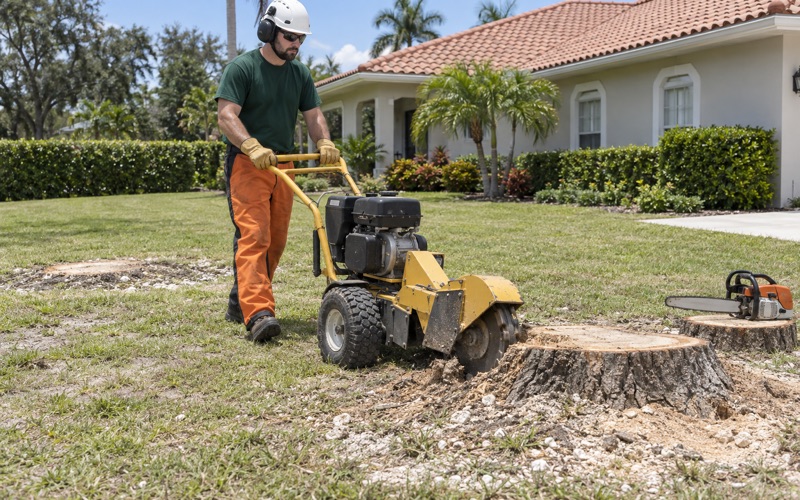
The stump work here is limited by water, not by hardpan. The Punta soil series, with its type location in Charlotte County, carries a zone of saturation at about 6 to 18 inches for one to three months in the summer rainy season, shallower than a grinder’s rated cut of roughly 12 to 16 inches below grade.
- 20+ Years on This Coast
- Written Condition Reports
- Four Counties Covered