Fort Myers Tree Removal Pros has been doing tree removal in Punta Rassa for more than twenty years, and almost nothing about the job here starts the way it starts on an ordinary Lee County lot. The ground is tidal. The buildings are tall. The person who can authorize a removal is usually a board rather than the resident standing under the tree.
That changes the order of operations far more than it changes the cutting. Before we price anything on this peninsula we work out which property type the tree sits on, because that one answer decides whether the state’s arborist-documentation route is available at all or whether the work goes to Lee County Community Development as an ordinary vegetation removal permit.
What we hand back is a written, dated condition report on any tree we recommend taking down, so the reasoning exists before the saw does. Hauling and disposal sit on their own line of the estimate rather than disappearing into a lump sum. And when a tree should stay, we say so, and price the pruning or the cable instead.
The Ian surge figure that belongs to this address
Most of Southwest Florida discusses Hurricane Ian in general terms. Punta Rassa has a number of its own, and it is the right one to reason from when someone asks what happened to the trees on this frontage and why a few of them are still failing three years later.
8.37 feet, measured here and not borrowed
The National Hurricane Center’s tropical cyclone report for Hurricane Ian records landfall near Cayo Costa at 130 knots on September 28, 2022, then a second landfall near Punta Gorda at 125 knots. For Punta Rassa the report publishes a storm surge of 8.37 feet above mean higher high water. That is a gauge-referenced figure attached to this place.
We quote it as published and we do not extend it. The same report carries no canopy-mortality figure of any kind, for anywhere, so nobody can honestly tell you what share of this peninsula’s trees were lost. A percentage offered in that form is invented.
Above mean higher high water is not above your slab
Mean higher high water is a tidal datum, the long-run average of the higher of the two daily high waters. A surge stated against that datum describes the height of the water surface, not the depth that stood over any particular piece of ground. The same report expresses inundation for some other locations above ground level instead.
The two are not interchangeable, and swapping one for the other is how a confident claim about this address ends up wrong by several feet. When we reference the figure in a condition report we name the datum it is stated against, every time.
What the salt does after the water leaves
Storm surge salt inundation is a slow injury rather than a sudden one. A laurel oak or a slash pine that leafed out the spring after a surge event can still thin, die back from the top, and fail two or three seasons later. Delayed post-storm mortality is a pattern we have watched on this coast, not a theory we picked up somewhere.
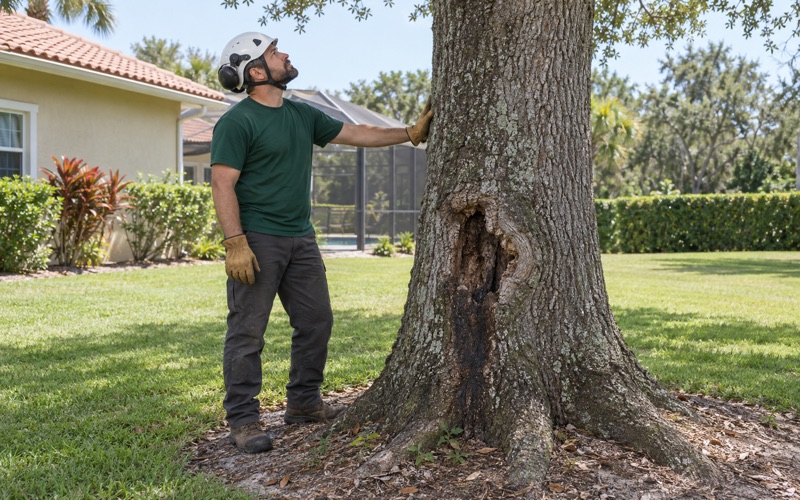
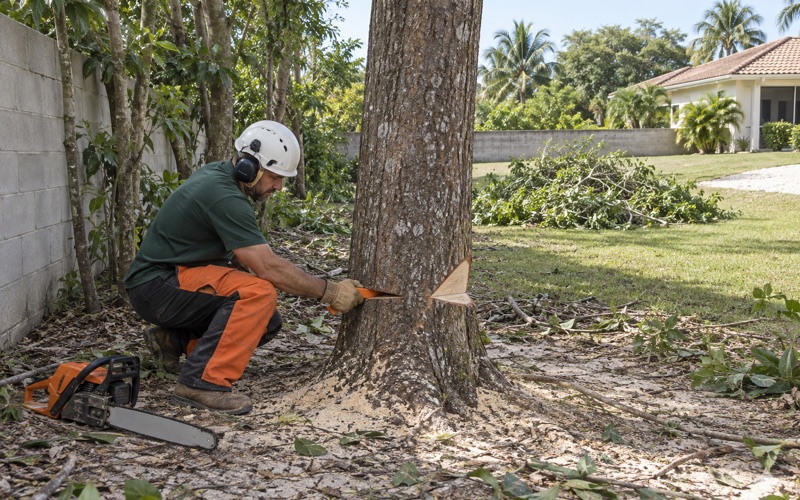
It is also why a removal here deserves a documented assessment rather than a glance. Florida issues no tree or arborist contractor license at all, so the credential that matters is the ISA certification the risk framework is built around. We work to ISA Best Management Practices Tree Risk Assessment, Second Edition 2017, and write down what we saw, so a board has something dated to read months afterward.
Looking for tree-removal closer to Estero? See Tree-Removal in Estero.
Who can actually authorize a removal on this ground
The statute most Florida property owners have heard about is Florida Statutes section 163.045, and on this peninsula it reaches very little of the housing. That is the reverse of how the law is usually described, and it is the single most useful thing to know before anyone quotes a job at this address.
Seventy-eight percent of the units here stand in towers
The American Community Survey 2024 five-year estimates put 77.8 percent of Punta Rassa’s housing units in structures of twenty or more units. Against that, the same source counts 137 owner-occupied one-unit detached homes in the entire place. The dominant property type here is not a house on a lot; it is a unit in a building, with the trees on common property.
That shapes the practical half of the work as much as the legal half. The tree usually belongs to an association rather than to the person who called us, access runs through shared drives and parking courts, and the schedule has to survive a board meeting before it survives the weather.
Section 163.045 stops at a single-family detached building
Subsection (1)(b) defines residential property as a single-family, detached building located on a lot that is actively used for single-family residential purposes. A condominium is not that. Neither is a townhome, a duplex, any attached or multifamily dwelling, a vacant or platted-but-unbuilt lot, or commercial, industrial or agricultural property.
Where the statute does reach — one of those 137 detached homes — the owner needs signed documentation from an ISA-certified arborist or a Florida licensed landscape architect stating that the tree poses an unacceptable risk, defined against ISA Best Management Practices Tree Risk Assessment, Second Edition 2017, as removal being the only means of practically mitigating that risk below moderate. Subsection (3) bars a replanting requirement. Subsection (4) excludes mangroves outright.
The county’s single-tree category, and the letter that starts it
Everything else routes to Lee County Community Development. There is no city hall here and no municipal code to consult: Punta Rassa is an unincorporated census designated place, so the Lee County Land Development Code is the code that reaches this address and the Board of County Commissioners is the legislature behind it. The county’s published Vegetation Permit Submittal Requirements sheet carries a SINGLE TREE category for removing individual trees within an existing community on common property, asking for species, quantity, location and photographs in the application description.
The same sheet states that if the applicant is not the owner of the property, a letter of authorization must be submitted with the application. On association ground that means the paperwork begins with the board, not with the crew. We build that step into the schedule instead of discovering it on the morning of the work.
Mangroves on this frontage answer to the state
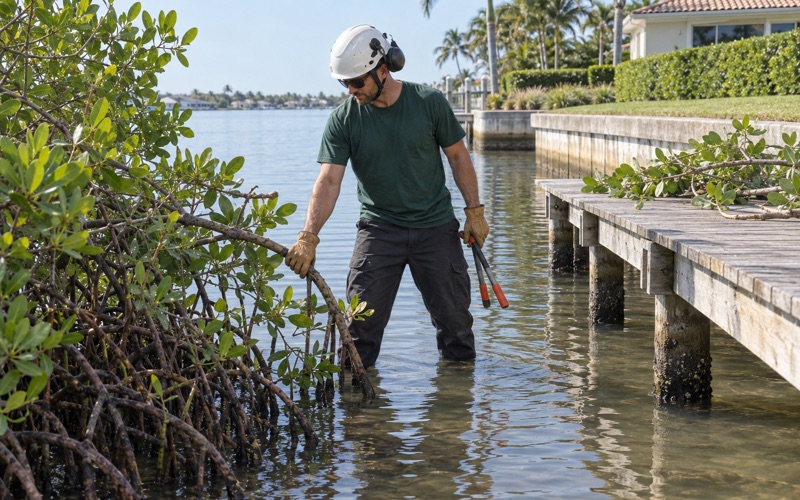
Where the water meets this peninsula there are mangroves, and the permitting for them does not sit in any office in Lee County. It sits with Florida. Getting that line wrong is expensive in a way ordinary tree work is not.
No body here administers the mangrove program
The Florida Department of Environmental Protection publishes the list of local governments that run the mangrove program themselves. There are seven of them statewide, Lee County is not among them, and no Punta Rassa body holds that authority either — there is no Punta Rassa body to hold it. A mangrove on this shoreline is a state matter, handled through the DEP South District.
The governing law is the Mangrove Trimming and Preservation Act at Florida Statutes sections 403.9321 through 403.9333, and the protected species are white, red and black mangrove. We treat a shoreline job as a state question from the first site visit rather than after a complaint.
What the owner exemption actually allows
The exemption an owner can work under is narrow and dimensional. On a shoreline of 150 feet or less it covers a riparian fringe no more than 10 feet pretrimmed, and the trimming may never take a mangrove below six feet. Over 150 feet of shoreline, no more than 65 percent may be trimmed under the exemption at all.
Anything 16 feet or over is staged, at no more than 25 percent of foliage in a year, and first-time trimming of a red mangrove requires ten days’ written notice. Using herbicides to defoliate a mangrove is strictly prohibited under section 403.9328(3). None of those numbers are ours to soften for a schedule.
Where a mangrove changes the removal conversation
Because subsection (4) of section 163.045 excludes mangroves, the arborist-documentation route that can clear a hazardous oak does nothing for the fringe, even on one of the detached lots. The two questions sit on the same parcel and have to be kept apart. On this frontage they very often are the same parcel.
In practice we scope the upland trees and the shoreline fringe as two jobs answering to two authorities, and we say plainly which side of that line an individual stem falls on before a price is written down.
Wet ground, tight access, and what leaves the site
The last part of a quote here is purely physical. What stops a stump grinder on this peninsula is neither rock nor hardpan, and what a crane or a lift has to negotiate is a built environment of towers, shared drives and screen cages rather than an open yard.
Tidal sediment, coastal sand, and a root plate with nothing to hold
The USDA official series descriptions for tidal and coastal ground in this county are locally named: Estero, Kesson, Wulfert and Captiva all carry Lee County type locations. Estero is described as very poorly drained and flooded during daily high tides. Wulfert’s typical pedon is muck in a mangrove swamp, and Captiva formed in thick deposits of sand and shell fragments.
Which of them is mapped on a given parcel is not something we will assert without a survey in hand. What we will say is what the whole family has in common for our purposes: a seasonal high water table close to grade for most of the year, sand and shell that gives a root plate almost nothing to grip, and sulfide-bearing tidal muck at the mangrove edge that is not machine ground at all.
Machines matched to the gate, not to the invoice
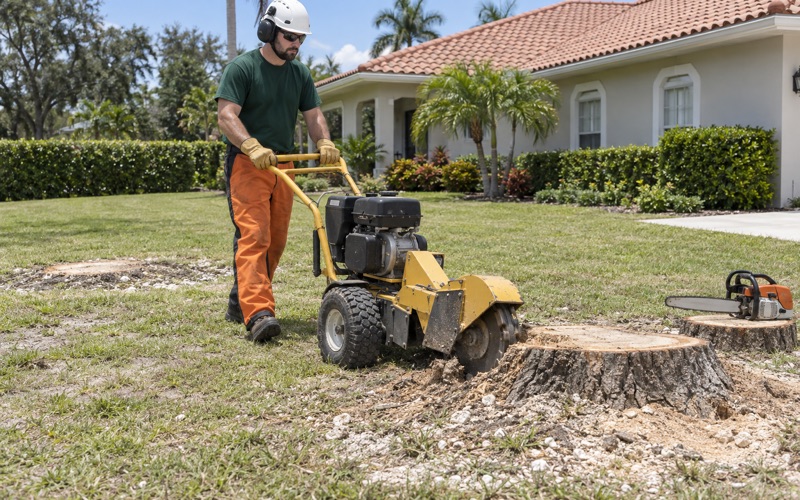
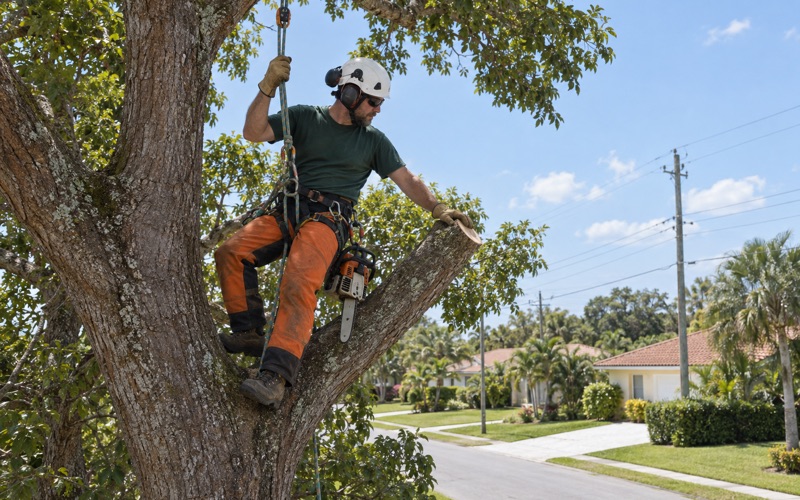
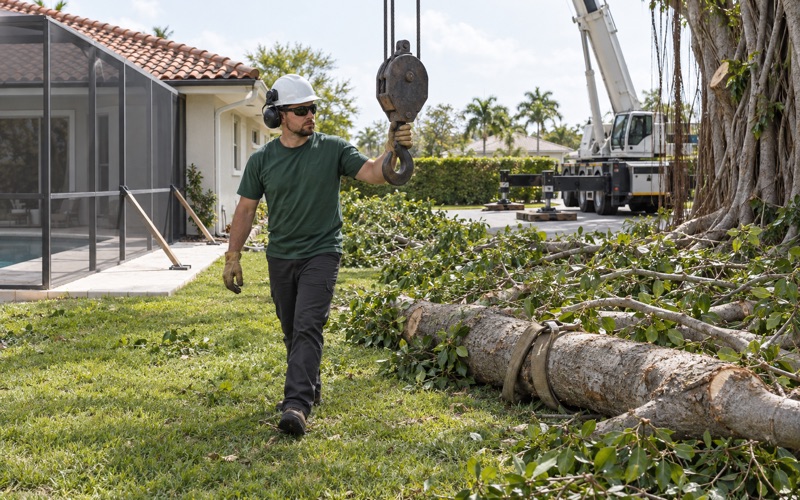
Twenty-plus years on this coast has mostly taught us equipment selection. A thirty-five inch grinder goes down a side yard a larger machine cannot enter, a crane pick lifts a limb over a screen cage instead of dragging it through one, and a spider lift reaches a courtyard tree no truck will ever park beside. A stump grinder below-grade cut gets planned around water rather than around a spec sheet.
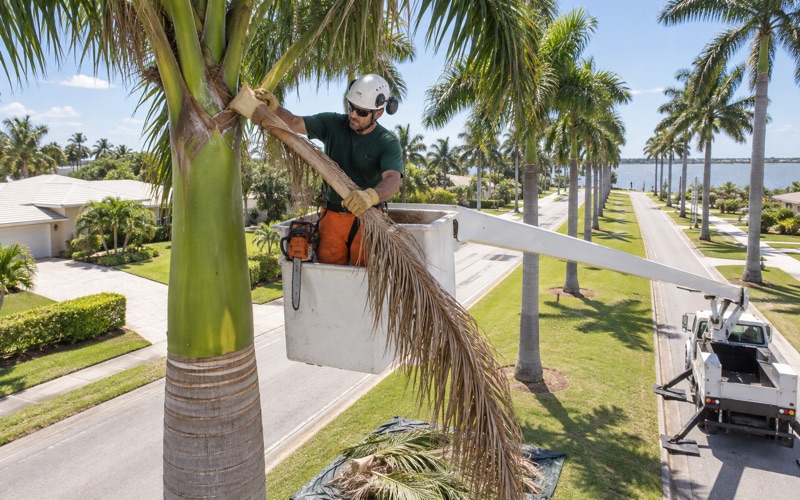
Palms are quoted as palms, on their own terms. A sabal palmetto has no branch collar and no cambium, one growing point, and a trunk that will never thicken again. Topping, hat racking and hurricane cuts are refused here, on palms and on hardwoods alike, however the job is asked for — ANSI A300 has a name for the cuts we will make and none for those.
The toll plaza is here, and the haul is its own line
The Sanibel Causeway’s toll plaza sits at the mainland end of the crossing, at Punta Rassa. Lee County’s facility page states that the plaza has three traffic toll lanes processing on average over three million vehicles annually, and that all three lanes flow in a westerly direction. Collection runs one way, so work at an address on this peninsula sits on the near side of it and carries no crossing cost at all.
Disposal is the cost that does move. Lee County’s FY26 horticultural waste gate rate is $43.92 per ton at Buckingham Horticulture with a $15 minimum, and we cross four county lines on one service map, each with its own tipping gate and its own tree-permit regime. That is why hauling carries its own line on the estimate, and why we give you a straight account of which regime your address actually sits under instead of averaging four of them together.
- 20+ Years on This Coast
- Written Condition Reports
- Four Counties Covered