Fort Myers Tree Removal Pros has handled tree removal in Sanibel for more than twenty years, and this island is the one address on our map where the mangrove counter and the tree counter are the same City desk. Nothing about the sequence here matches the mainland. Paperwork comes first, an inspection comes before the saw, and the calendar is built around both.
What changes most is who signs off. The State of Florida has delegated authority to the City of Sanibel to regulate the trimming and alteration of mangroves on the island, so a mangrove question about your shoreline is answered by City Natural Resources staff rather than a state district office. A crew working from generic Florida guidance gets that wrong on its first job here.
We quote the work here the same way we do everywhere else. Any tree we recommend taking down gets a written, dated condition report first, so the reasoning exists on paper before the saw does, and hauling and disposal sit on their own line because the gate rate changes at every county line we cross. Florida issues no tree or arborist contractor license at all, and we tell you that rather than printing a word that means nothing in this state.
Mangroves here answer to the City, not the state
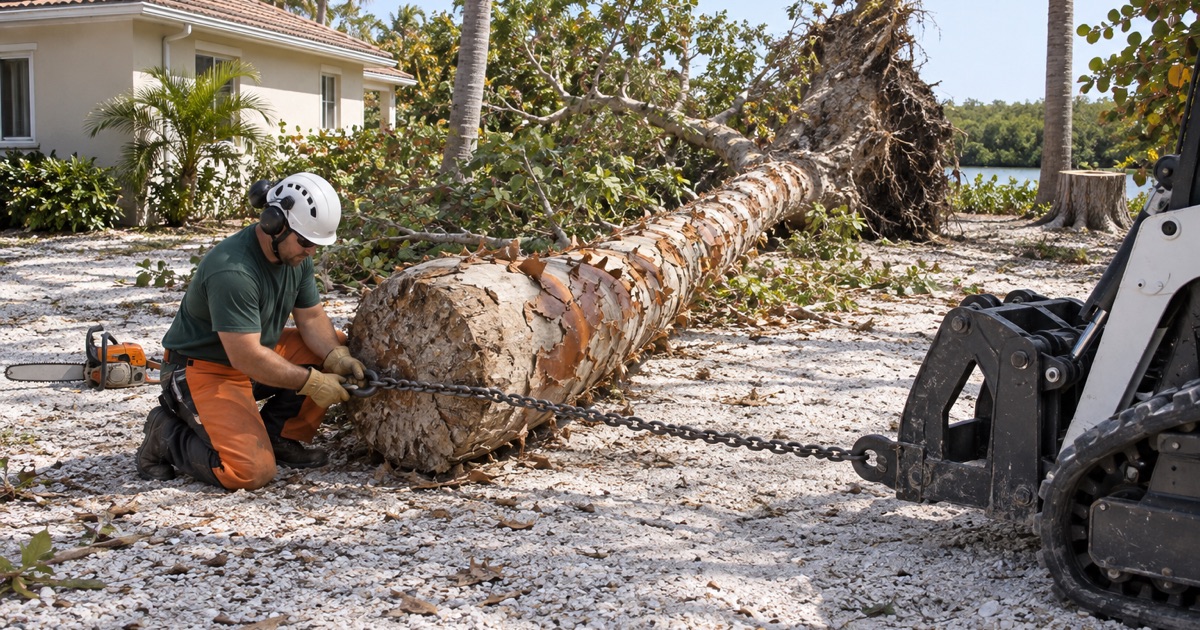
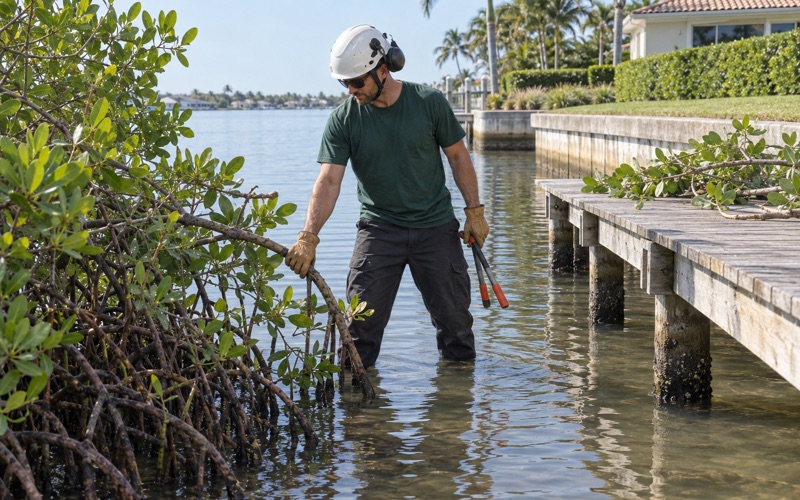
Mangroves are the part of a Sanibel job that cannot be improvised. The program that governs them elsewhere in Florida has been handed to the City here, along with the certification standard and the inspection that goes with it.
One of seven local governments in the state with this authority
The Florida Department of Environmental Protection publishes the list of local governments to which it has delegated mangrove trimming authority, and there are seven names on it. The City of Sanibel is one of them, and the delegation is authorized under Section 403.9324, Florida Statutes. Every other address we serve answers to the state program directly.
In practice that means the City’s Natural Resources Department at 239-472-3700 is the office with the answer about your property. The Mangrove Trimming and Preservation Act still sets the frame, but the reading that governs this shoreline is the City’s own.
Notification first, and an inspection before and after
The City states it without qualification: notification to the City of Sanibel is always required before taking any action involving mangroves, and an inspection by Natural Resources staff is always required before trimming them. The City describes the before-and-after inspection as what keeps the law correctly interpreted and applied, which makes it substantive rather than clerical.
That is a scheduling fact with teeth. A mangrove job on this island is not a same-day job, and a crew that arrives and starts cutting has broken the rule before the first cut. We build the notification and the inspection windows into the quote instead of discovering them on the morning of the work.
Over ten feet, and who is allowed to make the cut
Mangroves greater than 10 feet in height may only be trimmed by a Professional Mangrove Trimmer. The state delegated to the City the authority to set the certification standards for that role, and certification requires passing a City test on the City and state mangrove trimming and preservation standards. Two questions therefore sit on any mangrove bid here: whether the person holds the certification at all, and whether it is the one this City tests for.
Below that height the City’s published riparian-fringe limits do the work. Mangroves under 6 feet may not be trimmed; from 6 to 24 feet they may not be cut back more than 25 percent in any one year and may not be reduced below 6 feet; above 24 feet the height may not be reduced at all, though a quarter of the lateral foliage may come off annually. Outside the riparian fringe, a permit from the City is required to alter or trim them.
Looking for tree-removal closer to Captiva? See Tree-Removal in Captiva.
What puts a vegetation permit in front of the work
Mangroves are not the only trigger on this island. The City lists the activities that require a Vegetation Permit, among them a development permit, removal of protected native trees or shrubs, heavy pruning, work seaward of the control line, mangrove work, mechanical or undeveloped-property exotic removal, and chemical control of aquatic plants. Two of those catch jobs that would be a routine pruning decision anywhere else on this coast.
More than a quarter of the leaf area
Pruning or trimming more than 25 percent of the leaf area of any protected native tree or shrub requires a Vegetation Permit. That is a threshold rather than a guideline, and it turns an ordinary crown reduction into an application with a review attached.
It also changes how we specify a reduction. The percentage goes into the condition report instead of being judged on the ground, and where a target sits near the line we plan ANSI A300 directional pruning across two seasons rather than one permitted cut now. Topping and hat racking are refused here, on hardwoods and on palms, however the job is asked for.
Seaward of the 1974 Coastal Construction Control Line
Removal or trimming of any vegetation seaward of the 1974 Coastal Construction Control Line needs a permit as well, whatever the species and whatever its size. The City names that line specifically, and on a barrier island it runs through back yards rather than somewhere out on open dune. Where a property sits on more than one trigger, the conditions stack onto a single application.
Where Florida Statutes section 163.045 helps, and where it stops
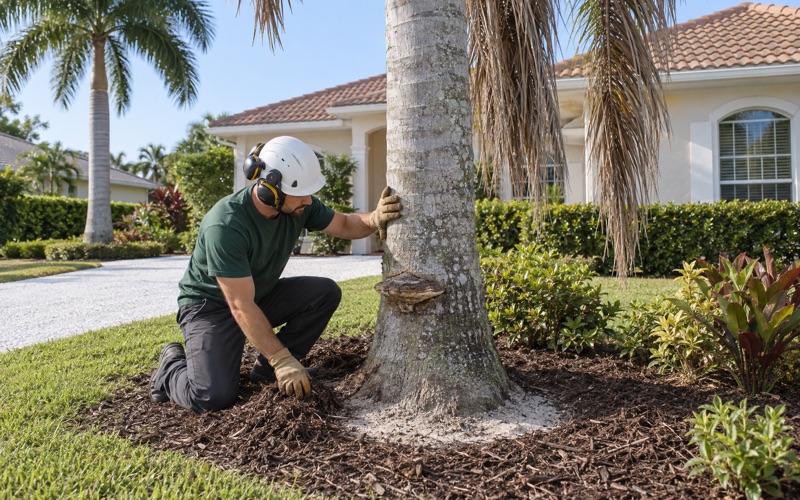
Section 163.045 bars a local government from requiring a notice, application, approval, permit, fee or mitigation to prune or remove a tree on residential property when the owner holds signed documentation from an ISA Certified Arborist or a Florida licensed landscape architect that the tree poses an unacceptable risk. On a detached single-family lot with a genuine hazard tree, that is a real and powerful tool.
Three limits decide how far it reaches on Sanibel. Subsection (4) excludes mangroves outright, so it touches none of the delegated program; the documentation has to carry a risk finding of the kind the ISA Best Management Practices for Tree Risk Assessment describe, so it is not a general exemption for a healthy protected native; and residential property is defined as a detached single-family building on a lot in active single-family use, which leaves condominiums and attached dwellings outside it.
Surge, salt, and the trees that fail later
Hurricane Ian put salt water across this island, and the tree work that follows a surge is not the tree work that follows a wind event. Much of what decides a removal here does not show itself for a season or more.
Nine to thirteen feet above ground level
The National Hurricane Center’s report on Ian publishes inundation of 9 to 13 feet above ground level on eastern Sanibel, with the causeway partly washed away. That is a depth that reached root plates and not only canopies. A tree that leafed out the following spring is not automatically a tree that is sound.
Salt in the soil, and delayed failure
The City attributes post-storm browning and leaf drop to saltwater storm-surge inundation and salt spray with too little rain to dilute the deposits, and it states that salt in the soil may linger for some time while spray may remain on the plant. It also states that an inch of rainfall or irrigation is enough to dilute soil salt to a non-harmful level.
Delayed post-storm mortality is what we watch for on a follow-up visit, and the ground here gives a weakened tree little help. The constraint on this island is a water table sitting within a foot or two of grade for most of the year, in sand and shell that gives a root plate very little to hold, rather than any hardpan.
What the City says warrants removal, and what warrants pruning
The City publishes its own criteria for that decision. Removal is warranted when the lower main trunk is cracked or broken, a large stem has split away, the tree leans toward a person, structure, vehicle or animal, major roots are severed or broken, or multiple limbs greater than 8 inches in diameter are broken. Restoration pruning is the answer instead on a young tree with a trunk 10 inches in diameter or less, a defoliated canopy, and broken or dead branches 4 inches in diameter or less.
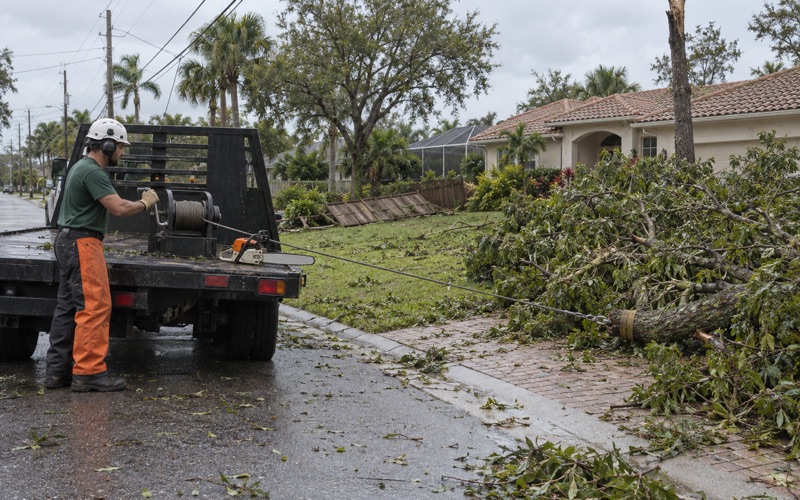
After a storm the City requires no permit for removing vegetation debris on private property, or for restoration trimming and corrective pruning of hurricane-damaged vegetation, excluding mangroves. Mangrove trimming and removal, any work seaward of the control line, and removal of live native vegetation all still need one. The mangrove carve-out survives the storm, and it is the sentence a hurried crew misses.
Exotics, machines, and getting the debris off the island
The last part of a Sanibel job is often the part that sets the price. What has to come out of the ground is governed by a list the City publishes, and everything that comes off the property leaves over a toll bridge.
Eight plants the City names, and an obligation that does not end
The City names eight invasive exotics: Brazilian pepper, melaleuca or punk tree, earleaf acacia, Java plum, scaevola or exotic inkberry, lead tree, mother-in-law’s tongue, and air potato. Complete removal of all City-listed invasive exotic vegetation is required before a Certificate of Occupancy is issued, and the City states that a homeowner must then keep the property free of these plants in perpetuity.
Three of those are not trees, so this is a vegetation obligation rather than a tree-removal list. It is also a standing duty attached to the land, which is why we quote exotic control on this island as recurring maintenance instead of a single clearing.
The tool decides which permits apply
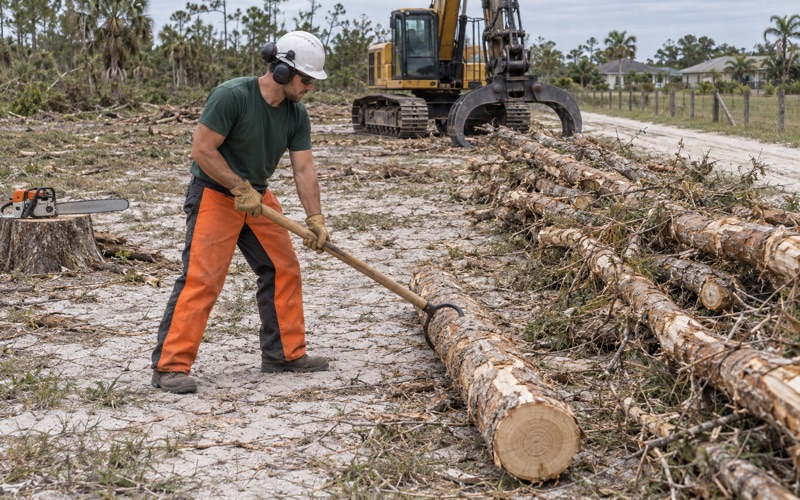
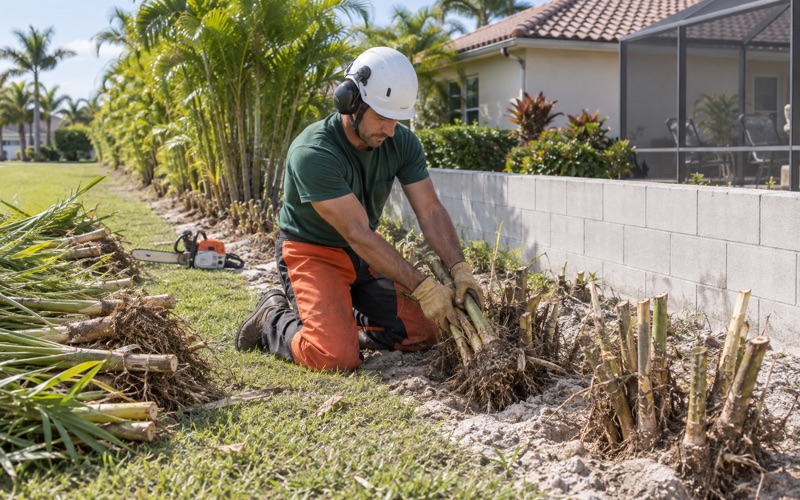
Hand removal of invasive exotic vegetation on developed property requires no vegetation permit. Mechanical removal always requires both a development permit and a vegetation permit, under Section 122-191 of the Sanibel Land Development Code as the City cites it. The trigger is the equipment rather than the plant, so a bid built around a skid-steer and a grapple is a different bid from one built around loppers.
The City’s Australian pine provisions at Code Sections 30-121 through 30-127 run the other way. An existing pine may stay, but where the City determines that a pine, or any other tree, is a danger to health, safety or welfare, or to City infrastructure such as a lift station, removal is required rather than optional.
Every load leaves by the causeway
No disposal, transfer, horticulture or mulch facility of any kind sits on the island, so everything we cut crosses back to a Lee County gate. Horticultural material at the Buckingham Horticulture facility runs $43.92 per ton with a $15 minimum this fiscal year, and that figure goes on its own line of the estimate rather than being buried in the removal price.
The toll is the other line item. Lee County’s Sanibel Toll Plaza collects in one direction only, westbound toward the island, at $6.00 for two axles, $9.00 for three, $12.00 for four and $15.00 for five on a transponder with a prepaid account, plus $3.00 for each additional axle. A chip truck towing a chip box is a four-axle combination every time it comes across.
- 20+ Years on This Coast
- Written Condition Reports
- Four Counties Covered