
Fort Myers Tree Removal Pros brings twenty-plus years of stump grinding to Fort Myers, FL and to surrounding cities including North Fort Myers, Cypress Lake, Cape Coral, Florida Gulf Coast University and Lehigh Acres. That covers single stumps left by somebody else’s removal, whole yards of them after a storm, palm stumps, and the root chasing that a slab or a fence line sometimes needs afterward.
What makes this work local is the ground rather than the trade. Grinding depth in most of the country is a conversation about rock; here it is a conversation about water, because a seasonal high water table sits within a foot and a half of the surface for months of most years and the wheel finds it long before it finds anything hard. Two soils in this service area put their limiting layer thirty-five inches apart, which is the difference between a routine cut and a machine throwing slurry.
So we quote the depth, the grindings, the crater and the haul-away as four separate decisions with four separate numbers, and we name the machine we are bringing and what it is actually rated to cut. A stump price that hides all four inside one figure is a price you cannot check.
What Stump Grinding Removes and What It Leaves
Grinding Against Full Stump Removal
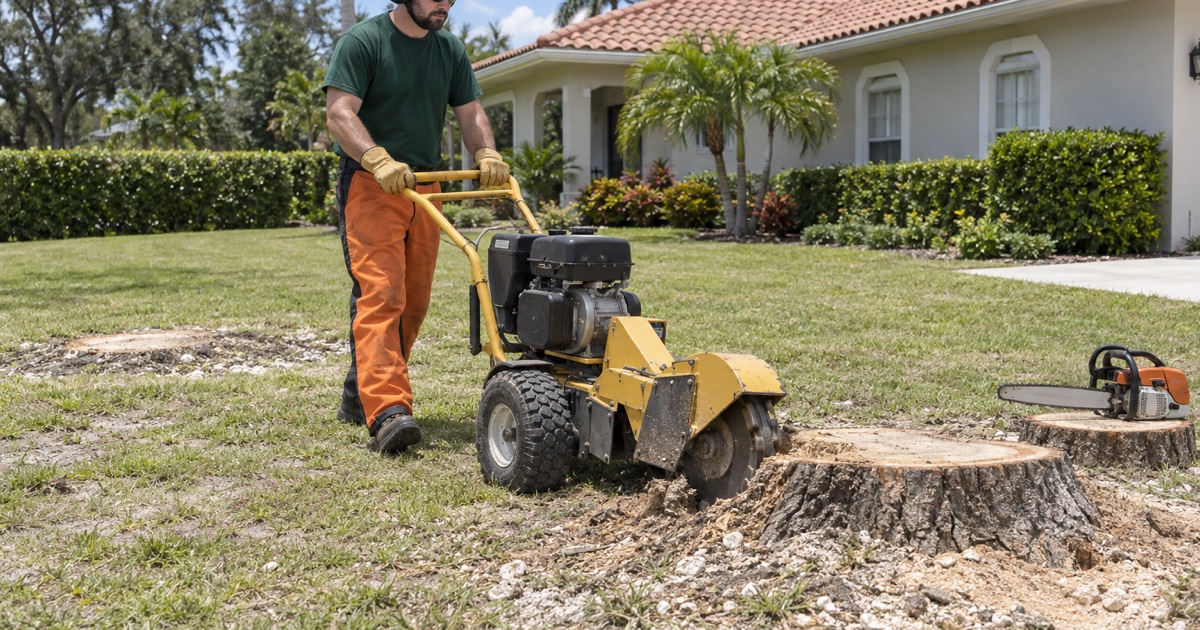
Grinding takes the stump down below grade with a rotating cutting wheel, leaving the root system in the ground to decay. Full extraction pulls the root plate out with an excavator, which is a far larger disturbance and a far larger hole, and is usually only worth it where a footing, a pool shell or a utility trench is going into the same ground. For a lawn or a bed, grinding is the right tool.
How Far Below Grade the Wheel Goes
The depth you need is set by what happens next on that spot, not by a standard number. Turf wants enough to take topsoil; a fence post, a paver base or a slab wants more, and a replanting wants the old root plate out of the new root ball’s way. We agree the target before the machine leaves the yard and we say plainly if the machine cannot reach it.
The Grindings, the Crater and the Backfill
A ground stump produces two or three times its own volume in chips and wood fiber, and removing that material exposes the hole it was filling. Those are three choices, not one: leave the mound to settle, rake it back and accept that it keeps sinking as it rots, or haul it out and bring clean fill in. Only the third gives you a level, plantable spot the same week.
What Actually Stops a Grinder Here
The Seasonal High Water Table, Not Hardpan
The limit in this market is saturation. Flatwoods soils across this service area carry a water table within six to eighteen inches of the surface for one to four months of most years, and a cutting wheel in wet sand moves material without shearing it. That is why the honest answer to a wet-season grinding question is sometimes a date rather than a price.
Two Flatwoods Soils, Thirty-Five Inches Apart
The hard layer under these sands is a spodic horizon, and it is not at one depth. The EauGallie series puts it around twenty-two inches, squarely inside a grinder’s rated cut; the Punta series, whose type location is in Charlotte County, puts it at fifty-seven to eighty inches, far below anything a grinder will reach. Same machine, same trade, two entirely different jobs.
Fill, Shell and Limestone in the Urban Core
Much of the developed ground near the river is not an intact natural profile at all but twenty to forty-eight inches of dredge-and-fill material over marine sediment. Expect shell fragments and limestone pieces in the cutting zone there, which dulls teeth faster and slows the cut. We would rather tell you that on the estimate than bill it as a surprise.
Access Decides the Machine
Thirty-Five Inches Through a Side Gate
The controlling measurement is the narrowest pinch point between the truck and the stump, and on most residential lots here that is a side gate or the gap between a house and a screen enclosure. A compact self-propelled grinder around thirty-five inches wide clears most of them. We measure it on the estimate visit, because a machine that will not fit is a wasted morning for everyone.
Width and Cutting Depth Are Not Coupled
This catches people out, so it is worth stating flatly: a narrow machine is not a shallow machine. One manufacturer’s thirty-five inch grinder is rated to twelve inches below grade and another manufacturer’s thirty-five inch grinder is rated to twenty-five. Width predicts nothing about depth, which is why we name the machine as configured rather than quoting a class of equipment.
Locates, Irrigation and the Tolerance Zone
Florida’s one-call law treats this as excavation, the cut sits inside the tolerance zone around a marked facility, and nothing in it exempts residential work. Beyond the marked utilities, the things that actually get hit here are irrigation laterals, low-voltage lighting runs and septic components, none of which get located for you. We walk those ourselves and mark what we find.
Palm Stumps, Roots and What Grows Back
Why a Palm Stump Cuts Differently
A palm has no cambium, no growth rings and no woody taproot; it has a dense mat of fibrous adventitious roots and a trunk built of vascular bundles in a spongy matrix. It cuts wet and stringy rather than chipping, it holds water, and the root mass is wider and shallower than people expect. A palm stump is not simply a smaller version of an oak stump.
Hardwood Roots That Resprout
Grinding kills the stump, not the root system, and some species here send suckers up along a root run for a year or more afterward. Where a removal sits on a fence line or over a septic drain field, we say which species we are dealing with and whether follow-up is likely, so the quote covers the actual outcome rather than the first visit.
Disease Cases Where Grinding Is Not Optional
Some findings make the stump part of the problem. Ganoderma butt rot, identified by a shelf-shaped conk in the lower four or five feet of a palm trunk, has no treatment and mandates removal and grinding, and the spot should not be replanted with another palm. That is a case where we quote the grinding as part of the removal rather than as an option, and explain why on the report.
- 20+ Years on This Coast
- Written Condition Reports
- Four Counties Covered